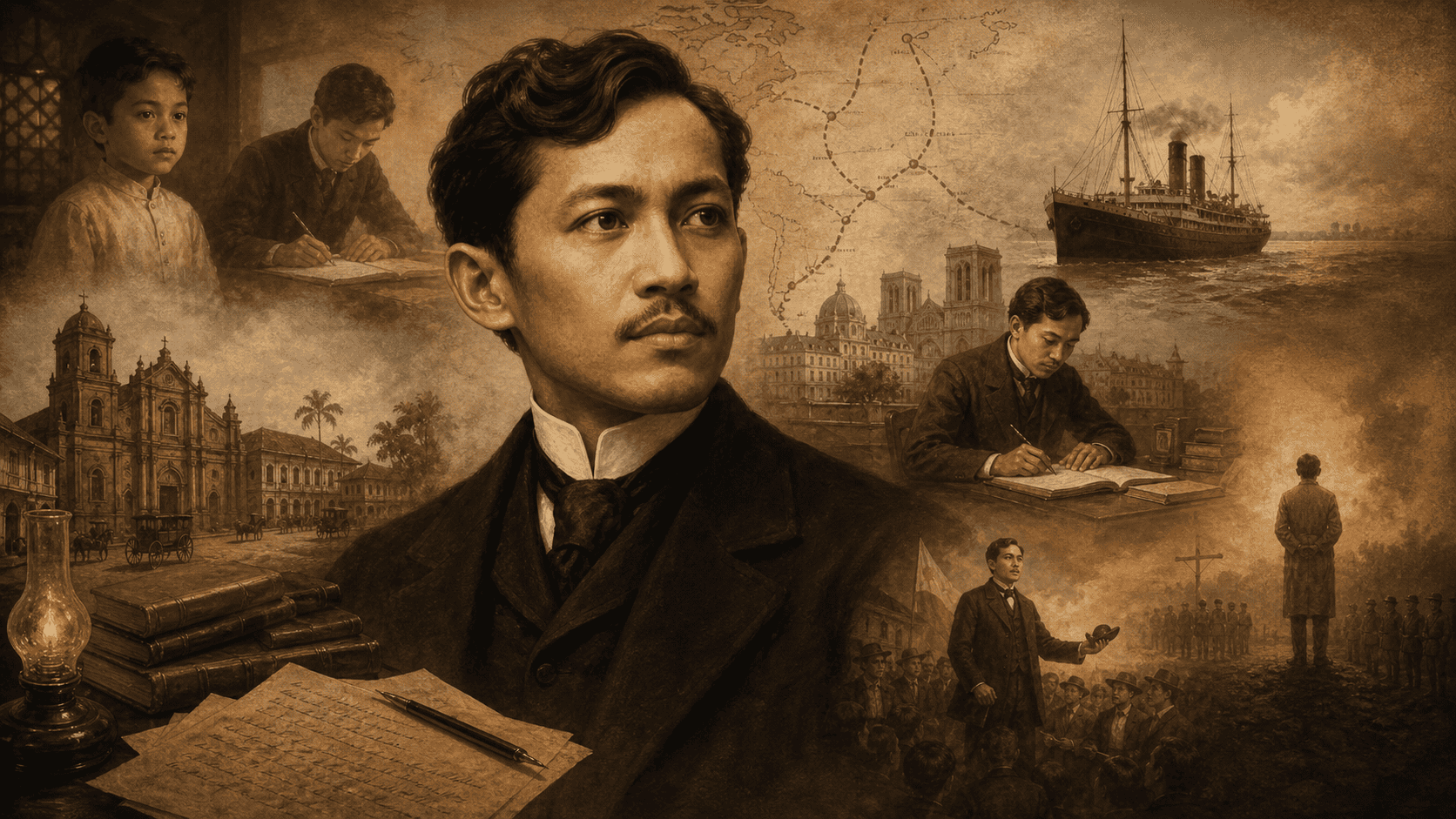
A chronological record of Rizal’s life — from his birth in Calamba in 1861 to his execution at Bagumbayan on December 30, 1896.
Early Life · 1861–1881
June 19, 1861: Born in Calamba, Laguna
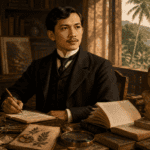
The seventh of eleven children born to Francisco Mercado and Teodora Alonso. His mother is his first teacher, beginning his education before he enters any school.
1869: Travels to Biñan for School
Accompanied by his brother Paciano, he studies under the strict Justiniano Aquino Cruz. He quickly surpasses every classmate.
February 17, 1872: Execution of Gomburza
Three Filipino priests — Gómez, Burgos, and Zamora — are garroted at Bagumbayan. Rizal is eleven years old. The injustice shapes his political consciousness permanently. He will later dedicate El Filibusterismo to their memory.
1872: His Mother Is Falsely Arrested
Teodora Alonso is imprisoned for two and a half years on fabricated charges. The experience deepens Rizal’s understanding of how colonial authority operates without evidence or fairness.
1875: Enters Ateneo Municipal de Manila
Enrolls at the Jesuit school and excels immediately. His teacher Francisco de Paula Sanchez encourages his poetry and writing.
1877: Bachelor of Arts with Highest Honors
Graduates from Ateneo at fifteen with the highest distinction. Immediately enrolls simultaneously in Philosophy and Medicine at the University of Santo Tomas.
1877–1882: University of Santo Tomas — Discrimination and Disillusionment
Rizal grows increasingly frustrated with the discriminatory treatment of Filipino students by Dominican professors. The experience is part of what drives him to seek education in Spain. Read more about Rizal’s years at UST.
1879: “A la Juventud Filipina” Wins First Prize
His poem wins a literary contest judged by Spaniards — the first time a Filipino-written Spanish poem is recognized by Spanish literary authority. He is eighteen. Read more about Rizal’s quotes on youth.
Europe and the Propaganda Movement · 1882–1891
May 1882: Secretly Leaves for Spain
Without telling his parents or colonial authorities, Rizal sails for Europe via Singapore. His brother Paciano provides 700 pesos for the journey — saved from his own modest income as a farmworker. His sister Saturnina gives him a diamond ring as an emergency reserve. The departure is kept secret partly because the family are tenants on a Dominican-owned hacienda; if the friars discovered they had sent a son abroad to be educated, the consequences could have been severe. He enrolls in medicine at the Universidad Central de Madrid. Read more about his formative years in Europe.
1884: Graduates in Medicine from Madrid
Earns his Licentiate in Medicine at 23. Also studies philosophy, letters, sculpture, and painting alongside his medical coursework. Read more about Rizal as a polymath.
June 1884: Toast at Juan Luna’s Madrid Exposition Award
Delivers a famous speech celebrating Luna and Hidalgo’s prize-winning paintings — framing Filipino artistic achievement as proof against colonial claims of Filipino inferiority. Read more about Rizal’s friends and allies.
1885–1886: Paris and Heidelberg — Ophthalmology Training
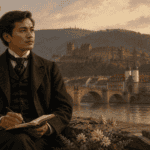
Studies under Dr. Louis de Wecker in Paris, then under Dr. Otto Becker in Heidelberg. Writes “A las Flores de Heidelberg.” Celebrates his 25th birthday in Wilhelmsfeld with Pastor Ullmer’s family.
March 1887: Noli Me Tangere Published in Berlin
His first novel — banned immediately by the colonial government — is printed at his own expense. No Spanish publisher would touch it. It circulates secretly across the Philippines, passed hand to hand. Read the Noli Me Tangere summary and literary analysis.
August 1887: Returns to the Philippines
Returns home to find Noli has caused an uproar. Colonial authorities are hostile. He practices medicine in Calamba under constant surveillance and pressure to leave.
February–April 1888: Forty-Five Days in Japan
En route back to Europe, Rizal spends forty-five days in Japan. He studies Japanese society with admiration, learns some of the language, and briefly falls in love with a woman named Seiko Usui.
April–May 1888: Visits the United States
Passes through New York, Chicago, Oakland, and Boston before sailing for England. He writes in his diary that America is undeniably a great country but has many defects.
May 1888: Arrives in London
Lodges at 37 Chalcot Crescent, Primrose Hill. Works at the British Museum daily, discovering de Morga’s Sucesos de las Islas Filipinas. A blue plaque now marks the house. Read more about Rizal in London.
1888: Active in the Propaganda Movement
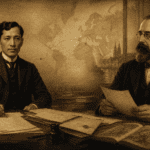
Contributes essays to La Solidaridad arguing for representation, civil liberties, and equal treatment under law. Read more about the Propaganda Movement.
February 1889: Letter to the Women of Malolos
Written in response to women who petitioned to be taught Spanish and were denied. One of his most direct political statements on freedom and cowardice. Read Rizal’s quotes on freedom.
March 1889: Leaves London
After ten months in Primrose Hill, he departs for Paris, then relocates to Brussels in 1890 specifically because it is cheaper — and it is in Brussels that he finishes writing El Filibusterismo.
1890: Annotated Edition of de Morga Published
Publishes his annotated Sucesos de las Islas Filipinas in Paris — historical evidence that Filipino civilization predated and would outlast Spanish colonialism.
September 1891: El Filibusterismo Published in Ghent
His second novel — darker, angrier — is published in Belgium. Together with Noli, it becomes the moral and intellectual foundation of the Philippine Revolution. Read the El Filibusterismo summary and literary analysis.
December 1891: Returns to Hong Kong, Operates on His Mother
Sets up an ophthalmology practice. His family joins him. He performs cataract surgery on Teodora Alonso, restoring her sight — the personal fulfilment of a decade of medical training.
La Liga Filipina and Exile in Dapitan · 1892–1896
July 3, 1892: Founds La Liga Filipina
Gathers reformists in Tondo and establishes the Philippine League — a civic, dues-funded organization for mutual aid, legal defense, and reform. Read more about La Liga Filipina.
July 6, 1892: Arrested and Exiled to Dapitan
Four days after founding La Liga Filipina, he is arrested and deported to Dapitan, Mindanao. The same week, Andres Bonifacio founds the Katipunan. Read about why Rizal was exiled to Dapitan.
1892–1895: Life in Exile — Building a Community
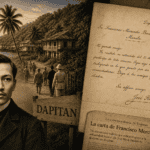
Opens a school, drains the town’s malaria-causing swamp, designs a water system, treats patients for free, and conducts scientific fieldwork. He discovers new species while under house arrest. Read more about Rizal in Dapitan.
1894: Operates on His Mother’s Second Eye
Successfully removes the cataract from Teodora Alonso’s right eye, two years after restoring the left. Read more about Rizal in Dapitan.
February 1895: Meets Josephine Bracken
Josephine Bracken arrives seeking treatment for her stepfather’s blindness. She stays. Read more about Rizal’s friends and allies.
December 1895: Petitions to Serve as Doctor in Cuba
Applies to Governor General Blanco to leave Dapitan and serve as a military doctor in Cuba. The petition is eventually approved, and it is this approval that puts him at sea when the revolution breaks out in August 1896. Read more about Rizal in Dapitan.
Revolution, Trial, and Execution · 1896
July 1, 1896: Katipunan Emissary Visits Dapitan
Pio Valenzuela arrives to inform Rizal of the planned uprising. Rizal advises against it. His position on premature revolution is unchanged.
July 31, 1896: Leaves Dapitan for Cuba
Permitted to leave exile after four years. Boards a ship for Spain, intending to travel on to Cuba as a military doctor. He is at sea when everything changes.
August 23, 1896: Philippine Revolution Breaks Out
The Katipunan is discovered and the revolution begins — while Rizal is at sea. He is arrested in Barcelona and returned to Manila. Read more about Rizal and the Revolution.
October 6, 1896: Arrested at Montjuic Castle, Barcelona
En route to Cuba, Rizal is arrested and imprisoned at Montjuic Castle in Barcelona after news of the revolution reaches Spain. He is held there for weeks before being shipped back to Manila under guard. Read more about Rizal’s Trial and Execution.
November 3, 1896: Imprisoned at Fort Santiago
Returned to Manila and imprisoned in Fort Santiago. From his cell, he writes a public manifesto explicitly opposing the revolution being waged in his name. It is ignored.
December 26, 1896: Military Trial, Sentenced to Death
Tried before a military tribunal and convicted of rebellion, sedition, and conspiracy. Sentenced to death for inspiring a revolution he had publicly opposed. Read about Rizal’s Trial and Execution.
December 29, 1896: Writes Mi Último Adiós
The night before his execution, he writes his final poem in his cell and hides it in an alcohol stove given to his sister Trinidad. Fourteen stanzas. Completely calm. Read Mi Último Adiós.
December 30, 1896: Marries Josephine Bracken
In the hours before his execution, Rizal marries Josephine Bracken in a civil ceremony at Fort Santiago. It is his last act before the march to Bagumbayan.
December 30, 1896, 7:03 AM: Executed at Bagumbayan, Manila
Shot by firing squad at the field that will become Rizal Park. He falls facing the sky. He is 35 years old. Read about the death of José Rizal and Rizal Park.
After His Death · 1896–1913
December 30, 1896: Buried Secretly at Paco Cemetery
His body is buried without a coffin in an unmarked grave at Paco Cemetery in Manila. His sister Narcisa discovers the burial site by bribing a caretaker and marks it with his initials in reverse “RPJ” so she can find it again.
1896–1898: The Revolution He Opposed Succeeds
The Philippine Revolution intensifies after his execution. Spain, weakened by the war, signs the Treaty of Paris in December 1898, ceding the Philippines to the United States. The colonial rule Rizal spent his life critiquing ends — though not in the way he had hoped.
December 30, 1898: First Rizal Day
General Emilio Aguinaldo declares December 30 a national day of mourning in Rizal’s memory, the first official commemoration of his death, two years after his execution.
1901: Rizal Monument Committee Established
The American colonial administration, under Governor General William Howard Taft, establishes a committee to build a monument at the site of his execution. An international design competition is held. Read more about why Rizal became the national hero.
1912: Remains Transferred from Paco Cemetery
Rizal’s remains are exhumed from Paco Cemetery and transferred to the base of the Rizal Monument at Luneta, where they rest today.
December 30, 1913: Rizal Monument Unveiled
The monument designed by Swiss sculptor Richard Kissling is formally unveiled at Luneta on the seventeenth anniversary of his execution — the same field where he was shot. Read more about Rizal Park.