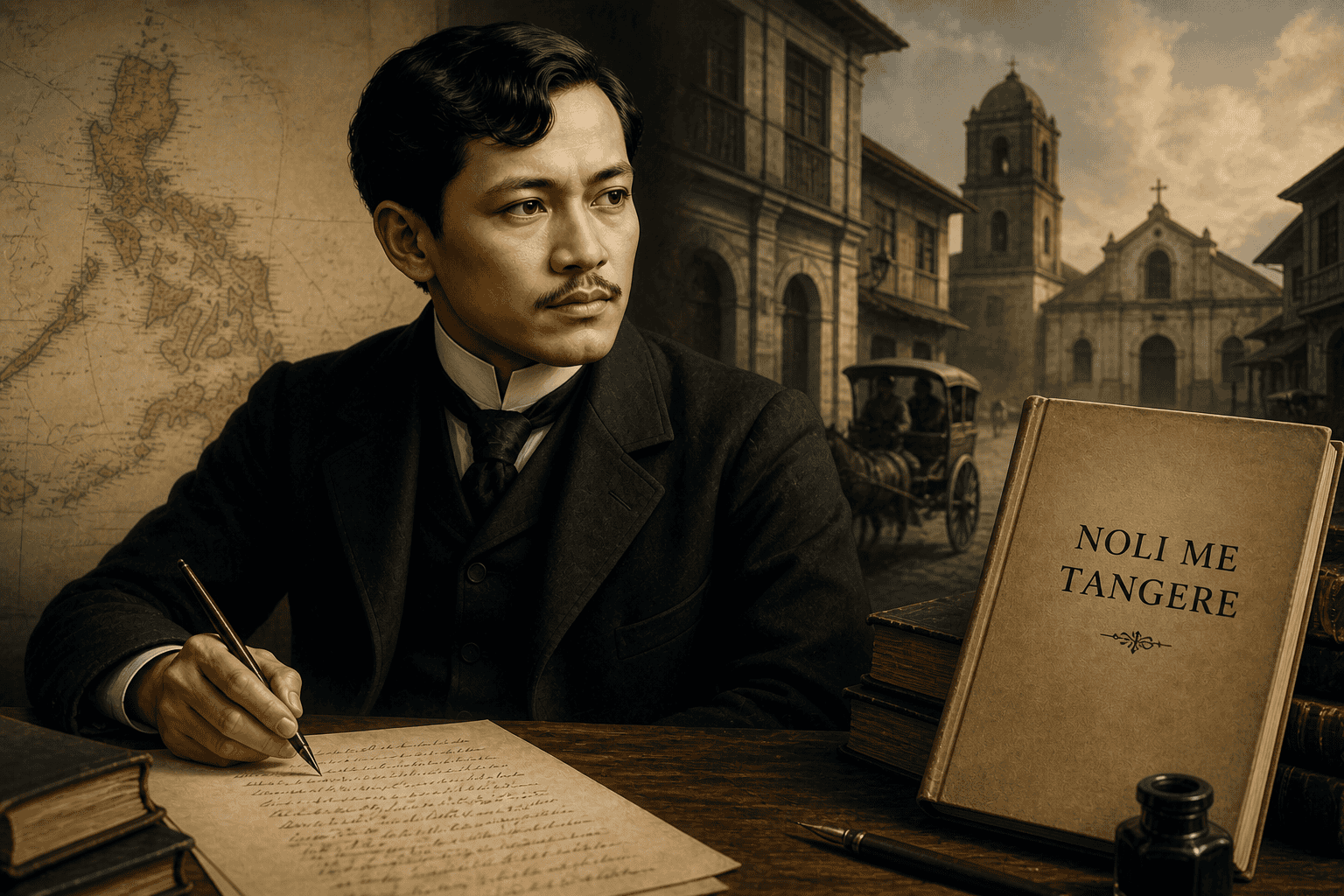
In 1887, a twenty-five-year-old Filipino doctor living in Berlin finished a novel he had been writing in fragments across Europe — in Madrid, in Paris, in rented rooms in cities far from the country he was writing about. He could not find a printer in Spain willing to touch it. He paid for the Berlin printing himself, going into debt to do so. He dedicated it to the three Filipino priests executed by the colonial government fifteen years earlier, whose deaths had shaped his own political consciousness since childhood.
The novel was Noli Me Tangere — “Touch Me Not,” a phrase from the Gospel of John, spoken by the risen Christ to Mary Magdalene. Rizal borrowed it not for its theological meaning but for its diagnostic one. He was naming a social cancer so deeply embedded in Philippine colonial life that the people living inside it had learned not to acknowledge it — because to touch it, to name it, to make it visible, was to invite punishment.
The novel named it anyway. And nothing in the Philippines was quite the same afterward.
What Kind of Novel It Is
Noli Me Tangere is sometimes described as a political novel, sometimes as a social novel, sometimes as a love story. It is all of these, and the combination is deliberate. Rizal understood that political arguments reach the people who are already paying attention. Stories reach everyone else.
He did not write a treatise on colonial abuse. He wrote about a young man who comes home, falls in love, tries to build a school, and is destroyed — not by a single villain but by a system, slowly, through the accumulated weight of small cruelties and large indifferences. The political argument is embedded in the emotional experience of following characters the reader comes to care about. By the time the machinery of colonial oppression has finished with Ibarra and María Clara and Sisa and her sons, the reader does not need to be told that something is wrong. They have felt it.
This was the novel’s strategy, and it worked. Copies were banned, burned where they were found, and passed hand to hand in secret across the archipelago. People copied them by hand when printed copies ran out. You do not smuggle a treatise. You smuggle a story.
Ibarra and the Fate of Good Intentions
Crisóstomo Ibarra returns from seven years in Europe full of the kind of hope that reads, in retrospect, as heartbreaking. He wants to build a school. He wants to apply what he has learned abroad to the community he loves. He believes, genuinely and without irony, that the colonial system contains enough space for reform if approached correctly — with patience, with respect for the existing order, with the right arguments made to the right people.
The novel is the systematic dismantling of this belief.
Every effort Ibarra makes is undermined — not always through outright opposition but through the more insidious mechanisms of bureaucratic obstruction, social suspicion, and the manipulation of people who have reasons of their own to see him fail. Padre Dámaso, the friar who holds unofficial power over the town, has a personal stake in Ibarra’s destruction that the novel eventually reveals. The colonial administrators who might theoretically support Ibarra’s school have no incentive to do so. The community members who admire Ibarra are afraid to say so publicly.
What Rizal understood — and what gives Ibarra’s story its particular weight — is that systems of oppression rarely require a single powerful antagonist. They sustain themselves through the accumulated choices of many people making individually rational decisions within a structure that rewards complicity and punishes integrity. Nobody needs to be a monster. The system works without monsters.
Ibarra is not destroyed because he is naive. He is destroyed because he is right, and the system cannot accommodate people who are right.
The Friars and the Problem of Unaccountable Power
Padre Dámaso and Padre Salví are among the most recognizable figures in Philippine literature, which is remarkable given that they are not interesting people. They are interesting positions — embodiments of what happens when religious authority operates without accountability, when the institution that is supposed to serve a community instead extracts from it.
Padre Dámaso is the cruder version: loud, racist, physically imposing, contemptuous of the Filipinos he governs. His prejudice is open, his behavior is flagrant, and the colonial system protects him anyway because the alternative — holding him accountable — would require acknowledging that the system that produced him is corrupt.
Padre Salví is the more frightening version precisely because he is quieter. His obsession with María Clara is wrapped in the language of piety. His manipulation of events is patient and indirect. He represents the particular danger of religious power that has learned to conceal itself — the cruelty that wears the face of virtue.
Rizal is careful throughout the novel not to attack Catholicism itself. He draws a consistent distinction between the faith and the institutions that have distorted it. Some of the novel’s most sympathetic characters are devout. The target is not belief but the structure of unaccountable institutional power — the fact that a man like Padre Dámaso or Padre Salví can do what they do because nothing in the colonial system requires them to stop.
María Clara and What the Novel Does With Gentleness
María Clara is the character who has been most misread across the novel’s long afterlife. She became, in the colonial and post-colonial imagination, the template for the ideal Filipina — gentle, pious, self-sacrificing, beautiful. Schools were named after her. Her image became a cultural ideal that outlasted the novel by generations.
This reading requires ignoring almost everything Rizal actually does with her.
María Clara is not presented as an ideal. She is presented as a tragedy. Her gentleness is real, but it is also a form of powerlessness — she has been raised in a world that offers women no other options. Her piety is genuine, but it is also the only avenue available to her when her world collapses. Her self-sacrifice is not nobility; it is the absence of alternatives.
The revelation that Padre Dámaso is her biological father — that the man who has controlled her life is also the man who violated her mother — is the novel’s most devastating disclosure. It means that the colonial system’s reach extends not just into public life but into the most intimate spaces of Filipino families. The friar’s power over María Clara is not incidental to her tragedy. It is its origin.
To read María Clara as an ideal is to perform exactly the kind of not-seeing that the novel’s title is about. The disease is there. The novel is asking you to look at it.
Sisa and the Weight of the Novel
If Ibarra is the novel’s argument and María Clara is its tragedy, Sisa is its heart — and the place where Noli Me Tangere most clearly refuses to be only a political novel.
Sisa is a poor woman whose sons, Basilio and Crispín, serve as sacristans at the local church. When money goes missing from the church collection, the boys are accused. Crispín disappears — the novel strongly implies he is killed by the sacristan mayor. Basilio escapes. Sisa, unable to find her sons and confronted by a system that has no interest in helping her, descends into madness.
Her madness is one of Philippine literature’s most enduring images, and its power comes from Rizal’s refusal to make it symbolic or redemptive. Sisa does not go mad because she is weak. She goes mad because she has been broken by forces she cannot oppose, looking for children she cannot find, in a system that has no mechanism for acknowledging her loss. Her suffering is not meaningful within the world of the novel. It is simply suffering — the kind that the colonial system produces constantly and ignores completely.
This is what elevates Noli Me Tangere above the level of political argument. It is not content to show you the system. It makes you feel what the system costs.
Satire as the Other Register
Alongside the tragedy, Rizal runs a sustained satirical thread that is sometimes overlooked in serious analysis but is essential to the novel’s texture.
Doña Victorina — obsessed with passing as Spanish, married to a Spanish husband she browbeats and belittles, contemptuous of everything Filipino including herself — is a figure of genuine comedy. So is the pompous town council, which mismanages everything it touches with the particular incompetence of people who have been given authority they did not earn. So are the social-climbing matrons who jockey for position at the same gatherings where, elsewhere in the novel, people are being destroyed.
Rizal uses these figures not as relief from the tragedy but as a parallel register of critique. The comedy and the tragedy are both saying the same thing: colonial power does not only produce suffering. It produces absurdity — a society organized around the performance of values it does not hold, by people who have learned to mistake status for virtue.
The satire is also, notably, aimed inward. Rizal was Filipino. Doña Victorina’s self-hatred is Filipino self-hatred. The town council’s dysfunction is Filipino dysfunction, produced by colonial conditions but not therefore excused. The novel does not let its Filipino characters be simply victims. It asks them — asks the Filipino reader — to see themselves clearly as well.
The Ending and What It Leaves Unresolved
The novel closes without resolution, which is exactly right. Ibarra is destroyed. María Clara retreats to the convent. Sisa dies without finding her sons. Basilio survives but as a damaged, orphaned child. The colonial system continues.
This refusal to resolve was deliberate. Rizal was not writing a story with a satisfying ending because he was not living in a situation with a satisfying ending. The injustice is still there. The novel’s final act is not catharsis but provocation — the reader is left with the discomfort of an injustice that has not been answered, because Rizal’s argument is that the reader is the one who must answer it.
Ibarra’s story continues in El Filibusterismo, where he returns as Simoun, transformed by what the system did to him. But Noli Me Tangere does not require the sequel to make its point. The point is made in the ending it refuses to give you.
Why It Reaches Beyond the Philippines
The novel was written about a specific country in a specific period under a specific colonial power — and it has been translated into dozens of languages and read on every inhabited continent. The reason is not that colonial Philippines is universally familiar. It is that the mechanisms Rizal describes are.
The way Padre Dámaso is protected despite his behavior — by a system that cannot afford to acknowledge what he represents — is recognizable. The way Ibarra’s good intentions are systematically undermined without anyone needing to be overtly malicious is recognizable. The way María Clara’s choices are constrained by a world that calls its constraints tradition is recognizable. The way Sisa’s suffering is invisible to the institutions that caused it is recognizable.
Noli Me Tangere endures because Rizal was describing something local with such precision that it became universal. That is what the best political fiction does — it goes so deeply into the specific that it comes out the other side into something everyone can see.
It named the disease. More than a century later, the name still fits.