The Last Night
Rizal had been in Fort Santiago since his arrival in Manila on November 3 — held in the colonial military prison at the mouth of the Pasig River while the authorities prepared their case against him. His trial concluded on December 28. The verdict was guilty. Governor-General Polavieja signed the death warrant the same day. Execution was set for dawn on December 30.
On the evening of December 29, his family was permitted a final visit. His mother Teodora came, and his sisters. Josephine Bracken — the Irish-born woman he had met in Dapitan and loved through the last four years of his life — was there too, and was married to him that evening in a ceremony performed by a priest in the cell itself. He wrote farewell letters: to his brother Paciano, to his close friend Ferdinand Blumentritt in Austria, to others he would not see again.
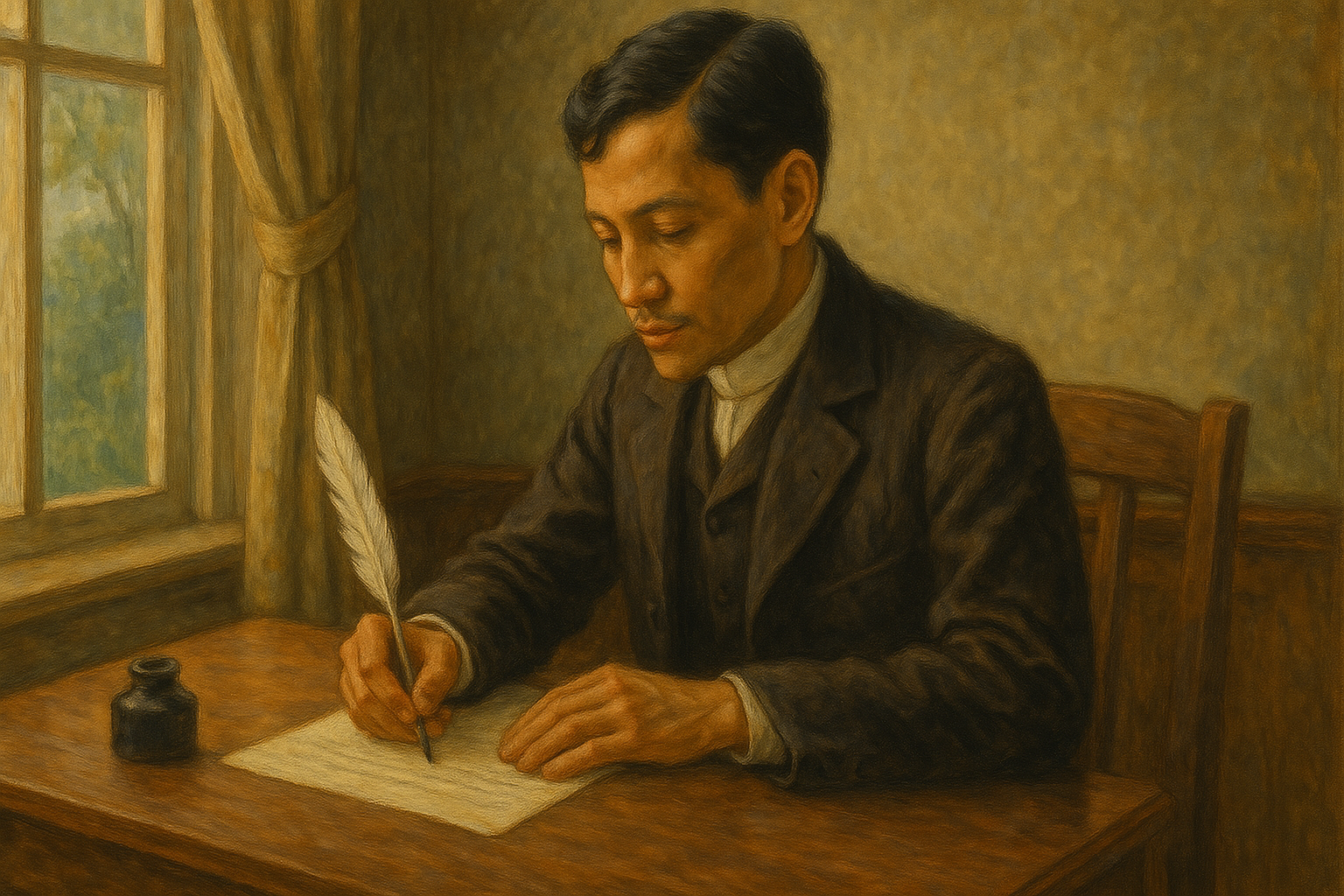
And then he wrote the poem.
He wrote it in Spanish, in fourteen stanzas of carefully metered verse, with the same technical discipline he had brought to everything he had ever written. He did not write in anger or bitterness. The register is one of a man who has made his peace with what is coming and wants to leave something behind that is worth finding — not a manifesto, not a political statement, but a poem: shaped, considered, and addressed not to his executioners but to the country itself, and to the generations that would come after it.
He gave it no title. The title it now carries — Mi Último Adiós, My Last Farewell — was added by the people who first circulated it in the days and weeks following his death.
Full Poem: Mi Último Adiós (Original Spanish Text)
Adiós, Patria adorada, región del sol querida,
Perla del mar de oriente, nuestro perdido Edén!
A darte voy alegre la triste mustia vida,
Y fuera más brillante, más fresca, más florida,
También por ti la diera, la diera por tu bien.
En campos de batalla, luchando con delirio,
Otros te dan sus vidas sin dudas, sin pesar;
El sitio nada importa, ciprés, laurel o lirio,
Cadalso o campo abierto, combate o cruel martirio,
¡Lo mismo es si lo piden la patria y el hogar!
Yo muero cuando veo que el cielo se colora
Y al fin anuncia el día tras lóbrego capuz;
Si grana necesitas para teñir tu aurora,
Vierte la sangre mía, derrámala en buen hora
Y dórela un reflejo de su naciente luz.
Mis sueños cuando apenas muchacho adolescente,
Mis sueños cuando joven ya lleno de vigor,
Fueron el verte un día, joya del mar de oriente,
Secos los negros ojos, alta la tersa frente,
Sin ceño, sin arrugas, sin manchas de rubor.
Ensueño de mi vida, mi ardiente vivo anhelo,
¡Salud te grita el alma que pronto va a partir!
¡Salud! ¡Ah, que es hermoso caer por darte vuelo,
Morir por darte vida, morir bajo tu cielo,
Y en tu encantada tierra la eternidad dormir!
Si sobre mi sepulcro vieres brotar un día
Entre la espesa yerba sencilla, humilde flor,
Acércala a tus labios y besa al alma mía,
Y sienta yo en mi frente bajo la tumba fría,
De tu ternura el soplo, de tu hálito el calor.
Deja a la luna verme con luz tranquila y suave,
Deja que el alba envíe su resplandor fugaz,
Deja gemir al viento con su murmullo grave,
Y si desciende y posa sobre mi cruz un ave,
Deja que el ave entone su cántico de paz.
Deja que el sol, ardiendo, las lluvias evapore
Y al cielo tornen puras, con mi clamor en pos;
Deja que un ser amigo mi fin temprano llore
Y en las serenas tardes cuando por mí alguien ore,
¡Ora también, oh Patria, por mi descanso a Dios!
Ora por todos cuantos murieron sin ventura,
Por cuantos padecieron tormentos sin igual,
Por nuestras pobres madres que gimen su amargura;
Por huérfanos y viudas, por presos en tortura
¡Y ora por ti que veas tu redención final!
Y cuando en noche oscura se envuelva el cementerio
Y solos sólo muertos queden velando allí,
No turbes su reposo, no turbes el misterio,
Tal vez acordes oigas de cítara o salterio,
¡Soy yo, querida Patria, yo que te canto a ti!
Y cuando ya mi tumba de todos olvidada
No tenga cruz ni piedra que marquen su lugar,
Deja que la are el hombre, la esparza con la azada,
Y mis cenizas, antes que vuelvan a la nada,
El polvo de tu alfombra que vayan a formar.
Entonces nada importa me pongas en olvido.
Tu atmósfera, tu espacio, tus valles cruzaré.
Vibrante y limpia nota seré para tu oído,
Aroma, luz, colores, rumor, canto, gemido,
¡Constante repitiendo la esencia de mi fe!
Mi patria idolatrada, dolor de mis dolores,
Querida Filipinas, oye el postrer adiós.
Ahí te dejo todo, mis padres, mis amores.
Voy donde no hay esclavos, verdugos ni opresores,
Donde la fe no mata, donde el que reina es Dios.
¡Adiós, padres y hermanos, trozos del alma mía,
Amigos de la infancia en el perdido hogar!
¡Dad gracias que descanso del fatigoso día;
Adiós, dulce extranjera, mi amiga, mi alegría!
¡Adiós, queridos seres, morir es descansar!
What the Poem Actually Says
The poem is not what people who have not read it might expect. It is not a cry of rage. It is not a call to arms. It is a farewell — tender, precise, and suffused with a kind of grief that never tips into self-pity.
The opening stanzas address the Philippines directly, as a person addresses someone they love and are about to leave. Rizal offers his life without resentment, framing his death as one instance of a sacrifice that many have made and many more will make. The soldiers who die on battlefields, he writes, and the man who dies on the scaffold — the location differs, the meaning does not, if what is being served is the homeland.
The middle stanzas move through the natural world — moonlight, wind, birdsong, the turning of seasons — and imagine his presence persisting within it after death. He will be the rustle in the grass over his unmarked grave, the note in the air, the fragrance carried on the morning. These are not the images of a man in despair. They are the images of a man who has thought carefully about what it means to continue mattering after you are gone, and has concluded that it is possible.
The fourth stanza reaches back to his boyhood — to the dreams he carried as an adolescent, the vision of a Philippines that stood with dignity and without shame. He had spent his adult life working toward that vision. He is dying before it has been realized. The poem does not flinch from this fact. It holds it, steadily, and refuses to be destroyed by it.
The penultimate stanzas widen outward from his own death to encompass all the suffering of the colonial era — the mothers who grieve, the orphans, the prisoners, the men who died without anyone recording their names. He asks the Philippines to pray for them all. The poem’s moral scope, in these stanzas, is larger than one man’s farewell. It is an act of witness.
The final stanza — Adiós, padres y hermanos — returns to the intimate: parents, siblings, childhood friends, and in the last lines, an unnamed woman addressed as dulce extranjera, sweet foreigner, whom scholars have long understood as Josephine Bracken. The poem ends not with a declaration but with a quiet observation: morir es descansar — to die is to rest.
He wrote this in a prison cell, on the night before his execution, at 35 years old. The restraint of it is staggering.
The Alcohol Stove
The physical object through which the poem survived deserves its own attention. Rizal folded the manuscript carefully and concealed it inside a small alcohol burner — the kind used for heating in a cell without other light sources. He handed it to Trinidad, one of his sisters, as the family was leaving after the final visit. His instruction was quiet and unremarkable: there is something inside.
Trinidad understood. She left the prison with the stove. The following morning, after the execution at Bagumbayan, she opened it and found the folded manuscript. She showed it to the family. Copies were made. Within days the poem was circulating through the networks that had carried Rizal’s novels before it — passed from hand to hand, read aloud, memorized, wept over.
The original manuscript is held today at the National Library of the Philippines. The alcohol stove — or an object identified as such — is among the artifacts preserved at Fort Santiago. Both are worth seeing, if only to make real the physical specificity of what happened: a man, a cell, a stove, a folded piece of paper, and a sister who understood what her brother was telling her without him having to say it plainly.
The Title It Was Never Given
One of the most frequently overlooked facts about Mi Último Adiós is that Rizal did not name it. He wrote the poem, hid it, and died without attaching a title to what he had made.
The title was assigned posthumously by the people who first circulated the poem — most likely Mariano Ponce, one of the central figures of the Propaganda Movement, who worked from a copy that had reached him in Hong Kong. Mi Último Adiós — My Last Farewell — was the obvious choice, and it has held ever since. But it is worth knowing that what feels like a definitive, authored title is in fact an editorial addition, supplied by others after the fact. The poem itself, as Rizal left it, was untitled. It was simply the last thing he wrote.
Translations
The poem has been translated into dozens of languages, including Tagalog, English, German, French, Japanese, and Arabic. The English and Tagalog versions most widely encountered in the Philippines today are themselves contested ground — different translators have made different choices about how to render the poem’s metrical structure, its register, and its key images, and those choices carry real consequences for how the poem is understood.
The English translation most frequently anthologized outside the Philippines is that of Charles Derbyshire, published in 1912. The Tagalog version known as Huling Paalam has been rendered by multiple translators across different generations. None of them fully captures what the Spanish does, which is one of the enduring arguments for reading the poem in the language Rizal actually used — a language he chose with full awareness that it was the colonizer’s tongue, and that writing in it meant writing for the enemy as much as for the friend.
Why It Endures
Mi Último Adiós has been recited at funerals, read in classrooms, set to music, quoted in political speeches, and whispered in private by people in moments of grief for more than a century. Its endurance is not simply a product of its historical circumstances, though those circumstances are extraordinary. It endures because it is a genuinely good poem — because the emotion in it is earned rather than performed, because its images are precise rather than vague, and because it speaks to something that does not belong exclusively to the Philippines or to 1896.
What it speaks to is the experience of loving something — a place, a people, an idea — deeply enough to give your life for it, and facing that gift clearly, without illusion, without the comfort of certainty about what comes after. Rizal did not know whether the Philippines would eventually be free. He did not know whether his death would matter. He wrote the poem anyway, with everything he had, in the hours he had left.
That is what the poem is about. That is why it is still being read, even today.
Read next: My Last Farewell — the English translation of Mi Último Adiós.