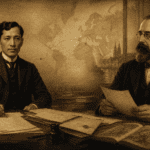

José Rizal died at thirty-five. In that time, he wrote two novels that brought down a colonial empire, contributed dozens of essays and poems to the reform press, translated Schiller and Andersen into Tagalog, compiled Philippine folklore for European journals, sculpted in terracotta and wood, painted in oil and watercolor, and built a relief map of Mindanao by hand in exile.
What follows is a guide to the full range of his output — organized by form, with notes on context, dating, and where to read or see the work today.
The Novels
The novels are where Rizal did his most consequential work — not because the essays and poems were less carefully made, but because fiction reaches people that argument cannot. By the time a reader has followed Ibarra through Noli Me Tangere and watched what the colonial system does to him, no political treatise is needed. The case has already been made, and felt.
Noli Me Tangere · Berlin, 1887
His first novel and the one that made him permanently dangerous to the colonial government. Rizal wrote it across several European cities — beginning in Madrid, continuing in Paris, finishing it in Berlin — and paid for the printing himself after no Spanish publisher would touch it.
The title is Latin for “Touch Me Not,” borrowed from the Gospel of John: Rizal used it to name a social cancer so embedded in Philippine colonial life that the people living inside it had learned not to acknowledge it.
The novel follows Crisóstomo Ibarra, a young Filipino who returns from Europe full of reformist hope and is systematically destroyed by the colonial machine — the corrupt friar orders, the indifferent bureaucracy, the legal system that protects the powerful and ignores everyone else. It was banned immediately. Copies were passed hand to hand across the archipelago, read aloud in secret, and copied by hand when printed editions ran out. Read the full summary and literary analysis.
El Filibusterismo · Ghent, 1891
The darker sequel, published four years later when Rizal had largely stopped believing that the system could be reformed. Ibarra returns as Simoun — a wealthy jeweler who has spent the intervening years accumulating the resources for violent revolution. The revolution fails.
The novel’s argument, delivered in its final pages by the elderly Padre Florentino, is that liberation built on hatred cannot produce freedom — that the preparation for genuine independence must be moral as much as political.
Rizal dedicated it to the three Filipino priests — Gómez, Burgos, and Zamora — executed in 1872, whose deaths had shaped his political consciousness since childhood. Read the full summary, literary analysis, and character guide. See also the comparison of the two novels.
Makamisa · Unfinished, begun 1892
In Dapitan, Rizal began a third novel — first in Tagalog, then restarted in Spanish — making it potentially the first Filipino novel written in the national language. He left it incomplete. Historian Ambeth Ocampo discovered the manuscript in 1987. It survives as a fragment and a signal of what he might have written had he lived longer.
The Essays
Rizal was, at his core, an arguer. The novels worked by showing; the essays worked by proving. Across his European years he produced a sustained body of political, historical, and cultural writing — much of it published in La Solidaridad, the reform newspaper that circulated among Filipino expatriates and sympathetic Spanish liberals — that named the colonial system’s failures with the precision of someone who had studied law, medicine, and history and understood exactly how an argument is constructed. The best of these essays have not dated.
The Indolence of the Filipino · La Solidaridad, 1890
One of the most precisely argued pieces he ever wrote. The Spanish colonial narrative held that Filipino poverty and underdevelopment were the result of Filipino laziness — a claim that conveniently absolved the colonial system of responsibility for the conditions it had created.
Rizal dismantles this argument systematically, documenting pre-colonial trade, industry, and social organization as evidence that the supposed indolence came after the colonizers, not before. The miseries of a people without freedom, he argued, should not be imputed to the people but to their rulers.
The Philippines a Century Hence · La Solidaridad, 1889–1890
A four-part essay serialized in the reform newspaper, projecting possible futures for the Philippines based on structural trends — education levels, migration patterns, economic conditions, the colonial government’s willingness or unwillingness to reform. Remarkably prescient in several of its forecasts. Required reading for understanding how Rizal thought about the long arc of colonial history.
Annotations to de Morga’s Sucesos de las Islas Filipinas · Paris, 1890
Antonio de Morga was a Spanish colonial official who published a firsthand account of Philippine life in 1609. Rizal tracked down a copy at the British Museum during his year in London, copied it by hand, and spent the following years annotating it — inserting corrections, counter-evidence, and arguments on nearly every page.
The result was published in Paris in 1890 as historical proof that Filipino civilization was sophisticated and self-sufficient before the Spanish arrived. It is scholarship deployed as political argument. Read more about Rizal in London.
Letter to the Young Women of Malolos · 1889
Written in response to a group of young Filipina women who had petitioned to be taught Spanish and been denied by colonial authorities.
Rizal’s letter praises their courage and turns the denial into a broader argument about freedom, education, and the particular cowardice of systems that suppress both. One of the most direct political statements he ever made. Read Rizal’s quotes on freedom.
Love of Country · Diariong Tagalog, 1882
His first published essay, written shortly after arriving in Europe and printed in a Manila newspaper under the pen name Laong Laan. It frames patriotism not as sentiment but as ethical duty — the obligation of an educated person to the community that formed them. Read more about Rizal’s pen names.
The Monkey and the Turtle · Trübner’s Oriental Record, 1889
An illustrated retelling of a Philippine folk tale for a European scholarly journal — widely cited as the formal beginning of Philippine children’s literature. Rizal also contributed proverbs, riddles, and verse to the same journal under the title Specimens of Tagal Folklore, part of his sustained effort to document Philippine culture for audiences who knew nothing of it.
The Poetry
Rizal wrote poetry throughout his life — as a schoolboy winning prizes, as a student composing occasional verse for Manila’s literary circles, as an exile in Dapitan filling notebooks, and as a condemned man writing his last lines the night before his execution. What follows are the most significant pieces.
A la Juventud Filipina · 1879
Written at eighteen and submitted to a literary contest in Manila judged by Spaniards. It won first prize — the first time a Filipino-written Spanish poem had been recognized by Spanish literary authority.
The poem calls on the Filipino youth to raise their heads, use their talents, and remember that they are the hope of their country. Read the full poem and analysis and what Rizal said about youth.
Mi Último Adiós · December 29, 1896
The poem he wrote the night before his execution — untitled, hidden inside an alcohol stove given to his sister Trinidad. Fourteen stanzas of extraordinary calm.
He says goodbye to the Philippines, its mountains and seas, the people he loves. He says he dies willingly and without anger. He asks only that his death mean something for the country he spent his life writing about. It was later titled My Last Farewell by those who found it. Read the full poem and analysis and last words.
Mi Retiro · Dapitan, October 22, 1895
A long meditation on exile — on the strange peace of Dapitan, the consolations of science and teaching, the distance from everything he had known.
One of his most personal poems and one of the least read. Read the full poem and analysis.
To the Flowers of Heidelberg · 1886
Written during his time studying ophthalmology in Heidelberg — a poem about spring flowers and longing for the Philippines, suffused with the particular homesickness of someone who left voluntarily but cannot easily return. Read the full poem and analysis.
Hymn to Talisay · Dapitan, 1895
A song written for his students at the school he built in Dapitan — celebrating discipline, swimming, science, and the particular pleasures of learning beside the sea. Read the full poem.
Other poems on the site
Song of Maria Clara · Song of the Wanderer · Memories of My Town · To Josephine · To the Philippines · Kundiman · They Ask Me for Verses · Education Gives Luster to Motherland · Goodbye to Leonor · My Retreat · My Last Thought · First Inspiration · Sa Aking Mga Kabata
Drama
Rizal’s dramatic output is the least-read corner of his work, which is partly a function of how thoroughly the novels have eclipsed everything else he wrote.
But the plays came first — both major pieces were written when he was still a teenager at the Ateneo, before the novels, before Europe, before the reform movement had a name. They show a young writer already comfortable with allegory, classical reference, and the particular challenge of making an argument through characters rather than argument.
El Consejo de los Dioses · 1880
A classical allegory written for a Cervantes centenary contest in Manila — Rizal was nineteen. It won first prize, an early sign of his range as a writer working in the European humanist tradition.
Junto al Pasig · 1880
A one-act play performed at the Ateneo, combining Marian devotion with moral conflict set on the banks of the Pasig River. One of the earliest Filipino dramatic works in the Western theatrical tradition.
Translations
Rizal translated two major European works into Tagalog — not for scholarly prestige but to make literature available to Filipino readers who had been systematically denied access to it.
Wilhelm Tell by Friedrich Schiller (1886): A play about a people resisting tyrannical rule, translated during the same period Rizal was writing Noli Me Tangere. The choice of subject was not accidental.
Five tales by Hans Christian Andersen: Translated for his nieces and nephews — The Fir Tree, Thumbelina, The Ugly Duckling, The Angel, and The Little Match Girl. Personal gifts that also served as models for what Philippine children’s literature could be. Read more about Nick Joaquin as translator of Rizal’s works.
Visual Art and Sculpture
Rizal trained seriously in the visual arts — at the Academia de Dibujo y Pintura in Manila, at the Academy of Fine Arts of San Fernando in Madrid, and informally throughout his European travels. His surviving visual work is small in number but not in significance. Read the full guide to Rizal’s paintings and colored works.
Portrait of Saturnina Rizal, oil on canvas, c. 1878: Probably his only surviving oil painting — a portrait of his eldest sister, painted at around seventeen. Currently on loan to the National Museum of Fine Arts in Manila from Saturnina’s descendants.
The Triumph of Science over Death, clay, 1890: An allegorical sculpture — a figure holding a torch above a skull — made in Brussels and gifted to Ferdinand Blumentritt.
The Mother’s Revenge, terracotta, 1894: A mother dog battling a crocodile, modeled in Dapitan to teach his students a moral lesson. Now in the National Museum’s collection.
Josephine Sleeping, clay, Dapitan: An intimate study of Josephine Bracken, made during their years together in exile. Exhibited by the National Museum for the first time in 2024.
Relief Map of Mindanao, 1892: A large outdoor relief map of the island, constructed in Dapitan with his students. Declared a National Cultural Treasure.
A Note on Attribution
The poem Sa Aking Mga Kabata — often described as written by Rizal at age eight — is now widely considered apocryphal by historians. No manuscript exists, and its vocabulary and orthography are inconsistent with what an eight-year-old in 1869 would have written.
The poem appears on this site because it is taught in Philippine schools and is part of the cultural record, but readers should know the attribution is disputed.
Where to Start
If you are new to Rizal’s work, the most direct path is through the novels — Noli Me Tangere first, then El Filibusterismo — followed by The Philippines a Century Hence and The Indolence of the Filipino for the argumentative core. Pair those with Mi Último Adiós and the complete timeline of his life for context.
For a sense of who he was beyond the writing, the polymath page and the paintings guide fill in the rest.