Why London
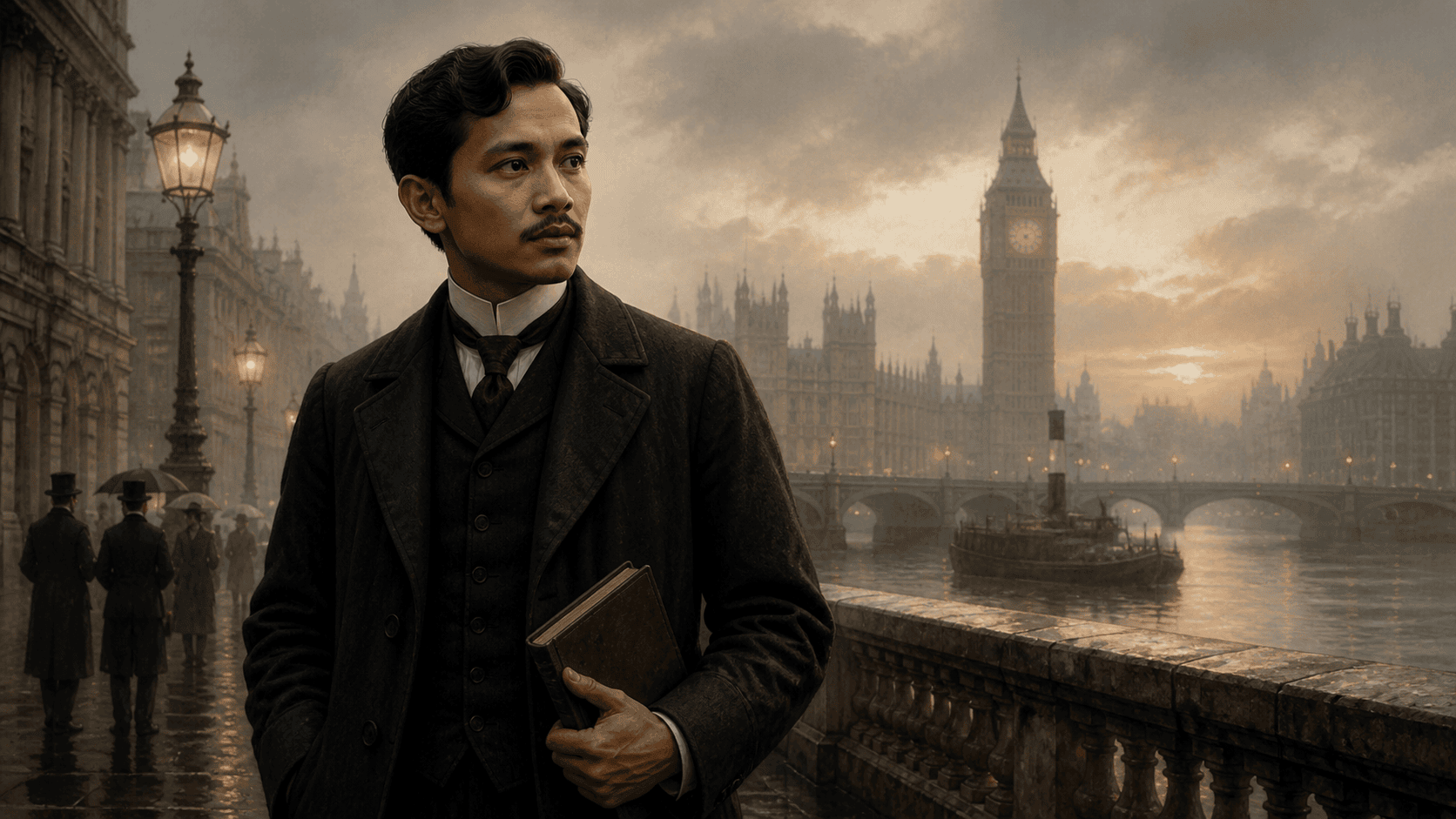
José Rizal arrived in London in late May 1888, having crossed the Atlantic from New York. He was 26 years old. Noli Me Tangere had been published the year before in Berlin, already banned in the Philippines, already causing a scandal in Madrid. The Spanish colonial authorities were watching him. He needed somewhere safe to work.
He had three reasons for choosing London specifically. He wanted to sharpen his English. He had heard that the British Museum held a rare early edition of a particular Spanish colonial text about the Philippines — a book he intended to annotate and republish. And he needed a city where the arm of the Spanish government couldn’t reach him. London gave him all three.
Primrose Hill, £2 a Week
He settled into two rooms at 37 Chalcot Crescent in Primrose Hill, lodging with the Beckett family for £2 a week. The house still stands on a quiet residential street not far from Regent’s Park. A blue plaque mounted on the facade in 1983 announces to anyone who passes: “Dr. José Rizal (1861–1896), Writer and National Hero of the Philippines, lived here.”
The Becketts were warm and cultured hosts. The father was an organist at St. Paul’s Church; the household included four daughters and two sons. Rizal grew particularly close to Gertrude, the eldest daughter, whose feelings for him eventually deepened beyond what he could honestly return — he was still in love with Leonor Rivera back home. Rather than let the situation become unfair to her, he resolved to leave. Before going, he carved portrait sculptures of each of the sisters and gave them as a farewell gift. That detail captures something essential about him: a man who could spend his mornings doing serious historical scholarship and his evenings making art for the people who had welcomed him.
The Reading Room
The real work of his London year took place four miles south of Primrose Hill, in Bloomsbury, inside the great domed Reading Room of the British Museum. It was one of the intellectual nerve centers of the Victorian world — a circular hall of iron and glass where Marx had drafted Das Kapital a generation earlier, where scholars from across the empire came to work with materials gathered from across the globe.
Rizal gained admission in mid-August 1888. The museum’s ledger recorded him as the fifteenth reader registered on that particular day, assigned an application number and an accession number for the documents he presented. In the space asking for his address, he wrote: 37 Chalcot Crescent, Primrose Hill. That entry still exists in the archive — the colonial subject signing himself into the empire’s greatest library, leaving a paper trail that has outlasted the empire itself.
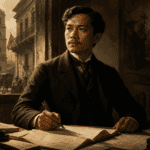
The Reading Room was free, open six days a week, and on busy days saw nearly five hundred readers at its desks. Rizal made it his office. He worked through the earliest printed materials on Philippine history he could locate, and in the latter part of 1888 found what he had come for: a first edition of Antonio de Morga’s Sucesos de las Islas Filipinas, published in Mexico in 1609. With no means of mechanical reproduction available to him, he sat down and copied the entire text by hand — and as he transcribed each page, he wrote his responses in the margins.
The Book and What It Meant
Antonio de Morga had been a Spanish colonial administrator in Manila in the late 16th century. What made his account unusual — and uniquely useful to Rizal — was that he was neither a priest nor a missionary. He was a civil official, and his record of pre-colonial Filipino life predated the most aggressive phase of Spanish cultural suppression. It was, in other words, a Spaniard’s own testimony that the Philippines had a rich and functioning civilization before Spain arrived.
Rizal grasped the strategic value immediately. If he could republish Morga’s account with his own annotations — correcting distortions, adding context, pushing back against the colonial mythology of Filipino backwardness — he could give his countrymen something the Spanish had spent three centuries trying to take from them: a documented past they could be proud of.
The annotated Sucesos was published in Paris in 1890, dedicated to the Filipino people. It stands as one of the earliest sustained works of anti-colonial historical criticism written from inside the colonized perspective — composed not in Manila, not in exile among other Filipinos, but alone at a reading room desk in Victorian London. When Morga wrote about Filipino food in terms that dripped with European disdain, Rizal answered him directly in the footnotes, pointing out that Spanish disgust at unfamiliar cuisine said considerably more about Spanish provincialism than about Filipino civilization. The annotations are combative, precise, and often quietly furious.
He was, by any honest reckoning, the first person to write the history of the Philippines as a Filipino — not as a subject, not as a curiosity, but as a person with as much claim to that history as anyone who had ever tried to take it from him.
More Than the Museum
His days at the Reading Room were the spine of the London year, but the rest of his time was equally dense. He contributed articles to La Solidaridad, the newspaper that served as the voice of the Filipino reform movement in Europe. He sculpted. He kept up an enormous correspondence — with Ferdinand Blumentritt in Austria, with his family in Calamba, with fellow reformers scattered across the continent.
He also wrote, during this period, the Letter to the Young Women of Malolos — a defense of the right of Filipino women to education, prompted by the story of a group of women in Bulacan who had organized their own school in defiance of a local Spanish priest. That Rizal was composing a feminist argument from a Primrose Hill boarding house while simultaneously reconstructing Philippine pre-colonial history at the British Museum tells you something about the pace at which he worked.
He spent Sundays with Dr. Reinhold Rost, a German-born librarian and scholar of Malayan languages who became a mentor and friend, and who described Rizal with an admiration that came through clearly even in translation. He played cricket. He boxed with the Beckett sons. From home came news that was uniformly grim — his family being driven off their land in Calamba by Dominican friars, relatives facing exile and humiliation, friends punished for the act of signing a petition. He kept working.
In December he crossed the Channel to visit Madrid and Barcelona, where he encountered Marcelo H. del Pilar and Mariano Ponce for the first time — two of the driving forces behind the Propaganda Movement. He was back at his desk in Bloomsbury in January.
The Departure
He left London on March 19, 1889, bound for Paris. The crossing felt heavy. He had made real friends, done serious work, and — in some meaningful sense — become a different thinker than the one who had arrived ten months earlier. He left a watercolor painting hanging in his study at Chalcot Crescent. He told himself he would return. He didn’t.
What he carried to Paris was the completed annotated Sucesos and the clearer conviction that the fight for the Philippines had to be fought on the terrain of history as much as politics. What he left behind was a signature in a ledger — his name, his address, the date — proof that a man from a colonized archipelago on the other side of the world had walked into the greatest library the British Empire had built and used it entirely for his own purposes.
Visiting Today
The house at 37 Chalcot Crescent is privately owned but the blue plaque is visible from the pavement. The nearest tube stop is Chalk Farm on the Northern Line. Primrose Hill Park is a few minutes’ walk and worth the climb — on a clear day the view takes in most of central London, and it isn’t difficult to picture Rizal standing there on a Sunday afternoon, looking out over the city that had given him ten months of productive exile.
The Reading Room itself no longer operates as a library. When the British Library moved to its current home at St. Pancras in 1997, the collection went with it, and the original domed hall was absorbed into the museum’s Great Court, now covered by a glass-and-steel roof designed by Norman Foster. The physical space remains. Rizal’s registration record is held at the British Library. Visitors to the museum can stand in the room where he worked, even if they don’t know it.
Read next: José Rizal: A Complete Biography — the full story of the man who came through London on his way to becoming a national hero.