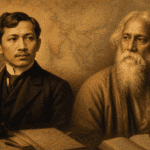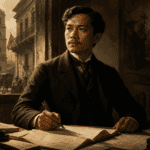
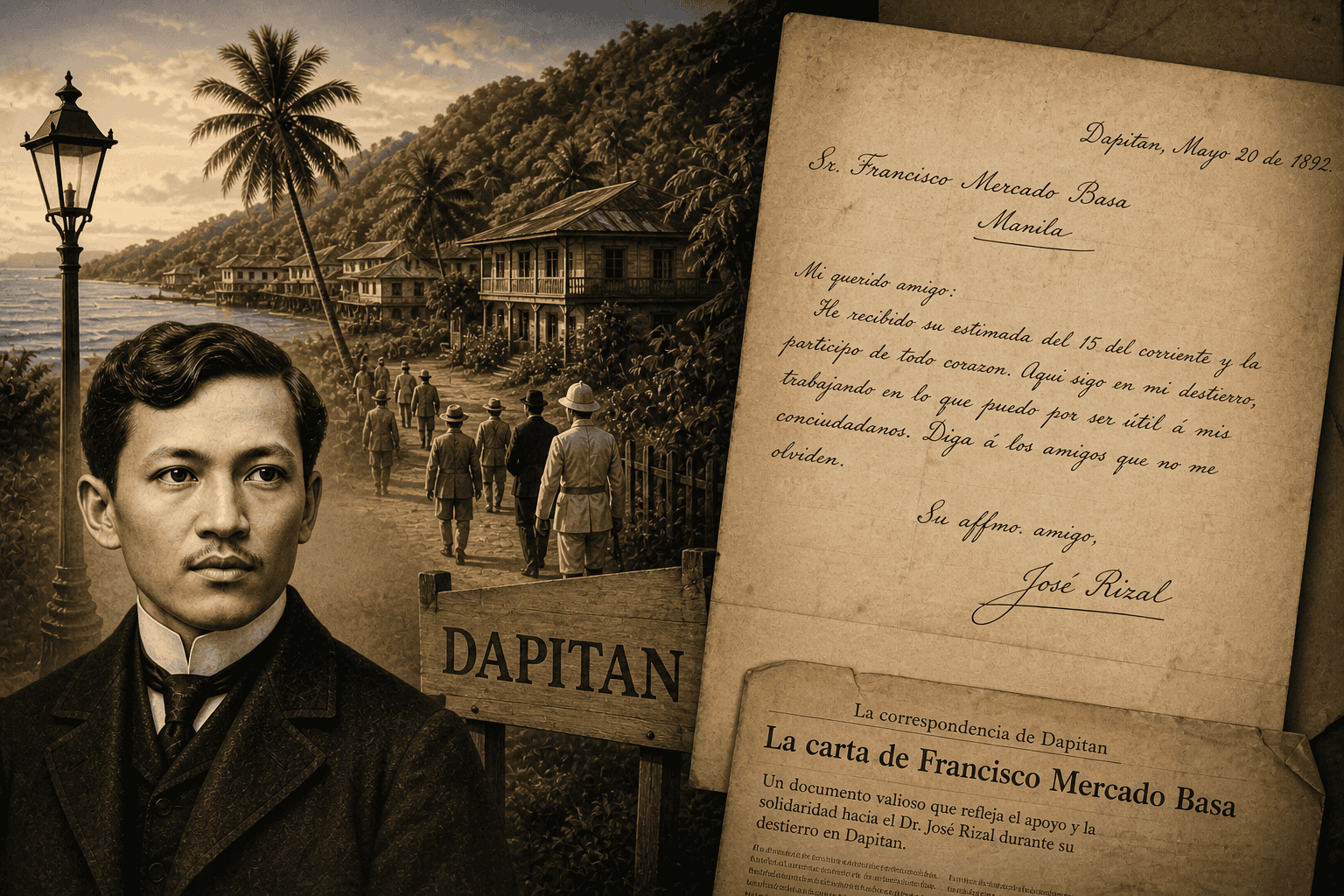
The story of Rizal’s arrest in July 1892 is often told as the story of an intercepted letter. That version is partly true and partly incomplete — and the incomplete part matters, because the actual documentary record of what the colonial government used against him is more revealing than the simplified account suggests.
There were two distinct pieces of evidence at the center of the case. The first was a package of anti-friar pamphlets found in Rizal’s luggage on arrival in Manila. The second was a letter written by his friend José Ma. Basa in Hong Kong. Neither was written as a call to armed rebellion. Both were used by Governor-General Eulogio Despujol to construct a case for deportation. Understanding what each document was, who wrote it, and what it actually said is essential to understanding why the authorities moved against Rizal when they did — and what the episode reveals about how colonial power worked.
The Primary Document: Pobres Frailes
The document that Despujol cited first in his deportation decree was not the Basa letter. It was a bundle of handbills titled Pobres Frailes — “Poor Friars” — found in one of the packages Rizal had brought to Manila on his return on June 26, 1892.
The pamphlets satirized the wealth and behavior of the Dominican religious orders, mocking the contrast between the friars’ professed poverty and their actual power over land, commerce, and local governance in the Philippines. They were in the tradition of anti-clerical Propaganda Movement writing — pointed, specific, and designed to circulate among readers who would recognize exactly who was being described.
Rizal denied that the pamphlets belonged to him or his sister Lucia, who had traveled with him. The authorities arrested him anyway. Despujol’s deportation decree, published in the Gaceta de Manila on July 7, 1892, cited the Pobres Frailes pamphlets explicitly as one of the reasons for the deportation: “a few hours after his arrival in Manila, there was found in one of the packages a bundle of handbills entitled Pobres Frailes in which the patient and humble generosity of Filipinos is satirized, and which accusation is published against the customs of the religious orders.”¹
Whether Rizal had brought the pamphlets or whether they had been planted — a possibility that several historians have considered — was never determined. The colonial government did not appear particularly interested in finding out.
The Secondary Document: The Basa Letter
José Ma. Basa was one of Rizal’s closest friends and most important collaborators. Born in Binondo, Manila, in 1839, he had been exiled to the Marianas Islands in the early 1870s for his association with Father José Burgos and the reformist committee that had advocated for changes in Spanish governance of the Philippines. After his exile, rather than returning to Manila, he settled in Hong Kong, where he rebuilt his business interests and resumed his anti-friar activities from a safer distance.
In Hong Kong, Basa became the primary conduit for Propaganda Movement materials entering the Philippines. He developed an extensive smuggling network — bribing customs officers, placing trusted Filipinos on vessels making the regular Hong Kong-Manila run, and hiding copies of La Solidaridad, Noli Me Tangere, and El Filibusterismo in cargo that colonial customs inspectors would not think to search carefully. Rizal had shipped the entire first edition of both novels to Basa in Hong Kong specifically so that Basa could get them into the Philippines. The Spanish colonial government knew who Basa was and watched his correspondence accordingly.
The letter at issue in the 1892 case was written by Basa in Hong Kong and addressed to recipients in the Philippines — the precise addressee is not definitively established in the historical record, but the letter appears to have been part of Basa’s regular correspondence with reformist contacts in Manila. Its contents were in keeping with the general tone of Propaganda Movement communication: an encouragement to political awareness, a call for civic unity, and a reference to Rizal as a figure whose ideas about education and national dignity were worth following and supporting.
The letter did not call for armed rebellion. It contained no plan for organized violence. In any context other than colonial surveillance, it would have been unremarkable correspondence between political allies. But its interception by the Spanish authorities — who were monitoring all incoming mail associated with known reformists — added Rizal’s name to a growing official file at a moment when the colonial government was already looking for grounds to act.
The Official Charges and What They Reveal
Despujol’s deportation decree listed four reasons for Rizal’s exile. They are worth examining in full because they show exactly what the colonial government considered actionable:
First, Rizal had published books and articles abroad showing disloyalty to Spain and which were “frankly anti-Catholic and imprudently anti-friar.” This was a reference to Noli Me Tangere and El Filibusterismo — novels that had been published five and three years earlier, respectively, and that the colonial government had been unable to suppress despite banning them.
Second, the Pobres Frailes pamphlets had been found in his luggage on arrival.
Third, El Filibusterismo had been dedicated to the memory of Fathers Burgos, Gómez, and Zamora — the three priests executed in the Cavite Mutiny of 1872, whom the colonial government considered traitors — and the novel’s title page contained language suggesting that the only salvation for the Philippines was separation from Spain.
Fourth, his founding of La Liga Filipina, which the authorities interpreted as the creation of a vehicle for organized political opposition. The decree did not name the Basa letter as a formal charge but rather as part of the broader context establishing Rizal’s connections to the reformist network.
None of these charges described an action that met a reasonable standard of sedition. Publishing novels, arriving with pamphlets of disputed ownership, dedicating a book to executed priests, and founding a civic organization were not crimes in any meaningful sense. But they were sufficient, in the logic of colonial administration, to justify removing from Manila a man who had become the symbolic center of a growing movement for Filipino national consciousness.
Who José Ma. Basa Was, and Why the Letter Mattered
The significance of the Basa letter lay not in its contents but in its author. Basa was not an ordinary reformist correspondent. He was a known smuggler of banned materials, an exile with a documented history of anti-friar activity, and the man most directly responsible for getting Rizal’s banned novels into the Philippines. A letter from Basa that mentioned Rizal was not read by the colonial authorities as civic correspondence. It was read as confirmation of an ongoing operational relationship between the Philippines’ most prominent reformist intellectual and the man running the underground distribution network for his most dangerous books.
That reading was not entirely wrong. Rizal and Basa were close friends with a genuine collaborative relationship. But the letter itself was not evidence of that collaboration in any meaningful evidentiary sense — it was a document that mentioned Rizal’s name in a political context, which in the colonial government’s framework was sufficient.
The authorities used the letter to connect Rizal’s return, the founding of the Liga, and the reformist network in Hong Kong into a single threatening picture. Each element on its own might have been manageable. Together, they gave Despujol a political case for action that he then implemented through administrative deportation — no trial, no formal charges, no right of defense.
The Deportation Without Trial
On July 6, 1892, three days after the founding of La Liga Filipina, Rizal was arrested at his lodgings in Manila and taken to Fort Santiago. His rooms were searched. No weapons were found. No plans for armed revolt. The investigation confirmed what was already apparent: Rizal was a writer and physician who had founded a civic organization, not a revolutionary preparing an uprising.
It did not matter. On July 14, Despujol signed the deportation order. On July 15 at 12:30 a.m., Rizal was taken under heavy guard to the steamer Cebu. On July 17, he arrived in Dapitan.
He had been given no trial, no formal charges to contest, and no opportunity to present a defense. The Pobres Frailes pamphlets that had triggered his arrest had not been proven to belong to him. The Basa letter had not been written by him. La Liga Filipina had been a legal civic organization. None of this was sufficient to prevent his deportation, because the deportation was not a legal proceeding. It was a political one — an administrative act carried out by a governor-general responding to friar pressure and his own judgment about what constituted a threat to public order.
What the Episode Reveals
The Basa letter and the Pobres Frailes pamphlets together illustrate something important about how colonial authority operated in the Philippines in 1892: the distinction between evidence and pretext had effectively collapsed. The colonial government did not need to prove that Rizal had done something specific. It needed to demonstrate, to its own satisfaction, that he represented a threat — and for that purpose, a letter from a friend in Hong Kong and a bundle of pamphlets of disputed ownership were sufficient.
A government that could exile a man on this basis was exactly the government that Noli Me Tangere had described: one that operated not through law but through power, and that had no mechanism for distinguishing between genuine threats to public order and the expression of ideas it found inconvenient.
Rizal understood this. He had written it, in fiction, five years before it happened to him.
For the full account of why Rizal returned to Manila and what he was trying to accomplish, see Why Rizal Was Exiled to Dapitan. For what happened during the four years of exile itself, see Rizal in Dapitan. For the trial that eventually followed, see Rizal’s Trial and Execution.
Sources
- Despujol’s deportation decree, published in the Gaceta de Manila, July 7, 1892. Cited in: Guerrero, Leon Ma. The First Filipino. Manila: National Historical Institute, 1963; and Zaide, Gregorio F. and Zaide, Sonia M. Jose Rizal: Life, Works, and Writings. Quezon City: All Nations Publishing, 1999.
Additional references: Coates, Austin. Rizal: Philippine Nationalist and Martyr. Singapore: Oxford University Press, 1968; Schumacher, John N., S.J. The Propaganda Movement: 1880–1895. Quezon City: Ateneo de Manila University Press, 1997; Agoncillo, Teodoro A. History of the Filipino People. Quezon City: Garotech Publishing, 1990; Inquirer News, “Jose Ma. Basa: Hero-smuggler of Propaganda Movement,” June 12, 2012; Epistolario Rizalino, Vols. 2–3. Manila: National Historical Institute; Spanish Military Commission. Causa no. 1.ª 1896. Archivo General Militar de Madrid.