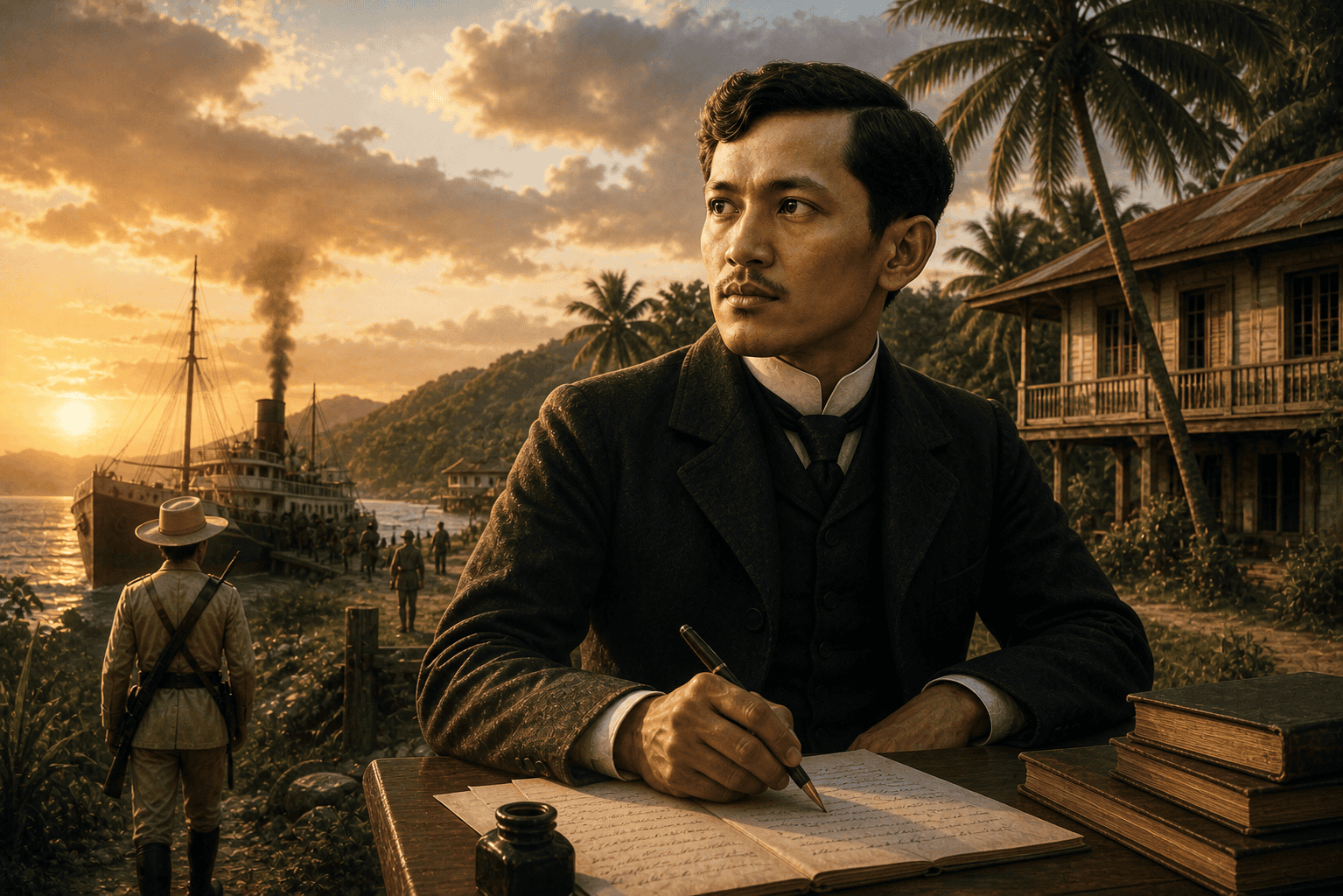
On July 17, 1892, eleven days after his arrest in Manila, José Rizal arrived in Dapitan, a small coastal town on the northwestern tip of Mindanao, and began four years of exile that the Spanish colonial government had designed to neutralize him. They were not entirely wrong about the threat he posed. They were entirely wrong about what exile would do to it.
Understanding why Rizal was sent to Dapitan requires understanding what he had done in the years before, what he did in the weeks immediately before his arrest, and how a colonial system calculates the difference between a man it can tolerate and a man it cannot.
The Accumulation of Reasons
The exile was not the result of a single incident. It was the culmination of a decade of grievances that the colonial government and the Catholic religious orders had been nursing since Noli Me Tangere was published in Berlin in 1887.
The novel had been banned in the Philippines almost immediately. The friars recognized themselves in its corrupt characters and its precise documentation of how they exercised power over ordinary Filipinos — through the confessional, through control of education, through the hacienda system, through their influence over colonial officials. The book was not simply an insult. It was an exposure, and it was accurate, which made it considerably more dangerous than an insult would have been.
El Filibusterismo, published in 1891, went further. Where Noli had been a diagnosis, Fili was a reckoning — a novel in which the colonial system’s refusal to reform generates a revolution it cannot contain. The religious orders petitioned successfully for its suppression. Their pressure on the colonial administration intensified every time Rizal’s name appeared in print.
Beyond the novels, there was the Calamba agrarian dispute. Rizal had used his European connections and his correspondence network to document and publicize the eviction of tenants — including members of his own family — from land administered by the Dominican order. The Rizal family was eventually forced off their property. Rizal continued to write about it from abroad. The Dominicans did not forget.
There was also his involvement in the Propaganda Movement — the loose network of Filipino reformists in Europe who published essays and manifestos arguing for equality, representation, and the removal of the friars from positions of civil authority. Rizal was the movement’s most prominent voice. The colonial government monitored his correspondence and kept records of his associations.
By the time Rizal decided to return to the Philippines in 1892, the file against him was long and the patience of his enemies was short.
The Decision to Return
Friends in Europe and Hong Kong urged him not to go back. They believed his life was in danger and that the authorities were simply waiting for an opportunity to act against him. Rizal understood the risk. He went anyway.
His reasoning, articulated in letters from this period, was a mixture of principle and practicality. He felt that remaining abroad while his family suffered the consequences of his work was untenable. He believed that his presence in the Philippines was necessary if any of the reform work he had been doing from a distance was to amount to anything. And he may have calculated — incorrectly, as it turned out — that a direct, visible engagement with the colonial authorities was less dangerous than the suspicion that gathered around an absent enemy.
He arrived in Manila on June 26, 1892. He was thirty-one years old.
La Liga Filipina and What It Threatened
Within days of his arrival, on July 3, 1892, Rizal convened a gathering in the Tondo district of Manila that resulted in the founding of La Liga Filipina. The organization’s stated aims were civic and educational — mutual aid, legal assistance, collective economic activity, the promotion of education. Its methods were explicitly peaceful. There was no call to arms, no advocacy for independence, no plan for anything the authorities could have characterized as sedition on its face.
But what La Liga represented was something the colonial system found genuinely threatening precisely because it was peaceful. An organized Filipino civic body — one that cut across regional and class lines, that created structures of collective action independent of colonial institutions, that operated under its own rules and toward its own purposes — was a different kind of problem from an armed uprising. Armed uprisings could be suppressed militarily. A network of organized, educated Filipinos who had learned to coordinate without colonial mediation was harder to dismantle.
Governor-General Eulogio Despujol saw the Liga as the nucleus of a political opposition. The friars saw it as a vehicle for Rizal’s influence to spread beyond what his books alone could reach. Both were probably correct.
The Intercepted Letter
The formal pretext for Rizal’s arrest came from a letter written by José Ma. Basa — a fellow reformist in Hong Kong — that was intercepted by the colonial authorities. The letter discussed reform, political awareness, and the need for Filipinos to organize their resistance to colonial abuses. Rizal had not written it. But his name was associated with the correspondence, and the authorities used the connection to add a sedition charge to the growing list of counts against him.
The intercepted letter was the trigger, not the cause. The decision to act against Rizal had effectively already been made. The letter gave Despujol the documentation he needed to move.
On July 6, 1892, three days after the founding of La Liga Filipina, Rizal was arrested at his lodgings in Manila. His rooms were searched. No weapons were found. No plans for armed uprising. No evidence of involvement in anything that met a reasonable standard of sedition. The investigation that followed confirmed what anyone paying attention already knew: Rizal was a writer and a doctor who had founded a civic organization, not a revolutionary preparing an armed revolt.
It did not matter. On July 14, 1892, Governor-General Despujol signed the order of deportation. Rizal was given no formal trial, no right to present a defense, and no specific charge to contest. He was given a destination instead: Dapitan, in Mindanao.
Why Dapitan
The choice of location was deliberate. Dapitan was remote — a small town on the northwestern coast of Mindanao, accessible only by sea, several days’ travel from Manila under the transportation conditions of 1892. It had a Spanish military garrison, which meant Rizal would be under continuous surveillance. And it was staffed by a Jesuit mission, which created a particular kind of irony: Rizal had been educated by the Jesuits at the Ateneo and retained a complex respect for the order, even as he had spent his adult life writing against the influence of the Spanish clergy in the Philippines. The colonial government presumably calculated that placing him under Jesuit supervision would create a more tractable exile than assigning him to a purely military setting.
The underlying logic was containment. Remove Rizal from Manila, from his reformist colleagues, from the circles of students and intellectuals and workers who read his work and came to hear him speak. Put him somewhere isolated enough that his communications could be monitored and his movements restricted. Wait for his influence to fade. This was how colonial systems managed men who were too prominent to execute quietly and too dangerous to ignore.
The Role of the Friars
The religious orders — particularly the Dominicans and Augustinians — were the most sustained institutional force behind the push to exile Rizal. Their grievances were specific and documented. Noli Me Tangere had given names and faces to abuses that the orders had been committing for decades and counting on the absence of a free press to keep invisible. El Filibusterismo had gone further, making the structural argument that reform was impossible within the existing system. The Calamba eviction had given those arguments a concrete, publicly known example.
The friars exercised their influence through their access to the colonial governor-general and through the pastoral networks that gave them reach into every town and village in the Philippines. They did not need to file formal charges. Their pressure on the colonial administration was continuous and well understood. When Despujol signed the deportation order, he was responding to a political environment that the orders had helped create and sustain.
What the Exile Was Meant to Accomplish — and What It Actually Did
Despujol and the friars expected exile to produce obscurity. They expected Rizal to disappear into the isolation of Dapitan, cut off from his supporters and his influence diminished by distance and time. What they got instead was something quite different.
During his four years in Dapitan, Rizal built a school for local children, practiced medicine and treated hundreds of patients, designed and constructed a water supply system for the town, conducted natural history research that produced specimens later recognized as new species, and transformed a piece of land he purchased with lottery winnings into a functioning small farm and community. He conducted correspondence with scientists in Europe, wrote poetry, and continued his intellectual work with the same discipline he had brought to everything else.
The exile was also where he met Josephine Bracken, the Irish-Filipino woman who became his companion in the final years of his life. And it was where, in the daily practice of service to an ordinary community, his character revealed itself most completely — not as a polemicist or a revolutionary, but as a man who believed that building something real for the people around him was as important as writing about what was being taken from them.
The colonial government had exiled a writer and a reformist agitator. What emerged from Dapitan, four years later, was something they had not anticipated and could not contain.
For the full account of what Rizal did during his four years in Dapitan, see the complete biography of José Rizal and the José Rizal timeline. For what came after Dapitan — his arrest, trial, and execution — see Rizal’s Trial and Execution.