
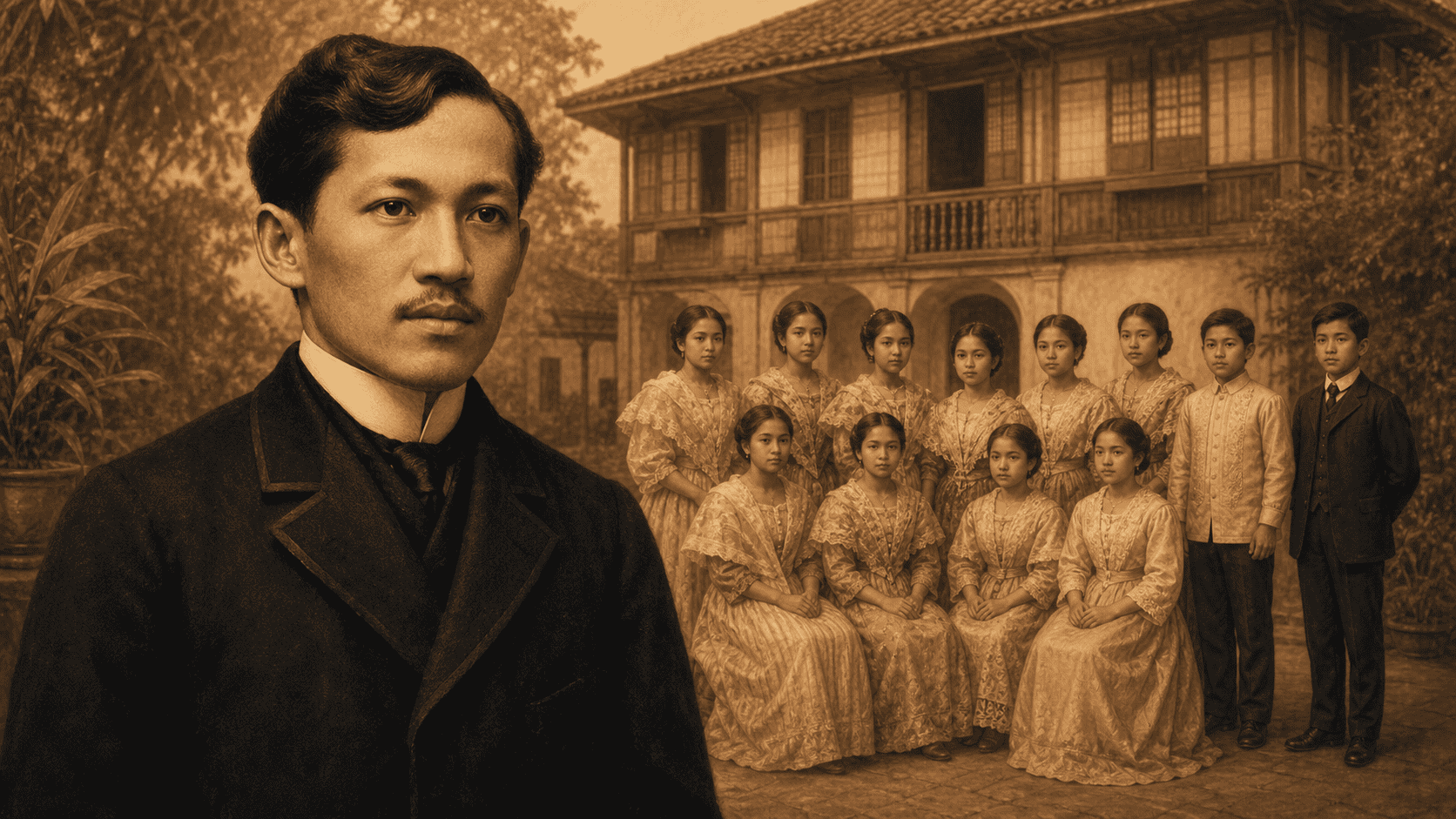
José Rizal was the seventh of eleven children. That placement — seventh, in the middle of a large family, with four siblings older and three younger — shaped him in ways that are easy to underestimate. He was never the eldest, never the one with primary responsibility. He had older brothers and sisters who cleared paths, absorbed blows, and made sacrifices that allowed him to become what he became.
Understanding the siblings is not a footnote to understanding Rizal. It is part of the story itself.
The Eleven
The Mercado-Rizal children arrived in this order:
- Saturnina
- Paciano
- Narcisa
- Olimpia
- Lucia,
- Maria
- José
- Concepción
- Josefa
- Trinidad
- Soledad
They grew up in Calamba, Laguna, in a household built on books, discipline, and the particular moral seriousness of parents who took education more seriously than almost anything else.
Their mother Teodora Alonso was their first teacher. Their father Francisco Mercado ran a modest farm. Neither was wealthy, but both understood that the mind was something worth building.
The family’s troubles with the Dominican friars, who claimed ownership of the agricultural land around Calamba and steadily raised rents on the tenants who worked it, would eventually consume years of the siblings’ lives, destroy their property, and scatter several of them from their home. By the time Rizal was executed in 1896, the family had already paid a significant price simply for sharing his name.
Saturnina, 1850: The Eldest
Saturnina (Neneng to the family) was seventeen years older than José and functioned in his life more as a second mother than as a sibling in the conventional sense. When the family needed to fund his studies in Europe, it was Saturnina’s household that contributed. When he needed steadiness from home, it was Saturnina who provided it.
Her husband Manuel Hidalgo was caught up in the repercussions of Rizal’s reformism — eventually imprisoned and exiled because of his family connection. Saturnina did not retreat from this. She remained loyal to both her husband and her brother, and after José’s death she became one of the primary keepers of the family’s physical archive — the letters, photographs, and documents that biographers would later depend on. The Saturnina portrait Rizal painted around 1878, which hangs today at the National Museum of Fine Arts, is the oldest of his known surviving paintings. He was seventeen when he painted her. She was nearly thirty. The care in the brushwork is evident.
Paciano, 1851: The One Who Made It Possible
Of all the siblings, Paciano had the most direct and consequential influence on who José became. He was six years older, politically formed earlier, and morally serious in a way that found its first model in Father José Burgos — one of the three priests executed at Bagumbayan in 1872. Paciano had studied under Burgos and witnessed, at twenty years old, what the colonial government does to Filipinos who speak too clearly.
He passed that education on to his younger brother. When José was ready to go to Europe, Paciano was the one who secretly funded the trip — 700 pesos saved from his own modest income as a farmworker, supplemented by a diamond ring from Saturnina as an emergency reserve. The departure was kept secret from the family’s landlords, the Dominican friars, because discovery could have meant eviction from the land they farmed.
Throughout the European years, Paciano managed the family’s increasingly difficult situation in Calamba — the land disputes, the legal harassment, the colonial surveillance — while sending money and letters to his brother as regularly as he could manage. The letters between them are among the warmest and most intellectually serious documents in the Rizal archive.
After José’s execution, Paciano joined the revolution. He became a general under Aguinaldo, fighting in Laguna. He was offered public positions after the wars and declined all of them, returning to farming and living the last decades of his life in quiet retirement. He outlived his famous brother by forty-three years, dying in 1930 at seventy-eight.
Narcisa, 1852: The Sister Who Found Him
Narcisa — Sisa, a name that takes on layered meaning given the tragic character of that name in Noli Me Tangere — was the artistic sibling: musical, perceptive, close to José throughout his life. When he was in Dapitan, she visited him. When he was imprisoned at Fort Santiago, she was among the family members allowed inside under strict surveillance.
After the execution, the colonial authorities buried José in Paco Cemetery in an unmarked grave, without a coffin, with no indication of the plot’s location. Narcisa refused to accept that. She interrogated cemetery workers, observed burial patterns, and eventually located the grave — identified by the reversed initials RPJ scratched into the soil. She purchased the adjacent lot immediately to protect it. Without her, the location of his remains would likely have been lost.
Olimpia, 1855: The Early Loss
Olimpia married Silvestre Ubaldo, a telegraph operator whose work and family connections eventually drew colonial suspicion. She died in 1887, in her early thirties, from causes the historical record does not document with precision — possibly postpartum complications, possibly sudden illness. Her death struck the family hard. José was in Europe when he learned of it.
She does not appear often in accounts of the family’s political life, which is partly because she died before the most consequential years. But her absence is itself part of the story — a reminder that the family’s losses were not only political.
Lucia, 1857: The One Whose Husband Was Denied Burial
Lucia’s husband Matriano Herbosa died in 1889. The local priest refused him Christian burial on the grounds that he was related by marriage to José Rizal, whose books were banned. The cruelty of this act — punishing a dead man for his wife’s family connection — was the kind of petty, vindictive abuse of religious authority that Rizal had written about in the novels. Lucia lived it personally.
She traveled to Dapitan to stay with José during his exile. She was present in his final days. After his execution she remained active, offering assistance to revolutionaries and sustaining the family’s networks through the turbulent years that followed.
Maria, 1859: The Confidante
Maria was steady and perceptive in the way that middle children sometimes are — attuned to the emotional temperature of those around them, trusted with the things people don’t say to everyone. José turned to her on personal matters, including the complicated situation with Leonor Rivera, the woman he loved for years in the Philippines while living abroad in Europe. Maria’s counsel was trusted precisely because it was honest rather than flattering.
During the Calamba dispute, she helped hold the family together through displacement and legal harassment. After José’s death, she became one of the primary sources for biographers seeking firsthand accounts of family life — a role she took seriously.
Concepción, 1862: The First Loss
Concepción (Concha) died in 1865 at three years old, from a fever. José was four. It was his first experience of death, and he wrote about it later with the particular tenderness of someone who had carried a loss since before he had words for it. The grief that runs through his fiction — the suffering of children, the helplessness of families in the face of forces they cannot control — has its earliest root here.
Josefa, 1865: The Revolutionary
Josefa was among the most politically active of the siblings. She joined the Katipunan, participated in revolutionary networks, and remained unmarried — devoting her life to a set of principles rather than to domestic arrangements. After José’s execution she continued attending meetings and safeguarding family documents and personal effects.
She also lived the longest of all the siblings, dying in 1945 at eighty years old — long enough to see the Japanese occupation of the country her brother had helped create.
Trinidad, 1868: The Keeper of the Poem
Trinidad’s place in the story rests on a single moment, and it is one of the most significant moments in Philippine literary history.
On the morning of December 30, 1896, as the family made its final visit to José’s cell at Fort Santiago, he pressed an alcohol stove into Trinidad’s hands. He told her quietly: there is something inside. She understood immediately, or sensed enough to not ask questions. She carried the stove out past the guards without betraying anything.
Inside was a folded sheet of paper. On it was written a poem — fourteen stanzas, untitled, composed through the night. It is now known as Mi Último Adiós — My Last Farewell. It is the most widely read thing Rizal ever wrote. It exists because Trinidad walked out of Fort Santiago with an alcohol stove and did not open it until she was safe.
She spent the rest of her life as a guardian of the family archive — letters, artifacts, testimonies — understanding that what she was protecting was not merely personal memory but the historical record of a nation.
Soledad, 1870: The Youngest
Soledad, the youngest, grew up in a household already shaped by everything that had happened to the older siblings. She became a teacher and married Pantaleon Quintero. Her letters — sharp, clear, with a strong sense of justice — show someone who understood the family’s significance and took her responsibility to its memory seriously. She was a source and a witness, and she used both roles well.
What the Family Tells Us
There is a version of Rizal’s story in which a solitary genius rises from modest provincial origins through sheer force of individual talent. That version is wrong, or at least incomplete.
Paciano funded the trip to Europe. Saturnina helped support his studies. Narcisa found his grave. Trinidad smuggled out his last poem. Each of them paid a price — in surveillance, in exile, in property lost, in husbands imprisoned or denied burial, in years spent managing a family under colonial harassment while the most famous member of it lived and worked abroad.
What Rizal became, he became because a family of eleven people believed in what he was trying to do and absorbed the consequences of his visibility so that he could keep doing it. The hero and the family are not separable. They are the same story.
Hi I’ve read a book about Jose Rizal and it was stated that his sister’s called him ute or moy, I would like to know if it’s true since I have never heard that nickname before aside from “Pepe”.