Two Men Who Should Never Have Met
Ferdinand Johann Franz Blumentritt was born in Prague in September 1853 — seven years before Rizal — the son of a Bohemian family in what was then the Austrian Empire. He studied history at Prague University and became, in the ordinary course of an academic career, a teacher and then a principal at the municipal school in Leitmeritz, a small town on the Elbe River in northern Bohemia, now the Czech city of Litoměřice. He was by all accounts a methodical, warm, and prolific scholar — a man who published extensively on Philippine languages and ethnography despite never having been to the Philippines, who corresponded with scholars across Europe, and who ran the Leitmeritz school with the same conscientious energy he applied to his research.
He had a wife, Rosa, and three children: Friedrich, Konrad, and a daughter named Dolores — whom he occasionally addressed with the Tagalog nickname Loleng, a detail that tells you something about the depth of his engagement with Philippine culture. He spoke German as his mother tongue, Spanish and English as working languages, and had been teaching himself enough Tagalog to work with Philippine texts. He had never been south of central Europe.
Rizal, in the summer of 1886, was in Heidelberg completing his ophthalmology training under Professor Otto Becker. He had been in Europe for four years, moving between Madrid, Paris, and Germany, publishing essays, developing his political analysis, beginning the novel that would eventually become Noli Me Tangere, and building the network of European contacts that sustained his intellectual life in exile. He heard, through some channel of the scholarly grapevine, that there was an Austrian in Leitmeritz who had developed an extensive scholarly interest in the Philippines — who had published on Philippine languages and ethnography with evident seriousness and genuine affection for his subject.
Rizal was, at this point in his life, lonely in the specific way that gifted people are lonely in foreign countries: surrounded by people but not yet fully known by any of them. He was proud of his culture and his country in a way that the colonial world did not easily accommodate. The idea that a European scholar had chosen the Philippines as a serious subject of study — not as a curiosity, not as an administrative problem, but as a people and a civilization worth sustained intellectual attention — moved him. He wrote to Blumentritt in German, which he had been learning since arriving in Heidelberg, as a gesture of respect and of effort.
The First Letter
The letter went out in late July 1886. Rizal introduced himself, expressed his admiration for Blumentritt’s work on Philippine languages, and explained that he was a Filipino medical student who happened to share Blumentritt’s interest in his country’s history and culture — from the inside, as it were. He sent a copy of an arithmetic textbook published in both Spanish and Tagalog that Blumentritt had been trying to obtain. It was a characteristically Rizalian opening: practical, considerate, and calibrated to establish common ground before anything else.
Blumentritt replied. He was thirty-three years old, with a settled professional life in a small Central European town, and a Filipino had just written to him in German from Heidelberg. He replied with warmth and scholarly curiosity and, apparently, immediate recognition that this was not an ordinary correspondent.
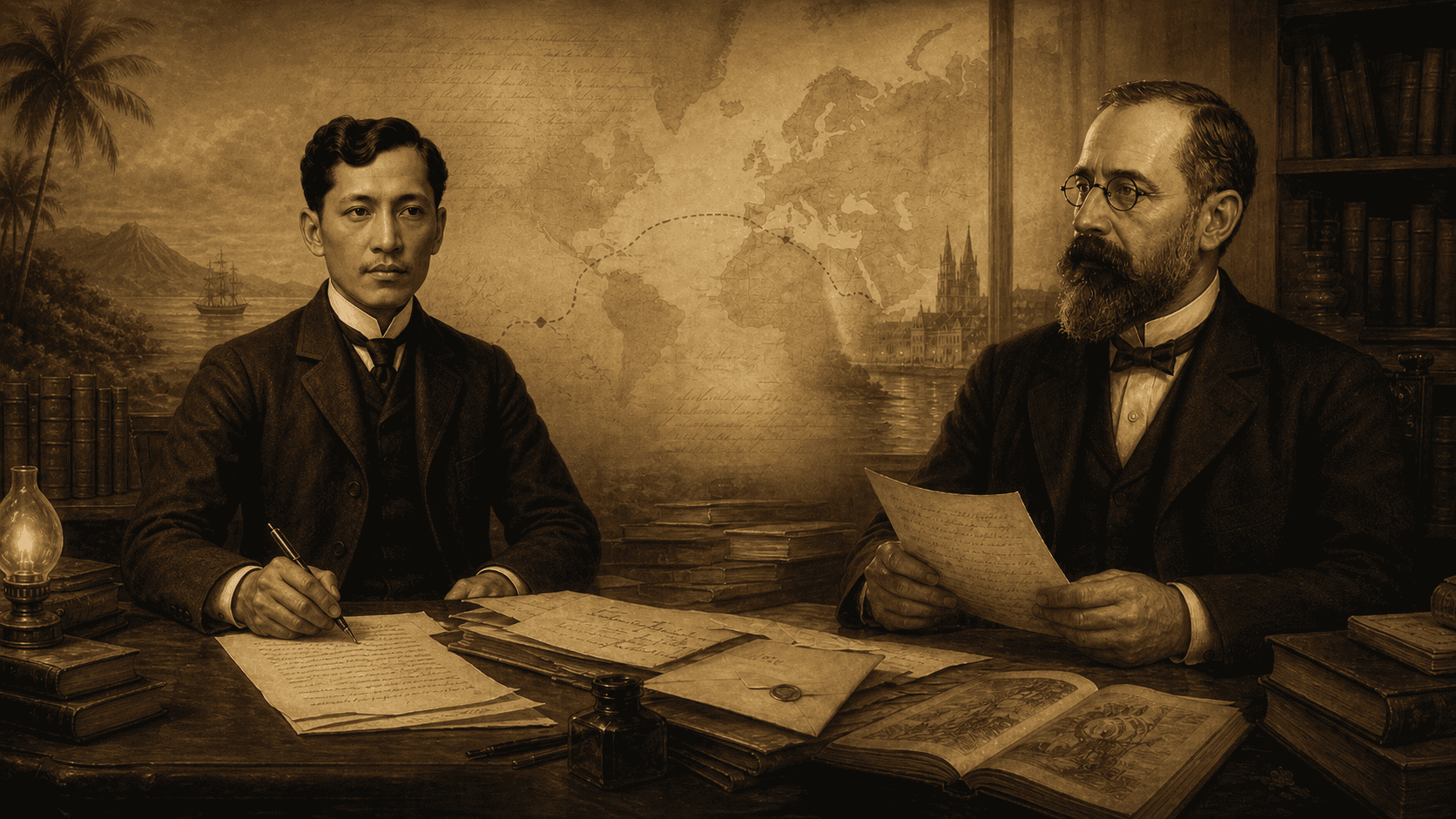
The letters went back and forth. They discussed Philippine languages, history, and colonial administration. They discussed Rizal’s research on pre-colonial Philippine civilization and Blumentritt’s ethnographic work. They discussed European politics and intellectual life. They moved, gradually and naturally, from the formal register of scholarly acquaintances to something more intimate — the Esteemed Sir of the early letters giving way, over months and then years, to Dear Friend and eventually Dear Brother.
Four months into the correspondence, Rizal sent Blumentritt a self-portrait done in crayon. Blumentritt sent his photograph. They were friends who had not yet met, exchanging faces across the distance because the letters alone were no longer enough.
Leitmeritz, May 1887
In the spring of 1887, Rizal was preparing to return to the Philippines after five years in Europe. He had completed the Noli Me Tangere in Berlin and arranged its printing with money borrowed from his friend Maximo Viola. Before sailing home, he made an extended tour of the continent — Prague, Vienna, Stuttgart, Munich, Geneva, Rome — and built into the itinerary four days in Leitmeritz, where Blumentritt was waiting for him.
Blumentritt met Rizal and Viola at the train station on May 14, 1887. He brought his family. He had arranged rooms for the two travelers at the Hotel Krebs. Over the four days that followed, he took them around the town, introduced them to the mayor — who was sufficiently impressed that both visitors signed the city’s guest book — and hosted them for dinner at the Blumentritt house each evening.
It was the only time they would ever meet in person. The entire friendship that followed — years of letters, the collaboration on the annotated Morga, the network of European scholars Blumentritt introduced Rizal to, the political advocacy Blumentritt undertook on behalf of the Philippines — grew from four days in a small Bohemian town.
When Rizal left Leitmeritz, he left behind a pencil sketch he had made of Blumentritt — a gift, something to carry his memory into the house where he had been so unexpectedly welcomed. Two days after leaving, he wrote to Blumentritt from the road. The letter — written in the immediate aftermath of the visit, while the feeling was still fresh — is among the most personal things Rizal ever committed to paper. He asked what he had done to deserve such friendship. He told Blumentritt that he would carry the memory of Leitmeritz with him and that in his darkest moments abroad he would remind himself: there is a little corner of Bohemia where good souls live who appreciate you, who will be glad at your joys and grieve at your sorrows.
He was twenty-five years old. He had a year to live before his return to the Philippines set in motion the chain of events that would end with his exile and, eventually, his execution.
What the Friendship Produced
The Rizal-Blumentritt correspondence is one of the more remarkable documents in the history of 19th-century anti-colonial thought. It runs to several hundred letters exchanged over ten years — covering Philippine history, linguistics, botany, zoology, colonial politics, friar abuses, European intellectual life, Rizal’s personal circumstances, Blumentritt’s family, and the daily texture of two lives conducted in very different corners of the world.
It was also practically useful in ways that are easy to underestimate. Through Blumentritt, Rizal gained access to a network of European scholars who took the Philippines seriously: Dr. Adolph Meyer in Dresden, Dr. Reinhold Rost in London, Rudolf Virchow the anthropologist in Berlin, and others. These were not casual acquaintances. They were people who read his work, responded to his arguments, and provided the kind of peer engagement that Rizal — writing in Spanish about a colonized archipelago that most European intellectuals had never considered — would otherwise have struggled to find.
Blumentritt wrote the preface to Rizal’s annotated edition of Antonio de Morga’s Sucesos de las Islas Filipinas, published in Paris in 1890. The preface lent the work European scholarly credibility at precisely the moment when it most needed it — when Rizal was arguing that the Philippines had a sophisticated civilization before Spain arrived, and when the colonial authorities were doing their best to suppress the argument. An Austrian professor vouching for the scholarship was not nothing.
Blumentritt also contributed articles to La Solidaridad, the newspaper of the Filipino reform movement in Europe — writing about the Philippines, for a Spanish-reading audience, from a position of European scholarly authority that the Filipino ilustrados could not claim for themselves in the same way. He was, in the formal language of contemporary advocacy, an ally — a person who used whatever privilege his position afforded to advance a cause that was not his own but that he had made his own through study and through friendship.
The Languages Between Them
One of the less remarked but genuinely remarkable aspects of the friendship is the sheer linguistic range it required. Rizal’s native language was Tagalog; his primary working language for the European years was Spanish; he had learned French during his time in Paris and was working on German when he wrote the first letter to Blumentritt. Blumentritt’s native language was German, with Spanish and English as additional working languages and Tagalog as a scholarly acquisition.
They corresponded primarily in Spanish, which gave them a common ground, but the first letter had been in German — Rizal’s gesture of meeting Blumentritt in his own language — and the friendship that followed operated across all the languages both men shared. They corrected each other’s usage, exchanged texts in multiple languages for comment and comparison, and collaborated in the way that scholars collaborate when they are genuinely interested in the same questions rather than simply performing scholarly collegiality.
Rizal at one point offered to model a bust of Blumentritt from his description — the sculptor’s eye applied to a face he knew only from a photograph. This impulse — to make something physical, something that could hold a presence across distance — runs through the correspondence as a recurring theme. The letters were never quite enough. They sent portraits, they sent books, they sent specimens. They were two people trying to sustain a real friendship through the medium available to them, which was paper, and doing it as fully as paper allowed.
Dapitan
When Rizal was exiled to Dapitan in 1892, the Blumentritt correspondence became one of his primary connections to the wider world. He wrote from Dapitan about what he was finding in the forests and on the shoreline — the specimens he was collecting for the European museums, the species he suspected were unknown to science, the landscape of Mindanao as it revealed itself to someone paying close attention. Blumentritt wrote back with scholarly interest, with news of Europe, with the ordinary details of family life in Leitmeritz that grounded Rizal’s isolation in the knowledge that somewhere the normal rhythms of friendship were continuing.
He told Blumentritt about Josephine Bracken. He told him about the school he was running, about the water system, about the lottery winnings and the land at Talisay. He told him, in the way that you tell a close friend about the texture of your daily life, what exile actually looked like from the inside.
Blumentritt, for his part, continued writing about the Philippines in European scholarly journals and continued using whatever platform his academic position provided to make the Philippine question legible to readers who would otherwise never have heard of it.
The Last Letter
On the night of December 29, 1896 — the night before his execution — Rizal wrote to Blumentritt from his cell at Fort Santiago.
The letter was short. He told Blumentritt that when the letter arrived, he would already be dead. He said he was to be shot the following morning at seven, and that he was innocent of the charge of rebellion. He said he was going to die with a tranquil conscience. He called Blumentritt his best and dearest friend and asked him never to think ill of him.
He signed it. He folded it. He arranged for it to be sent.
The letter reached Leitmeritz after the execution had already taken place. Blumentritt received news of Rizal’s death — probably through the newspapers before the letter arrived — and was devastated. He wrote about Rizal in the Austrian and German press, trying to make European readers understand what had happened and who had been killed. He continued his Philippine scholarship for the remaining seventeen years of his life. He remained, to the end, a loyal advocate for the country he had come to love through the correspondence of a man he had met in person only once, for four days, in a small Bohemian town, thirty-five years before his own death.
Blumentritt died in Leitmeritz on September 13, 1913. He is remembered in the Philippines by streets, a market, a railway station, and an LRT stop in Metro Manila — all named Blumentritt, in honor of the Austrian who never came but whose name became, through friendship and advocacy, part of the city’s daily geography.
Leitmeritz — now Litoměřice — is a twin city of both Calamba, Rizal’s birthplace, and Dapitan, the town where he spent four years in exile. The twin-city relationship was established in recognition of the connection that began with a letter written in German, in the summer of 1886, by a lonely Filipino student who wanted to thank an Austrian he had never met for caring about his country.
Read next: Rizal in Heidelberg — the poem he wrote on the Neckar riverbank, the eye clinic where he trained, and the place the friendship with Blumentritt began.