What they did not anticipate was what the sight of Rizal walking across that field would do to the people watching.
How He Got There
Rizal had been at sea when the revolution broke out. In late July 1896, he had finally received permission to leave four years of exile in Dapitan and serve as a military doctor in Cuba. He was en route — already past Manila, already in the open ocean — when the Katipunan was discovered and the uprising began in August.
Spanish authorities ordered his arrest. He was intercepted at sea and held at Montjuic Castle in Barcelona. On November 3, he arrived back in Manila aboard the transport ship Colón and was taken directly to Fort Santiago.
The irony of his situation was not lost on him. He had spent years arguing against premature revolution. He had refused to join the Katipunan. He had written a public manifesto from his prison cell explicitly opposing the uprising. He was now being charged with masterminding it.
The Trial
The military tribunal convened on December 26. It lasted a few hours. The charges were rebellion, sedition, and conspiracy — the evidence a mix of unsigned documents, misread correspondence, and forced testimony. His defense lawyers did what they could within a proceeding that had already decided its outcome.
The verdict was death by firing squad.
Rizal was told on December 27. By the accounts of those who were present, he received the news without visible distress. He asked for time to write.
The Night Before
On December 29, Rizal wrote farewell letters — to his parents, his siblings, his friends. He thanked people. He asked forgiveness. He urged his family to stay together and accept what was coming without bitterness.
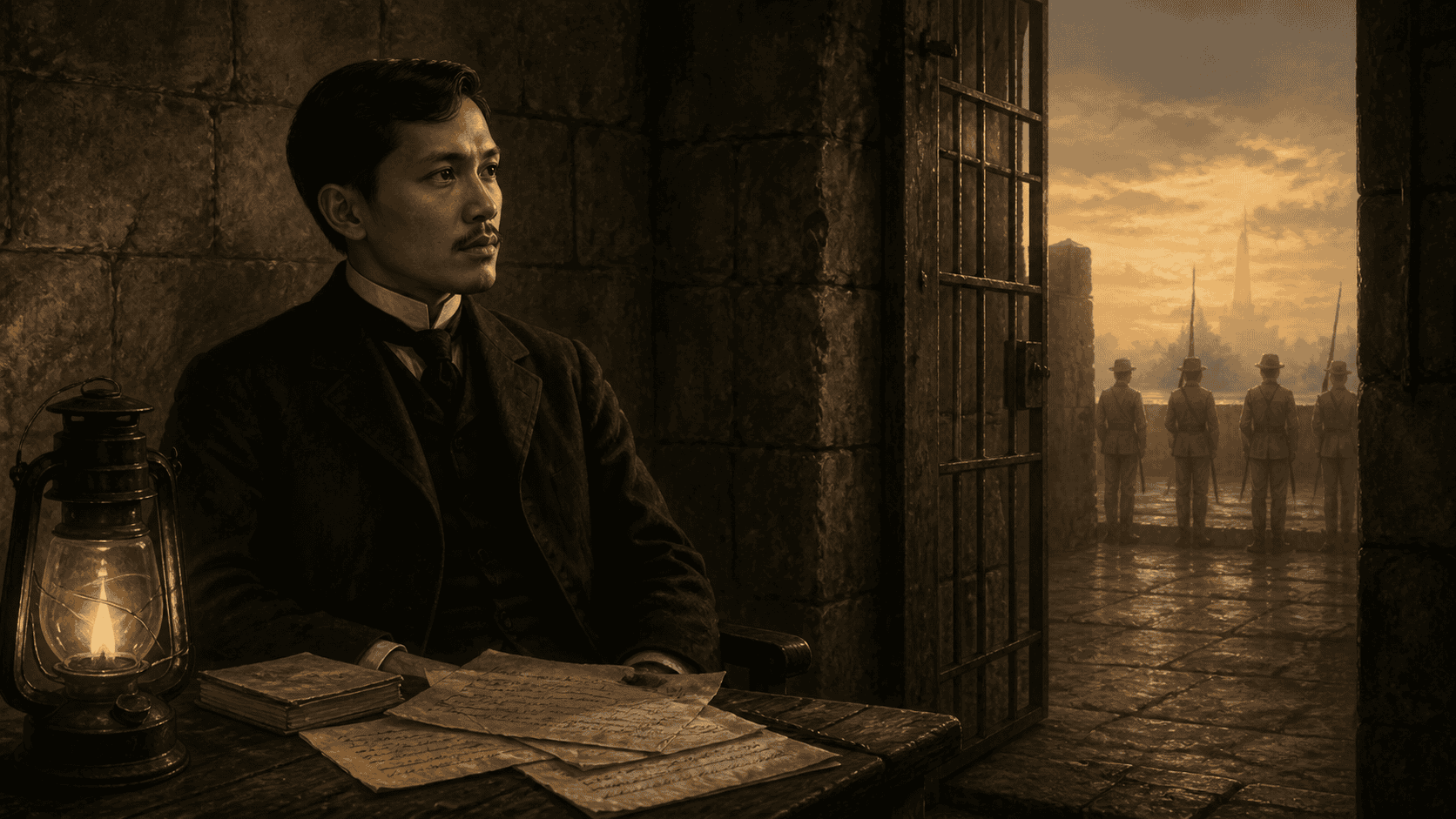
Sometime during that night, he finished the poem he had been composing in his cell. It had no title. He wrote it on a single sheet of paper, folded it tightly, and hid it inside an alcohol stove. On the morning of December 30, he gave the stove to his sister Trinidad, telling her there was something inside. She found it after he was dead.
The poem is fourteen stanzas long. It says goodbye to the Philippines — its mountains and sea, its fields and people. It says he dies without anger. It asks only that his death count for something. It is completely calm.
It is now known as Mi Último Adiós — My Last Farewell.
The Morning of December 30
His family was allowed a final visit before dawn. His mother Teodora, who had difficulty walking, came anyway. He held her hands. He told her he was ready. His sisters embraced him. He told them to take care of each other.
Josephine Bracken was brought in separately. They had been together in Dapitan for the better part of two years; she had come seeking treatment for her stepfather’s failing eyes and stayed. In the hours before his execution, a civil marriage ceremony was performed in his cell. He gave her a small book. Their parting was quiet.
He received the last sacraments. By several accounts, he spoke at length with the priests who came to him, engaging seriously with questions of faith and rejecting what he saw as the Church’s political manipulation, while maintaining his own belief in God. He was, to the end, a man who thought carefully about everything.
Bagumbayan
Shortly after six in the morning, the gates of Fort Santiago opened. Rizal walked out wearing a black suit, his hands bound, flanked by guards. The route to Bagumbayan passed through the old city — the moat, the walls, the streets of colonial Manila he had written about and criticized and loved.
Spectators had gathered behind barricades. Some wept. Others stood without speaking. A few foreign diplomats were present as observers. The field was open and flat, the morning air still carrying the cold of the night.
He asked to face the firing squad. The request was denied. He was made to turn his back to the eight Filipino soldiers; Spanish officers stood behind them with their own rifles, in case the Filipino soldiers failed to fire — and wait.
At 7:03 a.m., the command was given.
In the moment the rifles fired, witnesses said, Rizal twisted his body. He fell facing the rising sun.
What Happened After
The Spanish colonial government expected the execution to suppress the revolution. The calculation was logical: remove the intellectual authority behind the movement, break the moral center, and the resistance would lose its coherence.
The opposite happened.
News of the execution spread within hours. Filipinos who had been cautious were radicalized. Revolutionaries fought with renewed intensity. The colonial government’s willingness to execute a man who had publicly opposed the revolution — on charges that were transparently false — demonstrated, more clearly than any argument, that the system had no capacity for fairness and no intention of reform.
Rizal had spent his life trying to find a peaceful path. The colonial government had spent his entire public life demonstrating that no such path existed. His execution was the moment when those two facts finally met, and the conclusion was inescapable.
His body was buried without a coffin in an unmarked grave at Paco Cemetery. His sister Narcisa found the burial site by bribing a caretaker to mark it, using Rizal’s initials in reverse — RPJ — so she could find it again. His remains were transferred to the base of the Rizal Monument at Luneta in 1912, where they rest today.
The field where he was shot is now Rizal Park. His monument stands at its center, facing the bay. The changing of the guard at the monument is a daily ceremony. On December 30 each year, the date of his execution is observed as a national holiday.
He was thirty-five years old.