Rizal spent most of his adult life trying to prevent the revolution that eventually broke out in his name. This is the central paradox of his political life, and understanding it requires understanding exactly what he was for, what he was against, and why the colonial system’s response to the first made the second inevitable.
He was for reform — specific, documented, articulable reform — not as a vague aspiration but as a concrete political program. He was against armed rebellion, not on principle but on timing: he believed the Philippines was not yet ready, that a premature uprising would be crushed and the people would suffer more than they already did. And he watched, across fifteen years of writing and advocacy and exile, as the colonial government demonstrated that it had no intention of granting even the most modest of what he was asking for.
The revolution came anyway. And it came, in large part, because of the political consciousness his writing had produced — which is exactly what he had been afraid of.
What Rizal Was Actually Asking For
The reform program Rizal articulated in his essays for La Solidaridad and in his correspondence with the Spanish liberal press was specific and, by any reasonable standard, moderate. He was not asking for independence. He was asking for the treatment of the Philippines as a full province of Spain, with the rights that implied: representation in the Spanish Cortes, equality before the law, freedom of speech and of the press, and the removal of the Catholic religious orders from the positions of civil authority they had accumulated over three centuries of colonial rule.
The friar question was central to everything. The Dominican, Augustinian, Recollect, and Franciscan orders controlled education, owned vast tracts of agricultural land, administered parish governance, and submitted regular reports on their communities to colonial officials. Their authority was not merely spiritual — it was economic, administrative, and political. Rizal argued that this concentration of power in unaccountable, non-Filipino institutions was the primary mechanism through which Filipino dignity was suppressed and Filipino potential was stunted.
He documented this argument in two novels that the colonial government banned almost immediately after publication. Noli Me Tangere (1887) and El Filibusterismo (1891) were not primarily political tracts — they were works of fiction that functioned as social documentation, showing readers their own lives with a precision that made the colonial reality impossible to dismiss as exceptional or incidental. The system was not corrupt in places; the system was corruption. That was the argument.
The Execution of GomBurZa and What It Taught His Generation
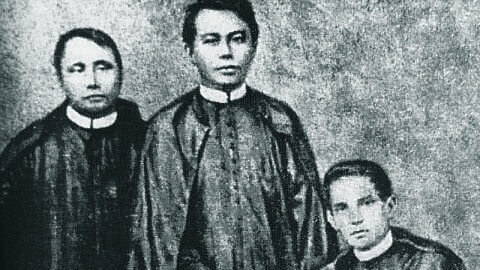
The political formation of Rizal’s generation was shaped by an event that occurred when he was eleven years old. In February 1872, three Filipino secular priests — Fathers Mariano Gómez, José Burgos, and Jacinto Zamora, known collectively as GomBurZa — were publicly executed at Bagumbayan on charges of complicity in the Cavite Mutiny. The charges were widely understood to be fabricated, manufactured by the religious orders who resented the secular priests’ growing influence and their advocacy for Filipino clergy.
The executions sent a clear message: the cost of challenging the colonial order, even through legitimate institutional means, was death. Rizal’s older brother Paciano had been a student of Father Burgos and was directly affected. The Rizal family’s subsequent caution — the shift from the surname Mercado to Rizal as a protective measure, the care with which they managed their visibility to colonial authorities — was a direct response to watching what happened to people who spoke too clearly.
Rizal dedicated El Filibusterismo to the memory of Gómez, Burgos, and Zamora. The dedication was not symbolic. It was an argument: these men were not traitors. They were reformists who were killed because the colonial system could not tolerate the specific reforms they were advocating.
The Propaganda Movement and the Limits of Peaceful Advocacy
The Propaganda Movement was the organized expression of the reformist program in the 1880s and early 1890s. Operating from Spain, it brought together Filipino intellectuals and professionals — Rizal, Marcelo H. del Pilar, Graciano López Jaena, Mariano Ponce, and others — who used journalism, public argument, and personal lobbying to make the case for reform to the Spanish liberal establishment.
They were not without allies. Spanish liberals who believed in constitutional governance and equal rights were genuinely sympathetic to the Filipino reformists’ arguments. But sympathy in Madrid did not translate into policy in Manila, because policy in Manila was made in consultation with the Catholic religious orders, whose institutional interests were directly threatened by every reform the Propaganda Movement proposed. Representation in the Cortes would have given Filipinos a voice in decisions that currently went uncontested. Equal rights before the law would have made the friars accountable for abuses that were currently invisible to any court. Secularization would have stripped the orders of their civil authority entirely.
The orders lobbied against every proposal with the persistence and resources of institutions that had been in the Philippines for three centuries and intended to remain for three more. The Governor-General, whoever he happened to be at any given moment, needed their cooperation to govern the colony. The reform petitions went nowhere.
By 1891, when Rizal published El Filibusterismo — a novel whose central figure is a man who has abandoned peaceful reform and is planning a violent revolution — the argument within the novel reflected an argument happening in reality. Rizal did not endorse Simoun’s path. But he was honest enough to give it full weight.
The Calamba Dispute: Reform Made Personal
The Calamba agrarian dispute brought the abstract arguments about colonial land policy into direct contact with Rizal’s own family. The Rizal family, along with dozens of other tenant families in Calamba, Laguna, leased agricultural land from the Dominican order. In the late 1880s, the Dominicans moved to increase rents and tighten the terms of the leases. The tenants refused. The dispute went to the courts.
Rizal used his European connections and his access to the reformist press to document and publicize what was happening. He gathered testimony, wrote articles, and argued that the case was a microcosm of the broader problem: the religious orders using their institutional power to extract wealth from Filipino communities who had no legal recourse. The colonial courts sided with the Dominicans. The Rizal family and their neighbors were evicted from their land.
The episode confirmed what the Propaganda Movement’s decade of advocacy had suggested: that the colonial legal system was not a neutral mechanism for resolving disputes but an instrument of colonial power. Reform, pursued through legitimate institutional channels, had produced nothing for the families of Calamba except eviction.
La Liga Filipina: The Last Attempt
When Rizal returned to the Philippines in June 1892, he made one more attempt at organized peaceful reform. On July 3, 1892, he founded La Liga Filipina — a civic organization built around mutual aid, legal assistance, education, and collective economic activity. Its founding documents were explicitly peaceful. It had no armed wing and no revolutionary agenda.
It lasted four days. On July 6, Rizal was arrested. On July 14, he was deported to Dapitan.
The speed of the colonial government’s response to a peaceful civic organization was its own argument. If the system would not tolerate La Liga Filipina — a reading group with political ambitions — then what form of organized Filipino activity would it tolerate? The answer, demonstrated repeatedly across thirty years of colonial response to Filipino advocacy, was: none that threatened friar power or questioned the terms of colonial governance.
On the same night that Rizal was arrested, Andrés Bonifacio and the other founders of the Katipunan accelerated their planning. The failure of La Liga and the arrest of Rizal removed the last major advocate for the reformist path and cleared the space for a different approach entirely.
The Revolution Rizal Tried to Stop
The Katipunan launched its armed uprising in August 1896. Rizal had been informed of the organization’s plans in May of that year, when Pio Valenzuela traveled secretly to Dapitan to seek his endorsement. Rizal refused. He told Valenzuela that the revolution was premature, that the Filipino people were not yet prepared for armed conflict, and that the likely result was catastrophic loss of life. He was not wrong about the cost — the revolution was brutal and prolonged — but he was wrong that it could have been prevented.
The Katipunan used Rizal’s writings as spiritual foundation regardless of his personal position. His novels had produced the political consciousness that made the organization possible. His analysis of colonial injustice had given a generation of Filipinos a vocabulary for what they were experiencing and a framework for why it was wrong. The revolution did not happen despite Rizal’s reformism — it happened because of it, in the specific sense that his work had produced the conditions for it.
This is the paradox that El Filibusterismo had anticipated. Simoun, who abandons reform for revolution, is not the novel’s hero. But the novel does not pretend that Padre Florentino’s counsel — patience, moral development, working through legitimate means — will be enough on its own. The question the novel raises and does not fully answer is the question the Philippines was about to answer through force: when peaceful means are exhausted, what comes next?
Reform as the Foundation of What Followed
The revolution that broke out in 1896 was not a repudiation of the reformist program — it was its continuation through other means. Bonifacio admired Rizal’s intellect and understood that the Katipunan’s legitimacy rested in part on the moral framework Rizal had established. Apolinario Mabini, who became the Revolution’s primary political theorist, built his thinking on the reformist tradition’s insistence that Filipino self-governance required educated, morally serious citizens, not just military victory over a colonial power.
The argument that reform and resistance were separate movements — one moderate and the other radical, one peaceful and the other violent — misunderstands the relationship between them. Reform established the terms: what the Philippines was, what it deserved, what was being denied to it. Resistance provided the force. The two were sequential stages of the same political project, not competing alternatives.
Rizal did not live to see the revolution succeed or to witness the American colonial period that followed. He was executed on December 30, 1896, four months after the uprising began, convicted of inspiring a revolution he had argued against. The irony was exact: a man who had spent fifteen years trying to prevent armed rebellion was killed for inspiring it.
For more on the movement Rizal worked within, see The Propaganda Movement. For the revolution that followed, see The Revolution Rizal Tried to Stop — And Inspired Anyway. For the civic organization he founded days before his arrest, see La Liga Filipina: The Organization That Lasted Four Days.