The standard account goes like this: Rizal inspired the Philippine Revolution through his novels, his martyrdom provided the spark, and the rest followed. The account is not wrong. It is just incomplete in the ways that make history interesting.
What the standard account leaves out is that Rizal spent years actively trying to prevent the revolution he is credited with inspiring. He told the Katipunan it was premature. He refused to join it. He wrote, from his prison cell in Fort Santiago, a public manifesto explicitly disavowing the uprising that had just begun in his name. He asked the Spanish authorities to let him serve as a doctor in Cuba — an offer that, had it been accepted, would have put him on the opposite side of the world from the Philippine Revolution he allegedly led.
None of this diminishes what he contributed. It makes the contribution stranger, more human, and considerably more worth understanding.
What He Actually Believed About Revolution
Rizal’s opposition to armed revolt was not cowardice or colonial sympathizing. It was a strategic judgment, held with conviction across his entire adult life, rooted in a specific analysis of what the Philippines was and was not ready for.
He believed that a nation governed by consent requires citizens capable of self-governance — people educated enough to participate, organized enough to sustain institutions, and morally developed enough not to reproduce the abuses of the system they were replacing. The Philippines in 1896, in his view, had not yet completed that preparation. A revolution launched too soon, against a still-powerful colonial military, without international recognition or unified leadership, would fail — and the failure would cost more than patience would have.
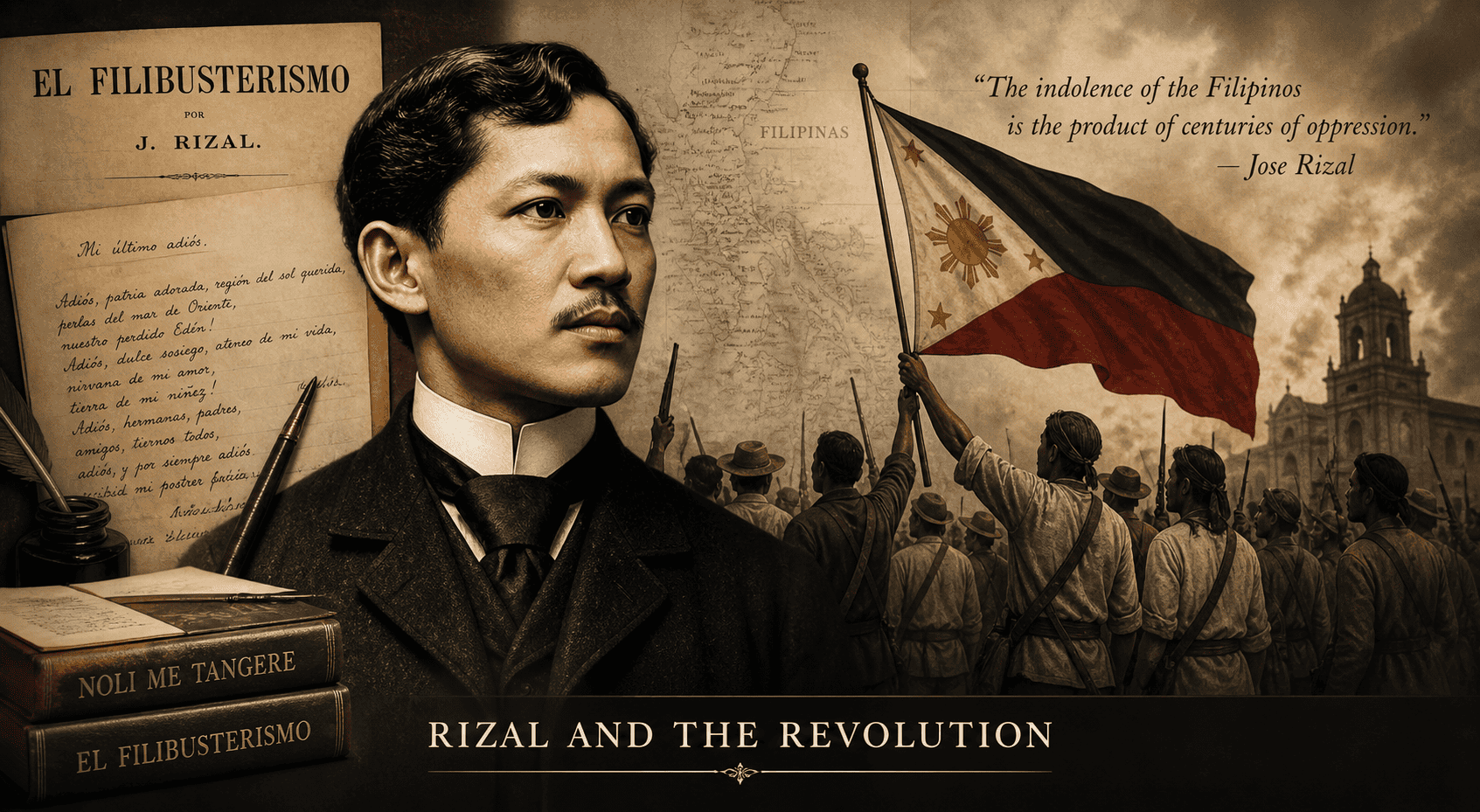
He had written this argument into El Filibusterismo six years earlier. Simoun’s revolution fails precisely because it is built on hatred and personal grievance rather than on the moral and civic foundation that Rizal believed genuine liberation required. The novel was both a work of fiction and a political position, and Rizal held the position consistently.
This did not mean he was indifferent to the injustice around him. The novels that exposed colonial cruelty, the essays that named the abuses, the civic organization he founded and watched arrested — none of this was the work of a man at peace with the status quo. He simply believed there was a path that did not end in massacre, and he kept trying to find it even as events made that path increasingly implausible.
How He Influenced the Revolution He Opposed
The paradox at the center of this story is that Rizal’s influence on the Philippine Revolution was enormous precisely because he had spent so long trying to prevent it.
Andres Bonifacio, who founded the Katipunan and launched the armed uprising, had read Rizal’s novels. So had the men around him. The political vocabulary of the revolution — the understanding of colonial rule as a system rather than a series of individual abuses, the claim that Filipinos were capable of self-governance, the argument that the colonial government’s legitimacy was built on lies — all of this came substantially from Rizal’s writing. Bonifacio and the Katipuneros were not reading political philosophy from distant European theorists. They were reading a Filipino doctor who had turned the colonial experience into narrative and given people the language to name what was happening to them.
Katipunan initiation ceremonies displayed Rizal’s portrait. Bonifacio carried copies of his poems. The revolutionary movement claimed him as its intellectual authority even as the man himself, in Dapitan, was asking to serve as a medical volunteer in Cuba rather than lead anyone into battle.
This is how ideas travel: not according to the intentions of the people who produce them, but according to the needs of the people who receive them. Rizal wrote novels about the consequences of oppression and the limits of reform. The people who read them drew their own conclusions about what to do next.
The Manifesto From Prison
When the Katipunan’s existence was discovered in August 1896 and the revolution began, Rizal was at sea, en route to Cuba. He was arrested at a stopover in Barcelona and returned to Manila. The Spanish colonial government charged him with rebellion, sedition, and conspiracy — charges that required them to argue he was the mastermind of an uprising he had in fact tried to dissuade.
From Fort Santiago, while awaiting trial, Rizal wrote a public manifesto. It is one of the most extraordinary documents in Philippine history and one of the least discussed. In it, he explicitly condemned the revolution, called on Filipinos to abandon the uprising, and argued that violence would harm rather than help the cause of reform.
The manifesto was ignored by the Katipunan. The revolution continued. Rizal’s trial proceeded regardless — the outcome had been decided before the first witness was called. The colonial government needed to execute someone whose existence had become politically intolerable, and the manifesto did not change that calculation.
He was convicted of inspiring a rebellion he had publicly opposed, sentenced by a legal system that had never once applied equally to him, and shot on December 30, 1896, at thirty-five years old.
What His Death Did
The execution confirmed everything Rizal had written about the colonial system. He had argued, in novel after novel and essay after essay, that the colonial government was incapable of reform, that its justice was not justice, and that it would protect its own interests regardless of the evidence or the law. His trial proved him right in the most public way possible.
The effect on the revolution was immediate and profound. Filipinos who had been hesitant joined the uprising. Provincial communities that had stayed neutral took sides. The argument that working within the colonial system was still worth trying — which Rizal himself had made his life’s work — collapsed under the weight of what the system had just done to its most eloquent advocate.
Rizal had spent thirty-five years trying to find a peaceful path. The colonial government had spent his entire public life demonstrating that no such path existed. His execution was the moment when those two facts met, and the conclusion was inescapable.
The Irony That History Left Behind
The Philippine Revolution succeeded — slowly, messily, with American intervention complicating everything — and the independent Philippines that emerged needed a national hero. The choice fell to Rizal rather than Bonifacio, partly through the colonial politics of the American period, partly through the genuine and widespread admiration Filipinos felt for him.
The result is a national mythology in which the revolution’s symbolic father is the man who wrote a manifesto against it. Historians have been debating this ever since, with good reason. Renato Constantino, one of the most influential Filipino historians of the twentieth century, argued that elevating Rizal over Bonifacio was a deliberate colonial choice — that the peaceful reformist was a more convenient symbol for the Americans than the working-class revolutionary who actually organized the uprising.
The debate is worth having. But it should not obscure what is genuinely remarkable about Rizal’s relationship to the revolution: that a man’s words can take on a life entirely independent of his intentions; that ideas, once they enter the world, belong to everyone who encounters them; and that the person most responsible for making a thing possible is not always the person who wanted it to happen.
Rizal did not want the Philippine Revolution of 1896. He wanted something harder and slower and more durable. The revolution happened anyway, in part because of him, despite him, and ultimately in his name.
What he made of that, in the final weeks of his life, is something only the poem he smuggled out in an alcohol stove tells us. Fourteen stanzas of extraordinary calm. No rage. No retraction. No bitterness toward the people who were dying in a cause he had publicly opposed.
Just farewell.