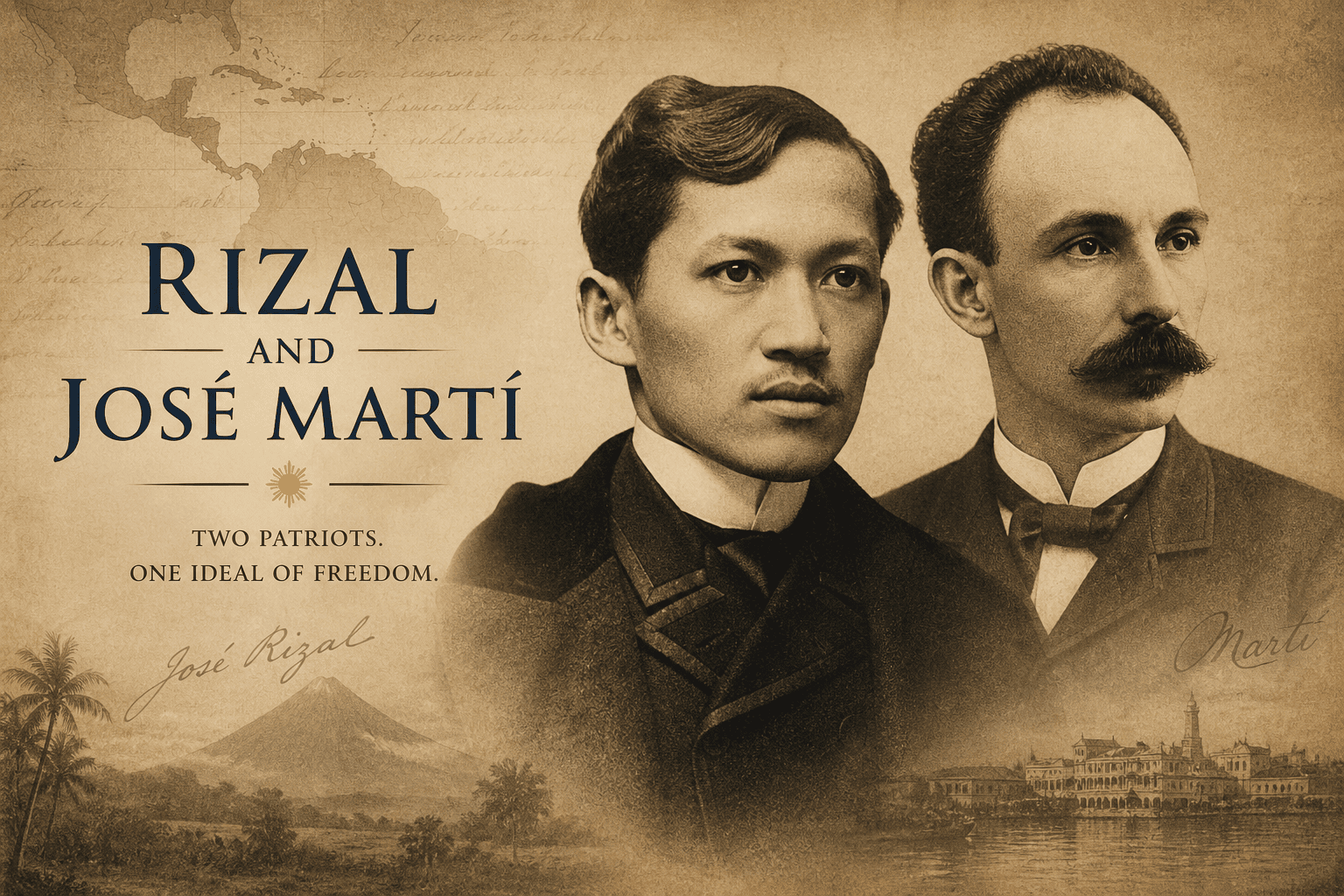
The Same Enemy, Thirteen Months Apart
José Martí died in military action at the Battle of Dos Ríos on May 19, 1895. He was 42 years old. He had spent most of his adult life in exile — deported, imprisoned, and driven from his homeland by the Spanish colonial government — and had returned to Cuba to fight in person rather than organize from the safety of New York.
José Rizal was executed by firing squad in Manila on December 30, 1896. He was 35. He had never taken up arms. He was shot anyway, on charges of sedition, because his novels had done more damage to colonial authority than any rifle.
Thirteen months apart. The same empire. The same logic: that a man who made his people feel seen and worthy and wronged was more dangerous than an army.
Poets First, Martyrs Second
Both men were, before anything else, writers.
Martí was, first and last, a writer — a poet of deceptive simplicity, an essayist of moral clarity, a journalist who made Cuban independence feel not just necessary but inevitable. His life’s work was to give his people a language for what was being done to them and a vision of what they might become.
Rizal was a novelist, poet, essayist, and propagandist whose two novels — Noli Me Tangere (1887) and El Filibusterismo (1891) — laid bare the rottenness of Spanish colonial rule in the Philippines with such precision and anger that they were banned immediately. They circulated anyway, hand to hand, read aloud in secret, passed across borders.
Both men understood what authoritarian regimes understand about literature: stories create consciousness, and consciousness creates resistance. You cannot shoot an idea. But you can shoot the man who put it into words.
Lives Built in Exile
Neither man could live in his own country. Both were shaped by years of displacement.
Martí was first exiled from Cuba in 1871. In 1895, he returned to Cuba to fight for its independence and died on the battlefield. In between, he lived in Spain, Mexico, Venezuela, and ultimately New York, where he spent fifteen years writing for Latin American newspapers, organizing the Cuban exile community, and building the political machinery that would eventually launch the final war of independence.
Rizal’s trajectory was similar. He spent years in Europe — Madrid, Paris, London, Heidelberg — studying medicine, annotating colonial-era texts, writing his novels, and corresponding with other Filipino intellectuals and reformers. He returned to the Philippines in 1892, was promptly exiled to the remote island of Dapitan, and was arrested in 1896 on his way to Cuba, of all places, where he had been approved to serve as a military doctor.
History is full of strange near-misses. Rizal was killed before reaching Cuba. Martí had been killed on Cuba before Rizal was executed. They would never share the same ground.
The Pen as the Primary Weapon
What set both men apart from other independence leaders was that they believed — deeply, strategically — in the power of writing to transform consciousness before transforming political reality.
Martí’s journalism, poetry, and essays did not merely stir feeling — they built the ideological architecture that made organized resistance possible. His writing gave the independence movement its vocabulary, its moral center, and its sense of historic necessity.
Rizal’s Noli Me Tangere did the same for the Philippines. The novel was not a call to arms. It was a mirror. It showed Filipino readers their own society — its beauty, its suffering, its corruption, its grief — in language that said: this is real, this matters, and you are not imagining it. Once people recognize their suffering in fiction, they start to ask why it exists, and who benefits from it continuing. Noli Me Tangere was published in 1887. The Philippine Revolution began in 1896. Rizal always insisted he did not want revolution. The revolution came anyway.
The Death That Became the Cause
In both cases, their deaths did more for independence than their lives had managed to achieve.
When Spanish troops shot Martí at Dos Ríos, his death was used as a rallying cry by Cuban revolutionaries and by those who had previously hesitated to join the revolt. A man who had spent decades trying to persuade, organize, and inspire became, in death, the thing that finally unified enough people to act.
Rizal’s execution on December 30, 1896 had the same galvanizing effect. He had asked for clemency. He had written a final poem — “Mi Último Adiós,” My Last Farewell — the night before he died, folded it into an alcohol stove, and handed it to his sister to find. He was not trying to be a martyr. But the Spanish colonial government made him one, and it was a catastrophic miscalculation. His death transformed ambivalent ilustrados into revolutionaries and handed the Katipunan — the revolutionary society already fighting in the mountains — a symbol of undeniable moral weight.
By 1898, the Spanish Empire had lost both Cuba and the Philippines.
What They Shared
The parallels are not superficial. They run to the bone.
Both were mestizo intellectuals who felt their colonized identities acutely and wrote from that feeling. Both were shaped by Europe — they studied there, published there, organized there — and came home carrying ideas that the empire had not anticipated would be turned against it. Both were offered mercy if they would recant or cooperate. Both refused. Both were killed by the same power, in the same decade, for the same reason: they had made enough people believe that things could be different.
On Martí, Nicaraguan poet Rubén Darío said he belonged to “an entire race, an entire continent.” Something similar might be said of Rizal — not just a Filipino hero, but a figure who belongs to every people who has ever been told that their story is not worth telling.
The Aftermath
Seven years and one day after Martí’s death, Cuba formally obtained its independence on May 20, 1902. The Philippines declared independence in 1898 — only to find itself transferred from Spanish to American colonial rule following the Spanish-American War, a cruel coda that Rizal, who had warned against both Spanish oppression and the dangers of rushing toward independence without preparation, might have written himself.
Today, Martí’s face is on Cuban currency. An international airport in Havana bears his name. The folk song “Guantanamera,” known the world over, draws its lyrics from his poetry collection Versos Sencillos.
Rizal’s face is on the Philippine peso. His execution site in Manila — Rizal Park, formerly Luneta — is the symbolic center of the nation. Every Filipino student studies him by law.
Two writers. Two islands. One empire that made the mistake of killing them.
Read next: My Last Farewell — Rizal’s Final Poem — the poem he wrote the night before his execution, and what it actually says.