
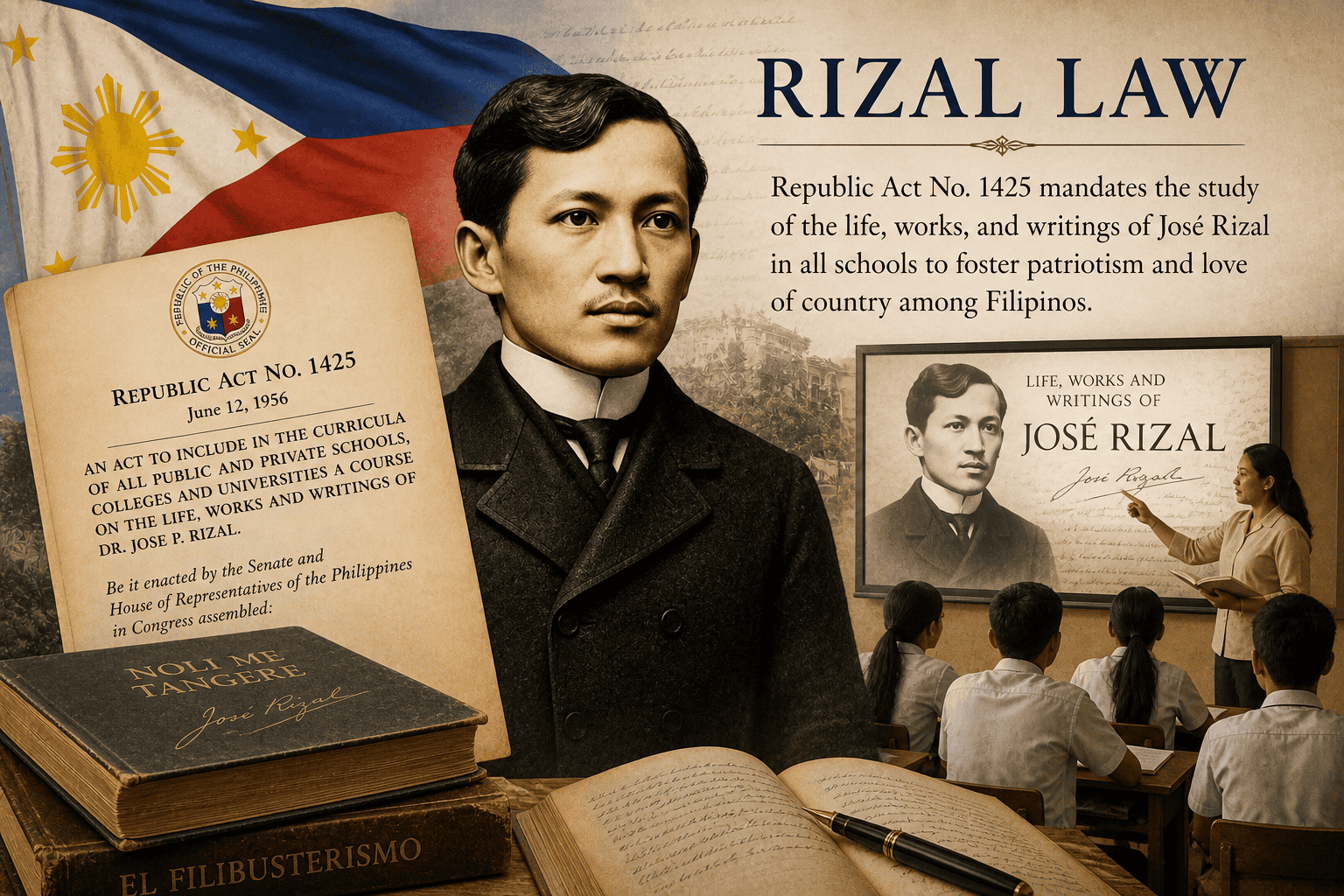
Republic Act No. 1425, known as the Rizal Law, is a 1956 Philippine statute that requires all educational institutions in the country — public and private, from high school through university — to include courses on the life, works, and writings of José Rizal, with particular emphasis on his two novels, Noli Me Tangere and El Filibusterismo. It was signed into law by President Ramon Magsaysay on June 12, 1956 — Flag Day, the anniversary of Philippine independence — and remains in force today.
RA 1425 is one of the most debated pieces of legislation in Philippine history. The fight over whether to pass it, and on what terms, lasted months, divided the Senate, drew in the Catholic Church, veterans of the 1896 revolution, Freemasons, civic organizations, and ordinary Filipinos who wrote to their representatives by the thousands. The compromise that finally allowed it to pass is itself a document of how democracy negotiates competing values — and the questions it raised about education, religious freedom, and the proper relationship between church and state have never fully gone away.
What RA 1425 Actually Requires
The full official title of the Rizal Law is: An Act to Include in the Curricula of All Public and Private Schools, Colleges and Universities Courses on the Life, Works and Writings of Jose Rizal, Particularly His Novels Noli Me Tangere and El Filibusterismo, Authorizing the Printing and Distribution Thereof, and for Other Purposes.
The law’s provisions are more specific than is often recognized. Every school in the Philippines must include a subject on Rizal’s life, works, and writings in its curriculum. At the college and university level, the unexpurgated versions of Noli Me Tangere and El Filibusterismo — or their translations into English, Tagalog, or other Philippine languages — are designated as the basic texts for the course. The law also directs the Board of National Education to promulgate implementing rules, including the preparation of primers and supplementary readers.
Beyond the curriculum mandate, RA 1425 requires all schools to maintain adequate library copies of the original or unexpurgated editions of both novels, along with Rizal’s other writings and biographies. It directs the state to ensure that Noli, Fili, and selected other works are translated into English, Tagalog, and the major regional languages of the Philippines, printed in inexpensive editions, and distributed free of charge through local councils and public reading rooms. When it was passed, the law authorized ₱300,000 in initial funding for printing and distribution — an unusually concrete fiscal commitment for a curricular statute.
One provision carries particular significance: students who, on religious grounds, object to reading the unexpurgated novels may be exempted from that specific requirement — but not from taking the Rizal course itself. According to historian Ambeth Ocampo, no student has ever formally availed of this exemption.
The Debate That Preceded RA 1425
Understanding the Rizal Law requires understanding the fight over the Rizal Bill, because the law emerged not from consensus but from a protracted and often bitter public confrontation that reveals a great deal about Philippine society in 1956.
The bill was first filed in the Senate on April 3, 1956 as Senate Bill 438, authored by Senator Claro M. Recto and sponsored by Senator José P. Laurel, then chairman of the Senate Committee on Education. Recto was the bill’s driving force — a nationalist politician who believed, with genuine conviction, that the study of Rizal’s novels was essential to cultivating the kind of historical consciousness and civic character that the Philippines needed in a postwar world still negotiating its relationship with American cultural and political influence. His argument was direct: if Filipinos did not understand what Rizal had written, they could not understand what had been done to their country or what it would take to build something better.
The opposition was immediate and organized. The Catholic Church in the Philippines, through a network of lay organizations including the Catholic Action of the Philippines, the Knights of Columbus, the Congregation of the Mission, and the Catholic Teachers Guild, mobilized against the bill on the grounds that Noli Me Tangere and El Filibusterismo contained anti-clerical passages that would endanger the faith of students forced to read them. The Archbishop of Manila, Rufino Santos, issued a pastoral letter protesting the compulsory reading requirement. Church sympathizers in the Senate — particularly Senators Francisco Rodrigo, Mariano Jesús Cuenco, and Decoroso Rosales — led the legislative opposition. Church leaders accused Recto of being a communist and anti-Catholic. Catholic schools were rumored to be threatening closure if the bill passed, though Recto publicly dismissed the threat.
The atmosphere was charged enough that when a Manila parish priest read the Archbishop’s circular denouncing the bill during Mass, Mayor Arsenio Lacson of Manila walked out of the church in protest. Outside the Senate, veterans of the 1896 revolution, the Freemasons, and organizations including the Alagad ni Rizal and the Knights of Rizal rallied in support. The public argument was, at its core, about the same tension that Rizal himself had spent his life navigating: the proper limits of the Church’s authority in a society where most citizens were Catholic.
Recto did not yield on his core position, but he was willing to negotiate its implementation. When Senator Laurel introduced a compromise amendment — allowing students at the elementary and secondary levels to use expurgated versions of the novels, and permitting college students to request exemption from the unexpurgated reading on religious grounds — the logjam broke. The bill was approved unanimously by the Senate on May 12, 1956. Recto, in his final statement before the vote, declared: “The people who would eliminate the books of Rizal from the schools would blot out from our minds the memory of the national hero. This is not a fight against Recto but a fight against Rizal.”
President Magsaysay signed RA 1425 on June 12, 1956.
How the Rizal Law Is Implemented Today
In basic education, the Department of Education has incorporated Rizal’s novels into the K–12 curriculum with Noli Me Tangere assigned in Grade 9 and El Filibusterismo in Grade 10 — a sequencing that follows the narrative arc of the two novels and places them at the point in a student’s education when engagement with their political and historical content is most likely to be substantive.
In higher education, the Commission on Higher Education and individual universities implement RA 1425 primarily through a three-unit course titled “Life and Works of Rizal,” which is a standard graduation requirement across virtually all degree programs in the Philippines regardless of field of study. A 1994 presidential memorandum reiterated the obligation of all institutions to comply fully with the law, and periodic CHED circulars have reinforced the requirement over the decades.
The practical implementation of the law varies considerably between institutions. Some universities approach the Rizal course as primarily historical and biographical. Others engage more deeply with the novels as literary and political texts — with the anti-clerical passages, the colonial sociology, the question of whether Simoun’s revolution was justified, and the debates that Rizal himself never fully resolved. The difference between a Rizal course taught as a compliance requirement and one taught as a genuine engagement with the novels is, in practice, very large.
Why the Rizal Law Was Passed — and Why It Matters
The preamble of RA 1425 states its purpose directly. It begins with a declaration that “today, more than any other period of our history, there is a need for a re-dedication to the ideals of freedom and nationalism for which our heroes lived and died.” It describes the life, works, and writings of Rizal — particularly Noli and Fili — as “a constant and inspiring source of patriotism with which the minds of the youth, especially during their formative and decisive years in school, should be suffused.” And it places this mandate within the state’s broader obligation to “develop moral character, personal discipline, civic conscience” in Filipino students.
The preamble was written in 1956, but the argument it makes is not narrowly historical. Rizal’s novels remain the most precise account ever written of how colonial power actually functioned in the Philippines — how it shaped people’s sense of themselves, how institutions justified abuse, how reformers were broken by systems that could not tolerate honesty. Reading them as literature is one thing. Reading them as political analysis, which is partly what they are, is another. The Rizal Law insists that Filipino students do both.
The 1956 debate over RA 1425 also matters in its own right — as a case study in exactly the kind of democratic argument that Rizal had spent his life arguing the Philippines needed to be capable of. The church-state confrontation over the bill, the negotiations that produced the exemption clause, the public mobilization on both sides, the floor speeches by Recto and his opponents: all of this was the Philippine democracy functioning as it was supposed to function, producing a law through genuine contestation rather than decree. That Rizal’s works — which had been banned by Spanish colonial authorities in 1887 — were now the subject of a democratic legislative fight was itself a vindication of something he had believed.
The Ongoing Argument
RA 1425 has been in continuous force for nearly seven decades, and the arguments it settled in 1956 have never fully gone away. Critics of the law have periodically argued that mandatory reading turns living literature into a compliance exercise — that students who are required to read Noli and Fili as a graduation requirement will inevitably approach them as boxes to check rather than books to engage with. This is a legitimate concern, and any honest assessment of the Rizal Law has to acknowledge that the quality of its implementation varies enormously.
Defenders of the law respond that some books are too important to leave to chance — that in a country where the school curriculum is the primary mechanism for reaching students across all economic levels and regional backgrounds, a legal mandate is the only reliable way to ensure that Rizal’s analysis of the Philippines reaches the people it was written for. Rizal himself wrote for a future audience he did not expect to see. RA 1425 is one attempt to make sure that audience exists.
The question of whether it succeeds depends less on the law itself than on the teachers who implement it, the institutions that support them, and the students who arrive in the classroom ready or not to take seriously what a thirty-five-year-old novelist wrote about their country in 1887 and 1891.
For more on the two novels at the center of RA 1425, see the complete summary of Noli Me Tangere and the complete summary of El Filibusterismo. For more on how Rizal came to be the national hero that the Rizal Law commemorates, see How Rizal Became the National Hero of the Philippines.