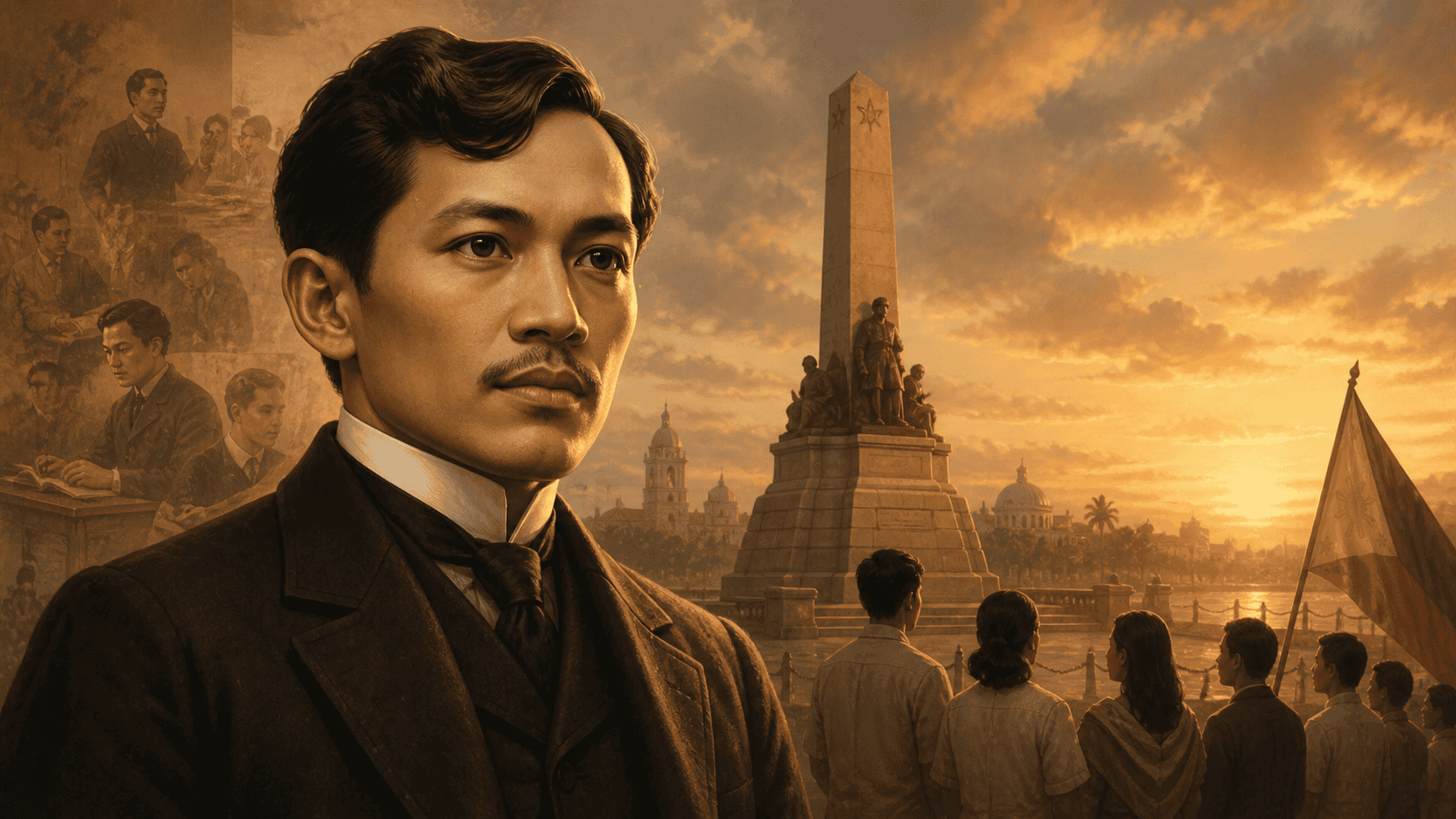
No law made José Rizal the national hero of the Philippines. No president signed a decree. No congress passed a bill. The Philippine government has never issued a formal document declaring him as such — a fact that surprises most Filipinos when they first hear it, and surprises international readers even more.
What actually happened is more interesting than a proclamation. Rizal became the national hero through a long, layered process involving revolutionary grief, colonial strategy, decades of public education, and finally, something that no government can manufacture: the genuine and sustained admiration of an entire people across more than a century. Understanding why Rizal holds this place requires understanding how he got there — and the two stories are inseparable.
What He Did
Before the politics of memory, there were the facts of a life.
Rizal was a physician trained in Madrid and Heidelberg who specialized in ophthalmology and operated on his own mother’s eyes. He was a novelist whose two books — Noli Me Tangere in 1887 and El Filibusterismo in 1891 — exposed the corruption, cruelty, and systemic abuse of Spanish colonial rule with a precision that the colonial government found more threatening than any army. He was a naturalist who discovered species in Dapitan that science had not yet recorded. He spoke more than twenty languages. He was a sculptor, a painter, a poet, and a linguist who understood that how a people name their own experience is itself a form of power.
He was also, from the perspective of the colonial government, a profoundly dangerous man — not because he organized armies but because he organized minds. His novels gave ordinary Filipinos a language for what they were living through. Readers recognized themselves in his characters and, for the first time, understood their suffering not as personal misfortune but as the product of a system that could be named, criticized, and ultimately changed.
He was executed by firing squad on December 30, 1896. He was thirty-five years old.
What His Death Did
The execution was meant to silence him. It had the opposite effect.
Filipinos who had admired Rizal now mourned him — and grief, when it is shared widely enough, becomes something else. The members of the Katipunan, the revolutionary society founded by Andres Bonifacio, recited passages from his writings. His final poem, Mi Último Adiós, written the night before his execution on paper smuggled out of his cell, circulated among revolutionaries as a kind of prayer. Bonifacio understood that Rizal’s death had done something that his life could not: it had made the injustice of colonial rule impossible to deny or ignore. If a peaceful reformer who never took up arms could be shot without justice, then the system could not be reformed. It had to be replaced.
The revolution that followed drew its moral authority from the memory of Rizal even when his own position on armed revolt had been ambivalent. His martyrdom gave the struggle a face and a story that united people across the divisions of region, language, and class.
How the Americans Shaped the Story
When the United States took control of the Philippines in 1898, they inherited a country still raw from revolution and full of people who had just fought for independence from one colonial power. They needed a way to stabilize the country without provoking another armed uprising.
Rizal was the answer they found — or rather, the answer they constructed.
American colonial administrators, led by Governor-General William Howard Taft, recognized that Rizal’s emphasis on peaceful reform, education, and civic virtue made him an ideal symbol for the kind of nationalism they could tolerate. He had advocated dialogue, not revolution. He had never raised a weapon. He had been killed by Spain, not by the Americans, which made celebrating him politically safe. He represented everything the colonial administration wanted Filipinos to aspire to: intelligence, discipline, gradualism, patience.
By contrast, leaders like Andres Bonifacio — who had founded the revolutionary Katipunan and led armed resistance — were less convenient. Elevating Bonifacio would have meant honoring a man who had taken up arms against colonial rule, which might have encouraged Filipinos to do the same against their new colonial rulers.
The Americans organized Rizal Monument committees, institutionalized December 30 as a public holiday, and embedded his life and works into the curriculum of schools they built across the archipelago. Generations of Filipino children learned who Rizal was through systems the Americans designed. This does not diminish Rizal’s genuine contributions — but it does explain why his particular form of heroism was amplified over others.
What Filipinos Did With That Narrative
Here is where the story becomes more nuanced than simple colonial imposition.
Filipino scholars, educators, and political leaders did not merely accept the American framing of Rizal — they expanded it, deepened it, and made it their own. Intellectuals like Claro M. Recto and Teodoro Kalaw wrote extensively about Rizal on their own terms. Filipino teachers in the 1920s and 1930s brought genuine reverence to his works in classrooms. Poets, novelists, and historians across the twentieth century returned to him again and again — not because a colonial government told them to, but because they found in his writing something true about their own experience.
The Rizal that Filipinos chose to honor was not quite the same as the Rizal the Americans promoted. The American version emphasized his peacefulness, his civility, his compatibility with colonial order. The Filipino version kept all of that but added something harder: the inconvenient fact of his execution, the fury of El Filibusterismo, the quiet radicalism of a man who believed his own people were capable of governing themselves at a time when the entire colonial world insisted otherwise.
Why He Holds the Place He Holds
The question of whether Rizal deserves to be the national hero — as opposed to Bonifacio, Aguinaldo, Mabini, or others — remains genuinely contested among Filipino historians and intellectuals. It is a serious debate, and the arguments on multiple sides are worth knowing.
What is not seriously contested is why the choice of Rizal has proven so durable across so many different periods of Philippine history, under Spanish rule, American administration, the Japanese occupation, the post-independence republic, and into the present.
His life offers something rare: a figure whose achievements were so varied and so demonstrably excellent that no single political faction can fully claim him. He was too intellectual for purely populist readings. Too reformist for purely revolutionary ones. Too human — with his doubts, his complicated relationships, his genuine ambivalence about violence — to become merely a symbol of purity. He resists simplification, which is precisely why he has survived it.
And perhaps most importantly: he was right. His belief that a people’s capacity for freedom depends on their capacity for self-knowledge — for honest reckoning with their own history, their own failures, their own potential — has not become less true with time.
No government proclaimed him the national hero. Filipinos, across more than a century of choosing and re-choosing, did.