Nick Joaquín’s translations of Rizal’s poems and plays remain, decades after they were first published, the versions most likely to be recited at civic ceremonies, anthologized in school readers, and heard in public life. That durability is not accidental. It is the result of a translator who understood that fidelity to a text is not just a matter of getting the words right — it is a matter of getting the music right.
Who Nick Joaquín Was
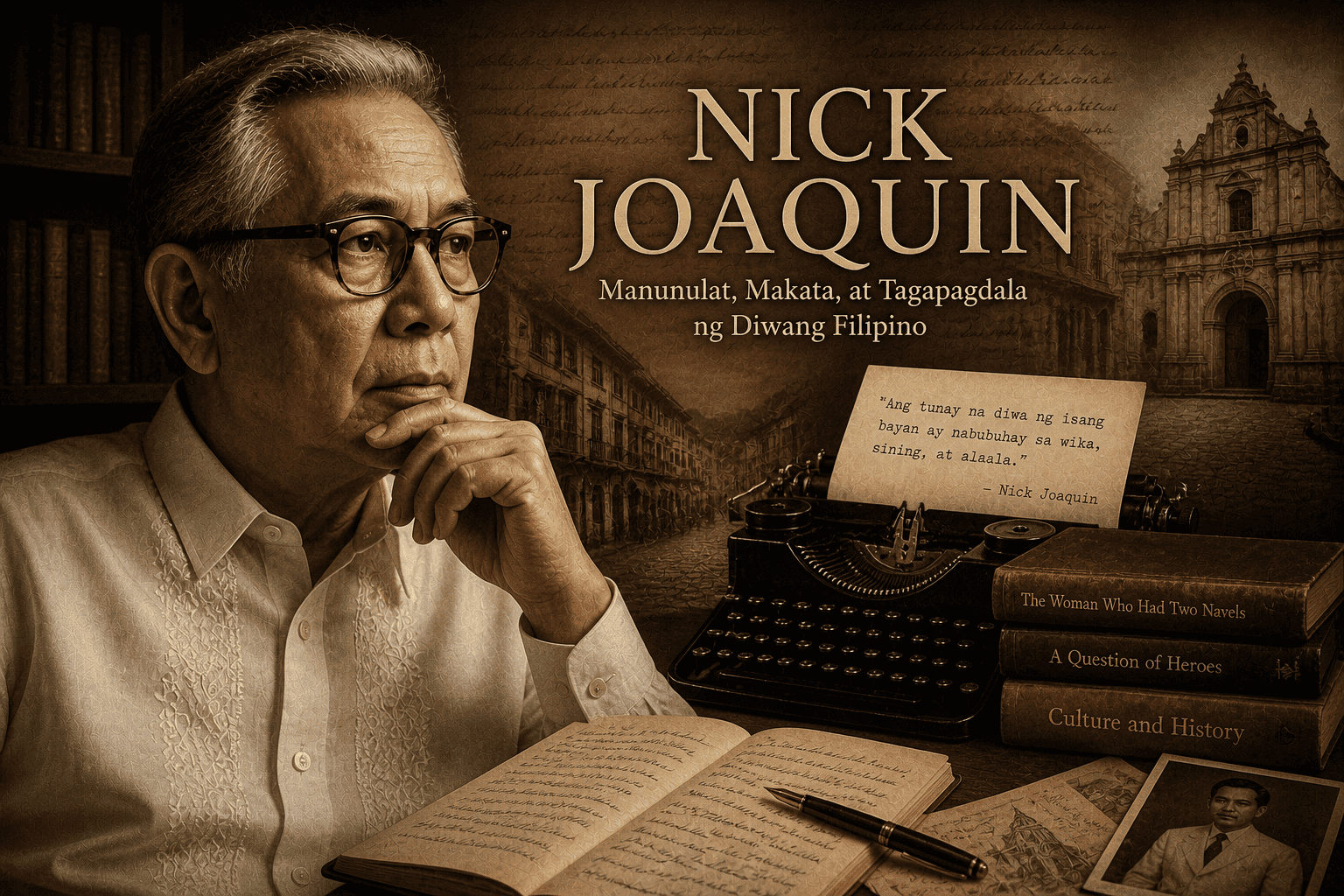
Joaquín was proclaimed National Artist for Literature in 1976, the same year his most sustained act of translation appeared in print. He was a journalist of unusual range who spent decades at the Philippine Free Press and wrote under the pen name Quijano de Manila. His fiction — most famously The Woman Who Had Two Navels — and his plays explored the layered, contradictory nature of Filipino identity with a stylistic ambition that few Philippine writers have matched before or since.
His English was dense, allusive, and deeply conscious of its own rhetorical weight. He was not the obvious choice for a translator who needed to disappear into a text. He was the right choice for a translator who needed to make a text live again in a language that is not its own.
The 1976 FEU Edition
The Complete Poems and Plays of Jose Rizal, published by Far Eastern University in 1976, was conceived as a bridge. Spanish literacy had declined substantially in the Philippines since the colonial period; the generation of Filipinos who might have read Rizal in the original was being replaced by one that read primarily in English. The FEU volume printed Spanish originals alongside Joaquín’s English translations, with his own foreword and annotations — a design that invited readers to compare, to question, to test his choices against Rizal’s words.
The book was far from a mechanical exercise. FEU characterized Joaquín’s approach as an artful blend of styles rather than a literal rendering — an attempt to make Rizal sound powerful in the language readers actually used, rather than to produce a technically accurate version that no one would want to read aloud. The bilingual format made the strategy visible: you could see where Joaquín had chosen music over precision, or idiom over literalism, and decide for yourself whether the trade was worth making.
The edition was relaunched by FEU in 2023, forty-seven years after its first publication. That a university press found it worth reissuing suggests something about how the translations have aged.
What He Translated
Joaquín concentrated on the poems and plays — the parts of Rizal most endangered by neglect once Spanish literacy faded.
Among the poems, his version of Mi Último Adiós is the one most readers encounter in civic life. Mi Último Adiós has been translated into English many times since Charles Derbyshire’s 1911 version, but Joaquín’s rendering has circulated persistently in print, in classrooms, and in public commemorations because it achieves something the more literal versions do not: it sounds like a poem worth hearing rather than a document worth preserving. The final stanza — his rendering of Rizal’s farewell to Josephine Bracken — has entered the language of Philippine public life in a way that few translations of any kind manage.
His translation of A la Juventud Filipina — the 1879 poem that won Rizal his first literary prize — is one of several widely read English versions of that poem, and his rendering of A las Flores del Heidelberg is regularly anthologized and performed.
For the plays, Joaquín translated both El Consejo de los Dioses — a learned classical allegory written by Rizal when he was nineteen, featuring Olympian speakers debating Western literary traditions — and Junto al Pasig, a Marian drama set on the banks of the Pasig River. The two works require entirely different registers: El Consejo demands classical rhetoric and wit; Junto al Pasig calls for something hymnic and processional. Joaquín supplied both.
What He Did Not Translate
It is worth being clear about this, because the assumption is easy to make: Joaquín did not translate Noli Me Tangere or El Filibusterismo. The major English versions of the novels are by Charles Derbyshire (1912), León Ma. Guerrero (1961), Ma. Soledad Lacson-Locsin (1996), and Harold Augenbraum for Penguin Classics (2006). Joaquín made a deliberate choice to work on the poems and plays rather than the novels — the smaller, more formally challenging works that were most at risk of disappearing into untranslatability.
Why the Translations Last
What distinguishes Joaquín as a translator is not lexical accuracy — though he was accurate — but what might be called hospitality. He welcomed Rizal’s Spanish into an English that felt native rather than imported, that could be spoken aloud at a ceremony without sounding like a translation.
This matters because translation is ultimately a social act as much as a literary one. A translation that only specialists read is not doing the full work of translation. Joaquín’s versions have circulated in classrooms and civic events and school readers for nearly half a century because they are accessible without being simplified, musical without being ornamental, and faithful to Rizal’s spirit even where they depart from his exact words.
The 2023 FEU reissue is available and in print. For anyone reading Rizal’s poems in English, Joaquín’s translations are the place to start.