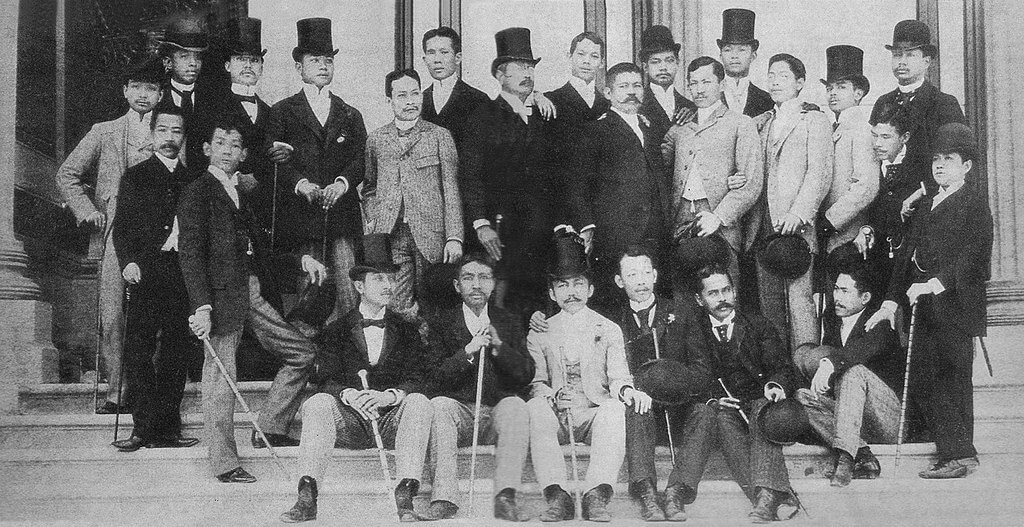
The Generation That Made It Possible
The Propaganda Movement did not emerge from nowhere. It was made possible by a specific historical confluence: the opening of the Suez Canal in 1869, which shortened the sea route between the Philippines and Europe and made study abroad significantly more accessible; the relative expansion of Philippine trade under partial liberalization in the mid-19th century, which generated enough surplus wealth among the ilustrado class to fund European educations; and the accumulated grievances of a population that had watched the colonial system grind through three centuries without fundamental reform.
By the late 1870s and early 1880s, Filipino students were arriving in Spain in meaningful numbers — in Madrid, in Barcelona, in smaller university towns. They arrived carrying the specific frustrations of people who had been educated just enough to understand clearly what was being done to them. They had read enough history and political philosophy to know that the colonial system’s justifications for itself were not arguments but assertions, and that assertions could be refuted.
In Madrid, they found something the Philippines denied them: the ability to speak freely, to organize openly, to publish without immediate suppression. They took full advantage of it.
What the Movement Actually Was
The name is slightly misleading. “Propaganda” in its 19th-century usage simply meant the dissemination of ideas — from the Latin propagare, to spread — without the modern connotation of manipulation or dishonesty. The Propaganda Movement was what it called itself: a campaign to spread accurate information about the Philippines, its history, its people, and the conditions under which they lived, with the aim of persuading Spain to grant reforms.
It was not a political party. It had no formal membership rolls, no dues, no elected leadership in any stable sense. It was a loose network of Filipino intellectuals connected by correspondence, by shared publications, by the social world of the expatriate Filipino community in Europe, and by a common conviction that the Philippines deserved better than what it had.
It was also, importantly, not a separatist movement. The ilustrados who drove it were not asking for independence. They were asking for equality within the empire — for the Philippines to be treated as a province of Spain with the rights that Spanish provinces nominally enjoyed, rather than as a colony administered for the benefit of the colonial power. They wanted representation in the Spanish Cortes, the parliament in Madrid. They wanted freedom of the press. They wanted the religious orders removed from civil administration. They wanted Filipinos to be subject to the same laws as Spaniards, rather than a separate colonial legal code that offered them fewer protections.
These were, by the standards of the era, moderate demands. The Spanish government’s refusal to meet even these moderate demands is the central political fact of the movement’s history.
La Solidaridad
The movement’s most durable institution was La Solidaridad, a fortnightly newspaper founded in Barcelona in February 1889. It became the primary public voice of the Filipino reform campaign — a publication where the ilustrados could write in Spanish, for a Spanish-reading audience, and make their case in the language and the forum of the colonizer.
The paper’s editors and contributors wrote with a combination of legal precision and moral urgency that reflected their formation: they had been educated in Spanish universities, they knew Spanish law, and they were prepared to hold Spain to its own stated principles. An article arguing for Filipino representation in the Cortes was not a radical demand — Spain had granted similar representation to Cuba and Puerto Rico at various points. Why not the Philippines?
The paper covered colonial abuses with documentation rather than rhetoric. It profiled specific cases of friar misconduct. It published correspondence, petitions, and legal arguments. It maintained the argument, consistently and publicly, that the problems of the Philippines were not the inherent defects of the Filipino people — as colonial mythology insisted — but the predictable consequences of a system designed to exploit rather than develop.
Marcelo H. del Pilar served as editor for much of the paper’s run, from 1889 until its final issue in 1895. He was a formidable polemicist — sharp, well-informed, and capable of a satirical precision that made colonial authorities uncomfortable. His Dasalan at Tocsohan — a parody of the rosary applied to friar abuses — had already made him notorious in the Philippines before he left for Spain. In Madrid he channeled the same energy into La Solidaridad, keeping the paper running through chronic funding shortages and the grinding difficulty of maintaining a campaign that Spain showed no sign of taking seriously.
The People
The central figures of the Propaganda Movement were a study in contrasts, unified by their common purpose and divided by temperament, strategy, and personality in ways that generated real friction.
Marcelo H. del Pilar — Plaridel, his pen name — was the movement’s primary organizer and propagandist. He managed La Solidaridad, coordinated the expatriate Filipino community in Madrid, and maintained the political correspondence that kept the campaign coherent. He was practical, sometimes ruthless about prioritizing the movement over everything else, and eventually died in Barcelona in 1896 in poverty, having spent everything he had on the cause.
Graciano López Jaena was the movement’s orator and its most flamboyant personality — a brilliant public speaker and satirist whose 1884 novella Fray Botod had already savaged friar abuses with dark humor. He had founded an earlier short-lived newspaper in Spain before La Solidaridad existed, and his energy and talent were central to the movement’s early momentum. He and del Pilar clashed repeatedly over resources and editorial direction, a conflict that weakened the movement’s cohesion in its later years. López Jaena also died in Barcelona in 1896, months after del Pilar, also in poverty.
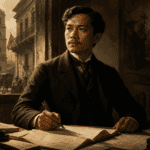
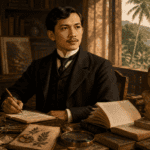
Rizal occupied a different position. He was the movement’s most famous member and its most intellectually formidable, but he was not primarily a movement organizer. He contributed essays to La Solidaridad and maintained the extensive correspondence network that connected Filipino reformists across Europe. But his primary contribution was the novels — Noli Me Tangere in 1887, El Filibusterismo in 1891 — which reached an audience that no newspaper could reach, operating through the informal distribution networks of a banned text rather than the formal channels of a legal publication.
Rizal was also, by the early 1890s, increasingly skeptical about the movement’s strategic direction. He believed — correctly, as events would show — that Spain was not going to reform the colonial administration in response to petitions and newspaper articles. His position was not that the goals were wrong but that the method was insufficient. This put him in an uncomfortable position: the movement needed his name and his moral authority, and he remained committed to its goals, but he had less faith in its strategy than its other leaders.
Other significant figures included Antonio Luna — later a general in the Philippine-American War — who contributed scientific and cultural writing to La Solidaridad; Mariano Ponce, who served as the paper’s business manager and was responsible for its distribution into the Philippines; and José Ma. Panganiban, a linguist and poet who died young, in 1890, before the movement had reached either its peak or its collapse.
The Campaign in Practice
The practical work of the Propaganda Movement was unglamorous. It involved writing — enormous amounts of writing, in Spanish, for Spanish readers who were mostly indifferent, with the hope of reaching the minority who might be persuaded or who occupied positions where persuasion could translate into policy. It involved petitioning the Spanish Cortes, whose members had little interest in Philippine affairs and less in disturbing the colonial arrangements that benefited Spanish commercial interests. It involved maintaining a newspaper on a budget that was never adequate, soliciting subscriptions and donations from Filipinos in the Philippines and in the diaspora, and managing the inevitable conflicts that arise when a group of strong-willed intellectuals are under financial pressure and running out of hope.
The paper was distributed into the Philippines through informal networks — smuggled in luggage, mailed in innocuous-looking packages, passed from hand to hand through the networks of the ilustrado class. Colonial authorities in Manila were aware of it and attempted to suppress it. They were only partially successful. Enough copies got through that the paper’s arguments circulated in the Philippines, shaping the intellectual formation of a generation that would later take more direct action.
Petitions were submitted to the Cortes. Meetings were held with Spanish politicians and journalists sympathetic to the Philippine cause. Pamphlets were written and distributed. The work was relentless and, for years, produced no visible result.
Why It Failed and What That Failure Meant
La Solidaridad ceased publication in November 1895, six years after its founding, due to a combination of financial exhaustion and the demoralization that comes from sustained effort against immovable opposition. Spain had not granted representation in the Cortes. The friars had not been secularized. The colonial legal code had not been reformed. The movement’s core demands had been heard and consistently ignored.
The failure was real. But its consequences were not what Spain intended.
The Propaganda Movement had created something that outlasted its immediate political disappointments: a political vocabulary, a body of documentation, and a generation of Filipinos who had learned, in the course of the campaign, to think of themselves as a people with rights rather than subjects with obligations. The arguments developed in La Solidaridad — about Filipino capacity for self-governance, about the colonial system’s internal contradictions, about the gap between Spain’s stated Christian values and its colonial practice — did not disappear when the paper stopped publishing. They became the intellectual foundation of the revolution that followed.
The Katipunan, founded in 1892 while La Solidaridad was still publishing, drew directly on this intellectual inheritance even as it rejected the Propaganda Movement’s strategic premises. Andres Bonifacio had read Rizal’s novels. The language of Filipino national identity that the ilustrados had developed in the pages of La Solidaridad gave the Katipunan’s members a framework for understanding what they were fighting for, even as they fought in ways the ilustrados had not envisioned.
The Propaganda Movement failed to reform the colonial system. It succeeded in creating the consciousness that made ending the colonial system possible. These are not the same achievement, but the second is not a small one.
The Price
The human cost of the movement is easy to overlook in retrospect, when the larger historical drama makes the individual suffering legible only as background. Del Pilar died in a Barcelona boarding house at 47, having spent years sending money home that he could not spare and working on a campaign that Spain refused to take seriously. López Jaena died at 38, also in Barcelona, also in poverty, three months later. Panganiban died at 29.
Rizal was shot by a firing squad at 35.
These were not men who lacked alternatives. They were educated, talented, and multilingual in an era when those qualities could purchase a comfortable professional life. They chose otherwise. The question of what that choice was worth — what the Propaganda Movement ultimately accomplished against what it cost the people who made it — is one the history of the Philippines is still working out.
Read next: Rizal and the Philippine Revolution — how the ideas of the Propaganda Movement gave way to armed resistance, and what Rizal’s role in that transition actually was.