The Architecture of Control
The Spanish colonial government in the Philippines operated through a layered chain of authority that extended from the governor-general in Manila down to the gobernadorcillo in each town. On paper it was an orderly administrative system. In practice it was a mechanism for extracting labor, land revenue, and taxes from a population that had very little recourse when the system worked against them — which it routinely did.
The governor-general, appointed by the Crown in Madrid, held executive, military, and judicial authority over the entire archipelago. He was the king’s representative, theoretically answerable to Spain, practically operating with enormous autonomy given the distance between Manila and Madrid and the slowness of 19th-century communication. A decision appealed to Madrid might take years to receive a response. In the meantime, the governor-general governed.
Below him, provincial administrators called alcaldes mayores combined the roles of judge, tax collector, and commercial regulator in a single office — a combination that made corruption not merely possible but structurally inevitable. An alcalde who also controlled local trade could set prices, award contracts, and adjudicate disputes in ways that served his own interests with minimal risk of accountability. Some were honest. Many were not.
At the local level, the gobernadorcillo — a Filipino, usually from the principalia or local elite class — served as the visible face of colonial administration in each town. He collected tribute, organized labor drafts, and mediated between the demands of the colonial state and the people beneath him. It was a position of some prestige and considerable danger: too much compliance with the Spanish made him a collaborator in the eyes of his community, too much independence made him a target of the Spanish.
The Friars: The Real Government
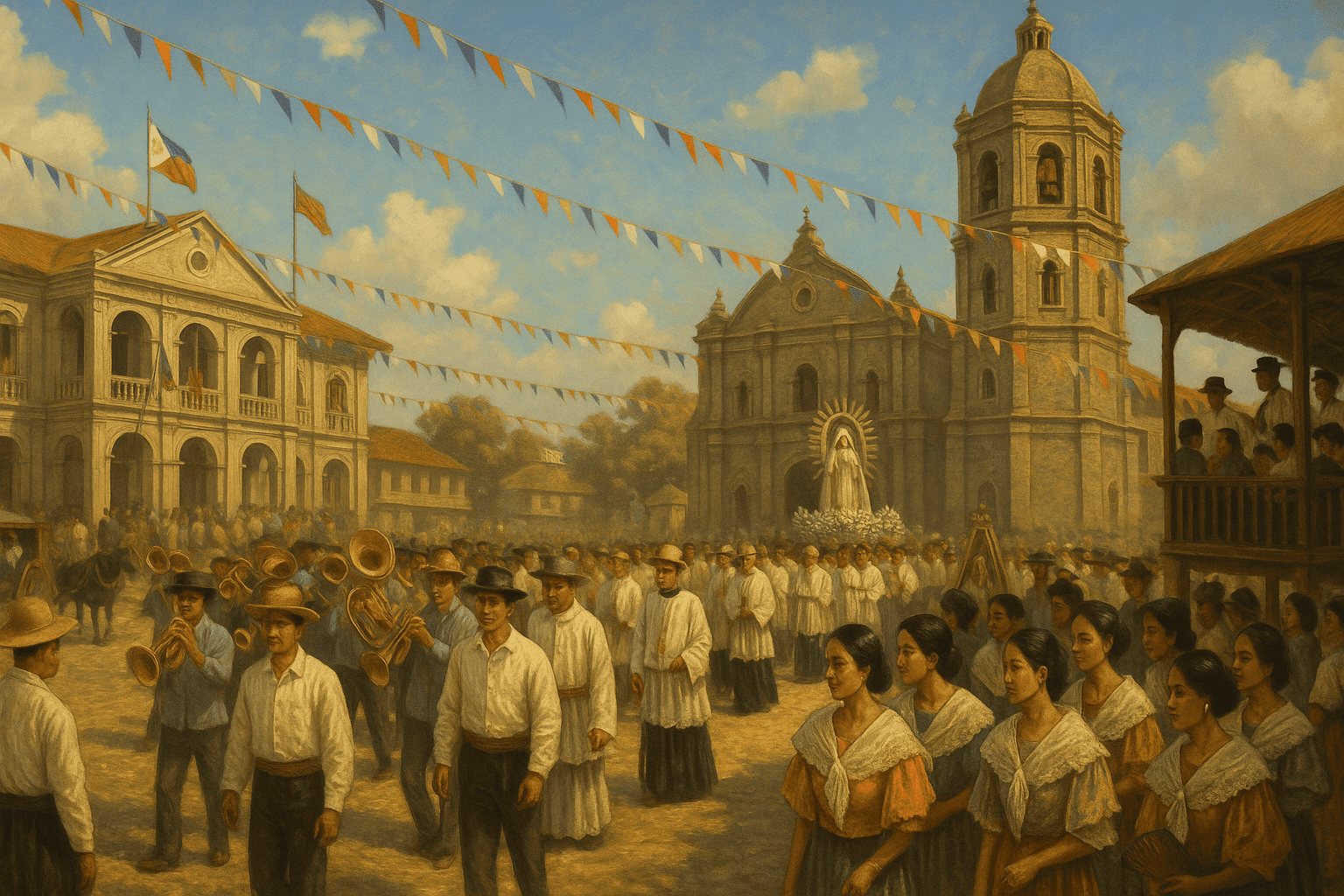
To understand Spanish colonial rule in the Philippines, you have to understand the friars — because in most of the country, in most people’s daily lives, the friar was the colonial government. Not the alcalde, not the gobernadorcillo, not the governor-general in Manila. The parish priest.
The Catholic religious orders — Augustinians, Dominicans, Franciscans, Recollects, and Jesuits — had been the primary agents of Spanish colonization since the 16th century. They had evangelized the archipelago, established its towns, built its churches, and in the process become so thoroughly embedded in the fabric of Filipino society that three centuries later their removal was nearly unthinkable to the colonial authorities who depended on them.
By Rizal’s time, the friars controlled the parish records — birth, marriage, death, all passed through the priest’s hands. They ran the elementary schools. They sat on the boards of educational institutions. They advised governors and governors-general on matters of policy. They reported on the loyalty or disloyalty of local populations. They owned land — enormous amounts of it, particularly in the provinces closest to Manila, where Dominican and Augustinian haciendas covered tens of thousands of hectares worked by Filipino tenant farmers who paid rent to religious orders that had no intention of reducing it.
The Mercado family of Calamba — Rizal’s family — farmed land owned by the Dominican order. When the Dominicans raised rents and eventually moved to evict the town’s farmers, including the Mercados, Rizal was in Europe. He followed the events from a distance and wrote about them with the cold fury of a man watching his family be crushed by an institution that claimed to represent God’s mercy. The eviction of Calamba’s farmers is the specific real-world event that most directly connects Noli Me Tangere‘s portrayal of friar land abuse to Rizal’s personal experience of it.
The friar’s power was not only economic and administrative. It was psychological. He presided over the rituals that marked the passage of Filipino life — baptism, confirmation, marriage, last rites. A family that fell out of favor with the parish priest could find their children refused baptism, their sick denied the last sacraments, their dead given a burial outside the church walls. These were not merely social humiliations. In a community organized around Catholic practice, they were existential threats.
Race, Class, and the Racial Hierarchy
Spanish colonial society was formally organized around a racial hierarchy that determined almost every aspect of what a person could own, what positions they could hold, and how the law would treat them if they came into conflict with someone above them on the ladder.
At the top were the peninsulares — Spaniards born in Spain, who occupied the highest civil, military, and ecclesiastical positions and enjoyed privileges unavailable to anyone born in the colony. Below them were the insulares — Spaniards born in the Philippines — who resented the peninsulares’ advantages and competed with them for administrative positions. Below the insulares were the mestizos — people of mixed Chinese-Filipino or Spanish-Filipino ancestry — who occupied a middle position in the hierarchy and had carved out significant economic space in trade, property, and the professions.
At the bottom of the formal hierarchy were the indios — native Filipinos — who constituted the vast majority of the population, bore the heaviest tax burden, performed the most labor, had the fewest legal protections, and were addressed in colonial official documents with a word that carried, however neutrally it was formally intended, the full weight of three centuries of condescension.
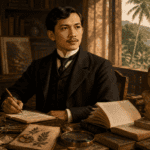
Rizal was a mestizo. His family’s mixed Chinese and Tagalog ancestry placed him in the middle tier of the racial hierarchy — educated, legally distinct from the indio class, able to access institutions closed to pure-blooded Filipinos. This position gave him both advantages and a particular vantage point. He could move through the colonial system with more freedom than most Filipinos, which meant he could see it more clearly, and what he saw enraged him.
The racial hierarchy was not merely social. It was encoded in law, in taxation rates, in access to education, in the right to bear certain surnames — the Decree of 1849 had required Filipino families to adopt Spanish surnames from an official catalog, erasing family names that had existed for generations and replacing them with identifiers that made the population easier for colonial administrators to track and tax. Rizal’s family’s surname, Mercado, came from this system.
The Economic System
The colonial economy was organized to extract. Its mechanisms were various but its purpose was singular: to transfer wealth from the Filipino population to the colonial state, the friar orders, and the commercial interests that operated under their protection.
The most basic instrument was the tribute — a head tax paid by every Filipino adult male, in cash or in kind, to the colonial government. Above the tribute sat a layer of additional fees: fees for the sacraments, fees for local festivals, fees for the documentation of land claims. Below the tribute sat the polo y servicio — the labor draft that required Filipino men to work on public construction projects for a specified number of days each year without pay. Wealthy Filipinos could pay for exemptions. Everyone else worked.
The tobacco monopoly, established in 1782 and not abolished until 1882, required farmers in designated provinces to grow tobacco exclusively for sale to the colonial government at government-set prices. They could not sell to anyone else. They could not grow anything else on the designated land. The monopoly generated significant revenue for the colonial treasury and significant misery for the farmers who operated under it.
Friar estates added another layer to the economic burden. Tenant farmers — kasama — worked friar land under agreements that could be renegotiated at the friar’s discretion. Rents rose. Evictions happened. Legal redress was available in theory and inaccessible in practice, because the courts were staffed by officials who understood which side their institutional interests lay on.
Education: What Was Allowed and What Was Not
Education under Spanish rule was available, but it was carefully bounded. Elementary schools in the towns taught reading, writing, arithmetic, and Catholic doctrine. Secondary education was available in Manila and in a handful of provincial centers. University education at institutions like the University of Santo Tomás was, by the standards of the era, reasonably serious — but it was ecclesiastically controlled and conservative in its curriculum, resistant to the scientific and liberal ideas circulating in European universities.
The colonial authorities understood clearly that certain kinds of knowledge were incompatible with colonial order. The systematic questioning of authority that European Enlightenment philosophy encouraged, the legal theory that grounded political legitimacy in popular consent rather than divine appointment, the historical scholarship that documented pre-colonial civilizations — all of this was potentially destabilizing, and it was correspondingly difficult to access within the colony.
Books were subject to censorship. The Inquisition had a long reach in the Philippines, and materials deemed subversive or heretical could be confiscated and their owners prosecuted. Personal correspondence was opened. Newspapers operated under the understanding that criticism of colonial administration or the religious orders could result in suppression.
It was this environment that pushed Rizal and the generation of ilustrados around him to seek education in Spain. They left not only for the quality of the European universities but for the access — to libraries, to ideas, to political traditions, to people who would argue with them as intellectual equals rather than managing them as colonial subjects.
What Daily Life Actually Looked Like
The colonial system was not experienced as an abstraction by the people who lived inside it. It was experienced as a series of specific, concrete encounters: the friar who controlled whether your child would be baptized, the alcalde whose commercial interests determined the price you received for your crop, the labor draft that pulled your husband away from the farm during planting season, the church fee that had to be paid before your mother could be buried in consecrated ground.
It was experienced as the knowledge that if you had a legal dispute with a friar or a Spanish official, you would lose — not because the law required it but because the law was administered by people who understood the hierarchy and acted accordingly. It was experienced as the specific humiliation of being addressed, in official documents and by colonial officials, in ways that made clear that your humanity was conditional on your usefulness to the system.
Rizal grew up observing this world from a position of relative privilege — his family was educated, economically stable, and mestizo rather than indio. He could see the system with more analytical distance than those most directly crushed by it. What he saw, he wrote down. Noli Me Tangere is the most comprehensive single account of what the colonial system felt like from the inside, written by someone who had both experienced it and thought carefully about what he was experiencing.
The novel was banned within weeks of its publication. The speed of the ban was itself a measure of how accurately Rizal had described what the colonial authorities needed to pretend was not happening.
The Contradictions That Made Revolution Inevitable
The Spanish colonial system in the Philippines carried within it a set of contradictions that made its eventual collapse, if not its precise timing, more or less inevitable.
It governed in the name of Christian civilization but administered with a brutality that its own moral framework condemned. It claimed to be elevating the Filipino people but structured every institution to prevent them from rising. It sent missionaries to teach literacy and then censored what the literate population was allowed to read. It built universities and then constrained what the universities were allowed to teach.
By the 1880s, a generation of Filipinos educated in Europe had returned with a clarity of analysis that the colonial system had no good answer to. They had read the Enlightenment philosophers. They had observed functioning representative governments. They had encountered the concept of human rights as a political principle rather than a theological aspiration. They had looked at the Philippines from the outside and seen, with new eyes, the gap between what their country was and what it might become.
Rizal was the most articulate of this generation, but he was not alone. The Propaganda Movement that coalesced around La Solidaridad in the late 1880s represented a collective demand for the colonial system to account for its own contradictions — to deliver the equality and dignity it claimed as the justification for its existence, or to admit that it had no such justification.
Spain could not do either. It could not reform the system without dismantling the interests — friar, commercial, administrative — that sustained it. And it could not honestly defend the system, because the defense required asserting things that the Filipino ilustrados could now demonstrate, in print, with documentation, were not true.
The revolution that followed was not inevitable in its particular form or timing. But the system that produced it had been generating the conditions for its own destruction for a very long time.
Read next: The Propaganda Movement — the campaign by Filipino ilustrados in Europe to reform colonial rule, and why it ultimately gave way to revolution.