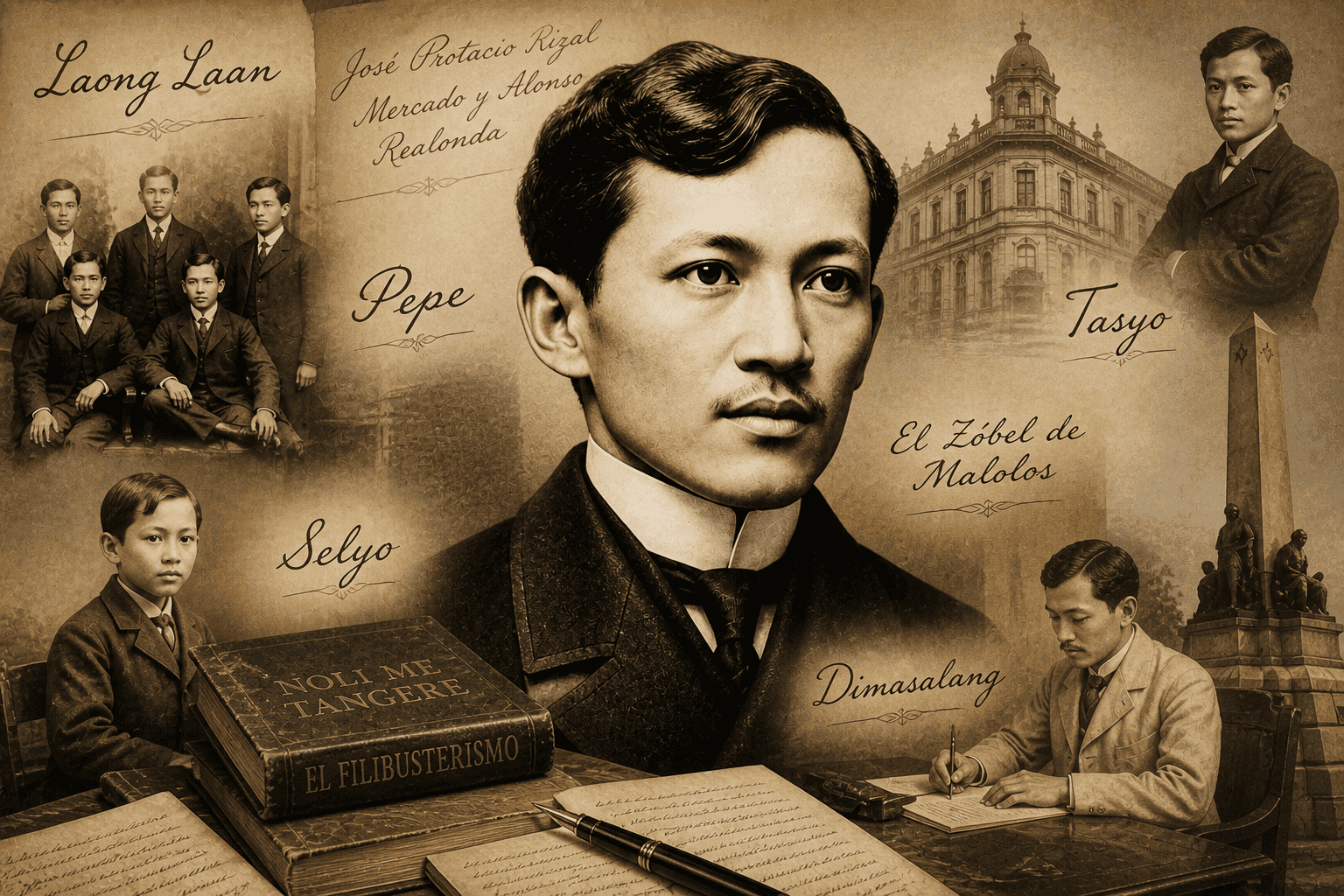
José Rizal’s full baptismal name — José Protasio Rizal Mercado y Alonso Realonda — was the kind of name that only appeared on official documents. In daily life, he was called something shorter and warmer, or something strategically different, depending on who was speaking and why.
The names and nicknames he accumulated across his life form a small biography of their own. Some came from family affection. Some were practical disguises. Some were conferred by strangers who saw in him something they needed a word for. Together they trace the arc of a man who was simultaneously a child called Pepe around the dinner table, a traveler using a false surname at a colonial port, and a figure that European reformists called the Brave Indian — all within the span of a single life.
This article covers his personal names and nicknames. For his published pen names — Laong Laan, Dimasalang, and others — see the pen names of José Rizal.
His Full Name and the Surname Question
Rizal was born on June 19, 1861, and baptized José Protasio Rizal Mercado y Alonso Realonda. The structure of the name follows the Spanish naming convention standard in colonial Philippines: a given name, a second given name, the father’s surname, and the mother’s surname connected by y.
The surname Mercado — from the Spanish word for market — had been the family’s primary name for generations. Rizal was a second surname that the family had adopted years earlier for legal registration purposes, following a colonial government decree requiring Filipino families to take surnames from an approved list. It was not originally the more prominent of the two names.
What changed that was politics. Paciano, Rizal’s older brother, had been closely associated with Father José Burgos — the reformist priest executed in the Cavite Mutiny of 1872. The name Mercado had become, through that association, one that attracted the attention of colonial authorities. When Rizal left for Europe in 1882, the family had already begun quietly shifting toward Rizal as the name they used in contexts where Mercado might invite scrutiny. By the time his novels made him famous, José Rizal was how the world knew him — and José Mercado was how he had traveled to get there.
Pepe
In the family home in Calamba, Rizal was called Pepe. It is the standard Spanish nickname for José — the same way that Paco is used for Francisco or Lupe for Guadalupe — and it was the name his mother, his sisters, and his brother used when they were not being formal.
The name appears throughout his personal correspondence. His letters home are signed with it in certain contexts, and his family’s letters to him address him with it. It belongs to the domestic register of his life — the dinners, the stories, the evenings on the azotea, the childhood in Laguna that he spent the rest of his life writing about from a distance. When Teodora Alonso wrote to her son in exile, she wrote to Pepe. The contrast between that name and the name that appeared in Spanish colonial surveillance reports is, in its small way, a measure of everything the colonial system took from ordinary Filipino families.
Ute and Ote
These are variants of the same informal nickname — shortened, further softened forms of address used by siblings and childhood friends in the Calamba household. Saturnina and Paciano used them. They appear rarely in the written record because they belong to the register of speech rather than correspondence — the kind of name that is spoken across a courtyard rather than written at the top of a letter.
Their significance is simply that they existed: that before Rizal was anything to the world, he was someone’s little brother with a home name, growing up in an ordinary household where people called him by sounds that carried no political weight at all.
Jose Mercado
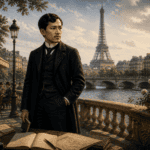
When Rizal boarded the ship Salvadora in May 1882 and began the journey to Europe that would define his adult life, he traveled as Jose Mercado. He was twenty years old, leaving without the knowledge of the Spanish authorities, who would not have permitted the departure of a known associate of reformist circles.
Mercado was not an invented name — it was genuinely his family name, and using it was not a deception in the way that a complete fabrication would have been. But the choice was strategic. The surname Rizal had not yet acquired the visibility that would come with the novels. Mercado was the family’s older name, less immediately identifiable to colonial authorities looking for the brother of Paciano, the former student of Father Burgos. It gave him just enough separation to get out.
He would use Jose Mercado again on later journeys. It was a practical tool, not a disguise in any elaborate sense — more like the instinct to keep your head down at the border than a carefully constructed false identity.
Doctor Uliman
After Rizal returned to Calamba in 1887 following his years of study in Europe, the townspeople needed a way to talk about him. He had come back with medical training from Heidelberg and Paris, an ophthalmological specialty that was genuinely rare in the Philippines at the time, and a set of European habits and mannerisms that set him apart from any physician they had encountered before.
They called him Doctor Uliman. It derives from Aleman — German, in Spanish — corrupted slightly in the Tagalog-inflected speech of Calamba. The name was a folk descriptor rather than a formal title: not “the German doctor” in any precise sense, since Rizal was Filipino, but a way of pointing to the European quality of his training and his methods that made him different from the local practitioners they were used to.
The name carried admiration and a certain wariness. He could do things with eyes that no one else in the province could do. He had been somewhere most of them would never go. The nickname was Calamba’s way of holding both those facts at once.
The Indio Bravo
This title was not given to Rizal in the Philippines. It came from Spanish liberals in Madrid who encountered him during his years there in the 1880s and found themselves confronted with the problem of what to call a Filipino who was clearly their intellectual equal and, in some respects, their superior.
Indio — Indian, in the colonial lexicon — was a term of diminishment. It marked the non-European colonized subject as categorically inferior, uneducated, uncivilized, not capable of the things that Europeans claimed for themselves. Bravo — brave, admirable — modified that diminishment into something closer to an acknowledgment. The Brave Indian. The Courageous One from the Colonies.
The phrase appeared in letters and speeches from Filipino reformists and their Spanish allies during the Propaganda Movement years. It was meant as praise, and Rizal accepted it as such. But it also carried the limitation embedded in every such honorific: the surprise that a person from the colonized world could be remarkable. The title defined him against an expected inadequacy that he had never accepted.
The Pride of the Malayan Race
This honorific came later and from a wider geography. As Rizal’s reputation spread beyond the Philippines — partly through the novels, partly through his scientific work and his correspondence with European scholars — he became, for some communities in Southeast Asia, a figure who represented the intellectual capacity of Malay peoples as a category.
The phrase “Pride of the Malayan Race” positioned him within a Pan-Asian framework that was emerging in the late nineteenth century alongside the various anti-colonial movements across the region. It is less a personal nickname than a symbolic attribution — a claim that his achievements belonged not just to the Philippines but to a broader community of peoples who had been told by their colonizers that achievement of that kind was not available to them.
Rizal himself was cautious about racial categories. His analysis of colonial society was grounded in specific political and institutional critiques rather than in racial solidarity as a framework. But the honorific stuck, and it remains part of how he is described in contexts that extend beyond the Philippine national narrative.
What the Names Reveal
The names people gave Rizal, and the names he gave himself for practical purposes, map the different forces that shaped his life. Pepe and Ute belong to the family that formed him. Jose Mercado belongs to the colonial apparatus that required him to be careful about who he appeared to be. Doctor Uliman belongs to the community that received him as something new and did not quite have a word for it. The Indio Bravo belongs to the European world that admired him while holding on to the categories that defined him as peripheral to it.
He moved through all of these names without settling into any one of them permanently. The name that lasted — José Rizal — was the one he had used in print, the one that the novels made famous, the one that the Spanish colonial government put in its surveillance reports and eventually on its list of the condemned. It was not the warmest of his names. But it was the one that did the most work.
For the pen names Rizal used in his published writing — Laong Laan, Dimasalang, P. Jacinto, and others — see the pen names of José Rizal. For the full story of his life, see the complete biography.