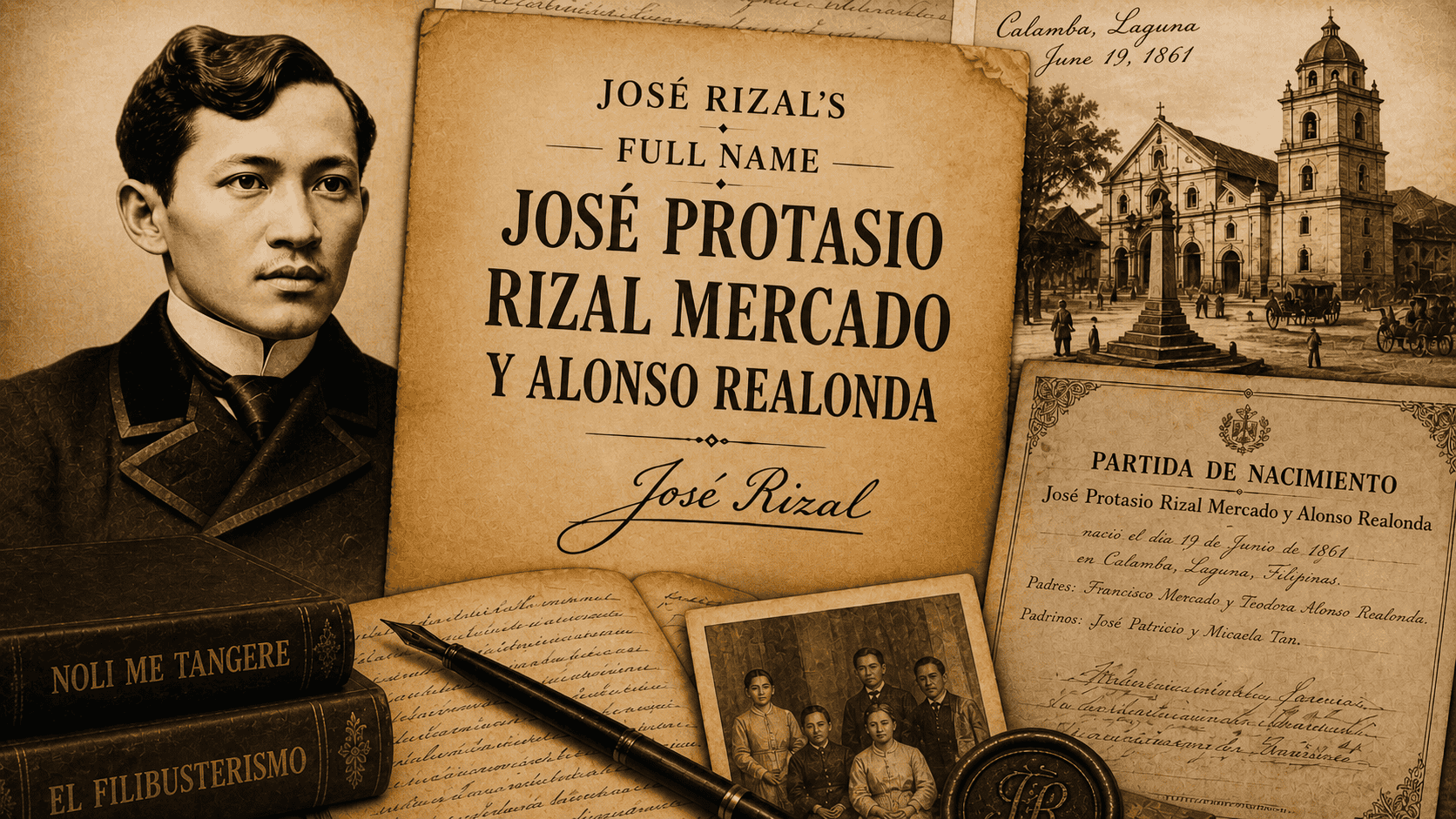
His full baptismal name was José Protasio Rizal Mercado y Alonso Realonda. It is a name that most Filipinos have seen written out at least once, usually in a textbook, and that most people promptly reduce to the two words everyone actually uses. This is understandable but unfortunate, because the full name is not just ceremonial length.
Each part of it carries a specific story — about his parents, about colonial naming law, about the political calculations that shaped which surname he chose to carry into public life.
The Given Names: José and Protasio
José was a Catholic given name, appropriate for a devout family in colonial Philippines. Naming a child after a saint was standard practice, and Saint Joseph — San José — was among the most common choices. The name appears throughout the Rizal family’s generations and was the name his mother and siblings used for him in its shortened, affectionate form: Pepe.
Protasio is the more unusual of the two given names. It derives from Saints Gervase and Protase, Roman martyrs whose feast day in the Catholic calendar falls on June 19 — the same day Rizal was born in 1861. The practice of naming children after the saint of the day was common in the Philippines under Spanish rule, where the Catholic liturgical calendar structured daily life in ways that extended to the naming of children. Protasio was not a name anyone called him. It belonged to the formal record of his existence, the baptismal register, the documents that established his identity in the colonial system.
The Paternal Surname: Mercado
Mercado — from the Spanish word for market — had been the Rizal family’s primary surname for generations. It was the name of his father, Francisco Mercado, and of his father’s father, and it carried with it a specific social position: the family belonged to the principalia, the Filipino landed gentry who occupied the intermediate tier of colonial society. They were not Spanish, but they were educated, propertied, and recognized. Mercado was a name that meant something in Laguna.
It was also, by 1882, a name that had become a liability. Rizal’s older brother Paciano had been closely associated with Father José Burgos — the reformist priest executed in the Cavite Mutiny of 1872 — and the colonial authorities had not forgotten the connection. The Mercado family had drawn scrutiny. When Rizal left the Philippines for Europe in 1882 to continue his studies, he traveled under the name Jose Mercado, which was genuinely his family surname, but he used it precisely because the name Rizal — still relatively obscure then — would attract less official attention at the port. The family had already begun quietly shifting which surname they led with in public contexts.
The Second Paternal Surname: Rizal
Rizal came from ricial — a Spanish word for a green field of grain, a field where the crop is ready or already being harvested. How it entered the family’s name is itself a product of colonial history.
In 1849, Governor-General Narciso Claveria issued a decree that standardized surnames across the Philippines. Before the decree, many Filipino families used indigenous names or informal identifiers that made record-keeping — and taxation, and surveillance — difficult for the colonial administration. Claveria produced a catalog of approved Spanish surnames and distributed sections of it to different provinces and municipalities. Families were required to choose a name from their assigned section and register it officially.
The Mercado family, already carrying their established surname, adopted Rizal as a secondary identifier. The exact motivation is not recorded, but the pattern was common: prominent families sometimes registered a second surname as a way of managing their visibility to colonial authorities, maintaining one name for official purposes and another for daily life. Rizal was unusual enough to be distinctive and Spanish enough to pass without difficulty.
What the family could not have anticipated was that this secondary surname — the one chosen partly to deflect attention — would become, through José’s novels and his execution, the most famous Filipino name in the world.
The Maternal Surname: Alonso
The y Alonso in his full name connects him to his mother’s line. Doña Teodora Alonso was Rizal’s mother — the woman he later credited as his first teacher, the person whose imprisonment by colonial authorities he described as one of the formative experiences of his childhood, and the model, many scholars believe, for the character of Doña Teodora in Noli Me Tangere.
The Alonso family were from Biñan, Laguna, and Manila. They were educated and respected, part of the same principalia stratum as the Mercados on the paternal side. Including the maternal surname in a child’s full name was standard practice under Spanish naming convention in the Philippines: the father’s surname came first, the mother’s surname followed after y (meaning “and”), and together they established the child’s dual lineage in a single name.
The Second Maternal Surname: Realonda
Realonda was adopted by Teodora’s family as a result of the same 1849 Claveria decree that had prompted the paternal side to register Rizal. The Alonso family chose Realonda — a name with no clear etymology in common Spanish usage, which suggests it may have been a phonetic adaptation, a family invention, or a selection from the less common portions of Claveria’s catalog.
Its presence in Rizal’s full name reflects the layered complexity of identity under colonial law: a name chosen by his maternal grandparents in response to a government decree, appended to a name they already had, which was then passed down to Teodora and through her to her children. Realonda appears at the end of José Rizal Mercado y Alonso Realonda as the most distant and most bureaucratic element of his identity — the furthest from anything personal, the most purely a product of colonial administration.
What the Full Name Tells Us
Reading José Protasio Rizal Mercado y Alonso Realonda as a complete document rather than a ceremonial formality reveals several things at once.
It tells us that he was born into a Catholic family attentive to the liturgical calendar, in a culture where the church structured not just worship but the naming of children. It tells us that his family were principalia on both sides — educated, landed, recognized within the colonial system but not of it. It tells us that his paternal family had navigated colonial surname law carefully enough to register a secondary identifier that would eventually become more famous than the primary one. And it tells us that his maternal family had done the same, choosing Realonda from a government catalog in 1849 and passing it down as part of their children’s official identities.
The name he chose to use publicly — José Rizal — stripped away the Mercado, the Alonso, and the Realonda, keeping only the given name and the secondary paternal surname that his novels would make internationally recognized. It was the lightest possible version of the full name, the one least burdened by the family’s colonial-era associations, and the one that carried the least risk for a young man leaving the Philippines on a ship in 1882 to study medicine in Europe.
He chose it for practical reasons. History made it permanent.
For more on the names and nicknames Rizal used throughout his life, see The Names and Nicknames of José Rizal and The Pen Names of José Rizal. For the full story of his family background, see Rizal’s Family Background: The Household That Made Him.