Noli Me Tangere is not primarily a novel of sentiment. It is a novel of diagnosis — precise, political, and deliberately unsentimental about the suffering it documents. Which makes the Song of María Clara, embedded near the middle of the book, stand out all the more sharply.
It is the one moment in the novel where Rizal allows pure lyric feeling to enter, and what the song expresses is not simply beautiful. It is quietly devastating.
The Poem
Sweet the hours in the native country,
where friendly shines the sun above!
Life is the breeze that sweeps the meadows;
tranquil is death; most tender, love.
Warm kisses on the lips are playing
as we awake to mother’s face:
the arms are seeking to embrace her,
the eyes are smiling as they gaze.
How sweet to die for the native country,
where friendly shines the sun above!
Death is the breeze for him who has
no country, no mother, and no love!
Where It Appears in the Novel
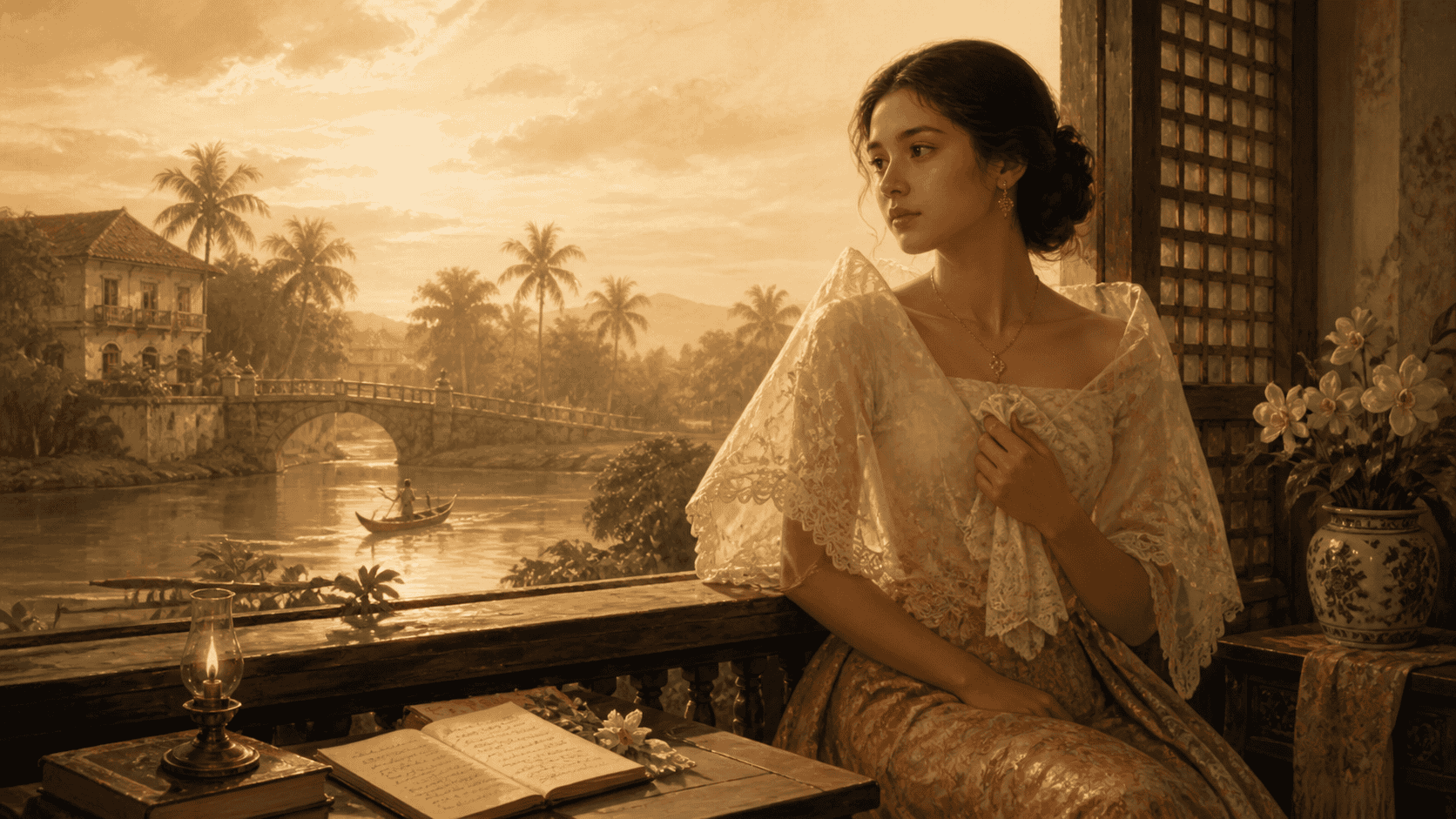
The song occurs in Chapter 12 of Noli Me Tangere, during a gathering on the lake. María Clara sings it to the company while they are on the water — a moment of apparent ease and beauty that sits in ironic contrast to the political violence and social corruption unfolding around the novel’s characters.
Rizal sets the scene carefully. The lake, the light, the voices on the water — it is one of the few passages in Noli that reads as genuinely peaceful. And then María Clara sings, and what she sings is a poem about dying for your country.
The juxtaposition is not accidental. Rizal was too precise a writer for accidents.
María Clara and What She Represents
María Clara is the novel’s female lead — the daughter of Padre Dámaso and the woman Crisóstomo Ibarra loves. She is beautiful, sheltered, devoted, and constrained at every turn by the social expectations of colonial Filipino society. She cannot act on her own desires. She cannot protect the people she loves. She cannot even fully know her own story, because the adults around her have withheld the truth of her parentage from her.
She is, in this reading, a portrait of what colonial society does to women who are born into it with too little power and too much goodness. She is also widely understood to have been modeled, at least in part, on Leonor Rivera — the woman Rizal loved for over a decade and lost, in the end, to the same colonial circumstances his novels were written to expose.
That Rizal gave this character a song to sing — and that the song is about love of country and the sweetness of dying for it — is not simply a decorative choice. María Clara cannot fight. She cannot speak publicly. She cannot change her situation. But she can sing, and what she sings, in front of everyone, is a poem about sacrifice and belonging. It is the one form of political expression available to her, and Rizal makes sure she uses it.
What the Poem Is Saying
The song moves through three stanzas that build on each other in a way that is easy to miss on a first reading.
The first stanza establishes the native land as the source of everything good: sunlight, life, tranquility, love. These are not grand political abstractions — they are sensory and intimate. The sun is friendly. The meadow has a breeze. Death, in this place, is tranquil rather than terrible. The homeland is where things are as they should be.
The second stanza narrows the focus to something even more intimate: the moment of waking to a mother’s face, the instinctive reaching of the arms, the eyes already smiling before the mind has fully arrived. It is the earliest memory of safety and belonging, and it anchors the poem’s abstraction — the “native country” — in something physical and irreducible.
The third stanza turns. It begins with an echo of the first — “How sweet to die for the native country” — but arrives somewhere different. Death is no longer tranquil for everyone. For the person who has no country, no mother, and no love, death is simply a breeze — indifferent, weightless, meaningless. It is not a comfort but an absence of everything that makes life worth preserving.
The poem is, in the end, an argument for belonging. Not a political argument — not a call to arms or a manifesto — but an emotional one: that the person stripped of country, family, and love has nothing left to lose, and therefore nothing left to live for either. Read in 1887 Manila, with the colonial government suppressing any expression of Filipino national feeling, the argument had an edge that the lyric surface deliberately softened.
The Poem and the Novel’s Larger Themes
The Song of María Clara is not the only poem embedded in Noli Me Tangere, but it is the most significant one. It does work that the novel’s prose cannot do directly — it expresses love of country in a form that is simultaneously too beautiful and too innocent to suppress, and it puts that expression in the mouth of a character who has been denied almost every other form of agency.
This is characteristic of how Rizal used literature. The novels were, among other things, arguments — about colonial abuse, about the hypocrisy of the friars, about the psychological damage done to a people taught to despise themselves. But some arguments land differently when they arrive as music. The Song of María Clara is Rizal understanding that, and using it.
For more on the novel this poem comes from, see the full summary of Noli Me Tangere and the analysis of its themes and characters. For Rizal’s most celebrated poem, see Mi Último Adiós.