José Rizal was ten years old. What he watched happen to his mother in that year did not leave him. It showed up in his novels, his essays, his letters, and in the particular fury that runs beneath even his most measured arguments about colonial rule.
It was his first lesson in how the system worked — and the lesson was personal enough to last a lifetime.
The Accusation
The dispute that produced the arrest was, at its origin, domestic and small. Teodora’s half-brother José Alberto had a troubled marriage, and when he sought her help in navigating a reconciliation, his wife turned on the intermediary instead of the husband. She accused Teodora of trying to poison her — a charge with no evidence, no witnesses, and no plausible motive.
What the charge did have was the right shape for colonial exploitation. The Mercado-Alonso family was educated, prosperous by local standards, and independent-minded — exactly the kind of family that friar-dominated colonial authority found threatening. The local officials moved quickly. They arrested Teodora not quietly but publicly, and they made her walk the distance to Santa Cruz rather than ride, in a deliberate act of humiliation designed to break her and send a message to everyone who knew her.
She walked the forty kilometers without breaking.
What a Ten-Year-Old Understood
Rizal wrote about this years later, and what strikes the reader of those accounts is how precisely he understood what had happened — not just to his mother but through her. He had watched a woman of intelligence and dignity, who had taught him to read before he entered any school, who had shaped his understanding of learning and virtue, be subjected to an arrest calculated to strip her of those things publicly.
He understood that the arrest was not really about the poisoning charge. It was about making the family smaller, more afraid, less likely to use its education and standing to resist. He understood that the colonial justice system was not interested in truth — it was interested in maintaining the conditions under which colonial authority continued to function without challenge.
This understanding did not come to him abstractly. It came to him through the specific image of his mother walking a road she should not have been on, for a crime she did not commit.
Two and a Half Years
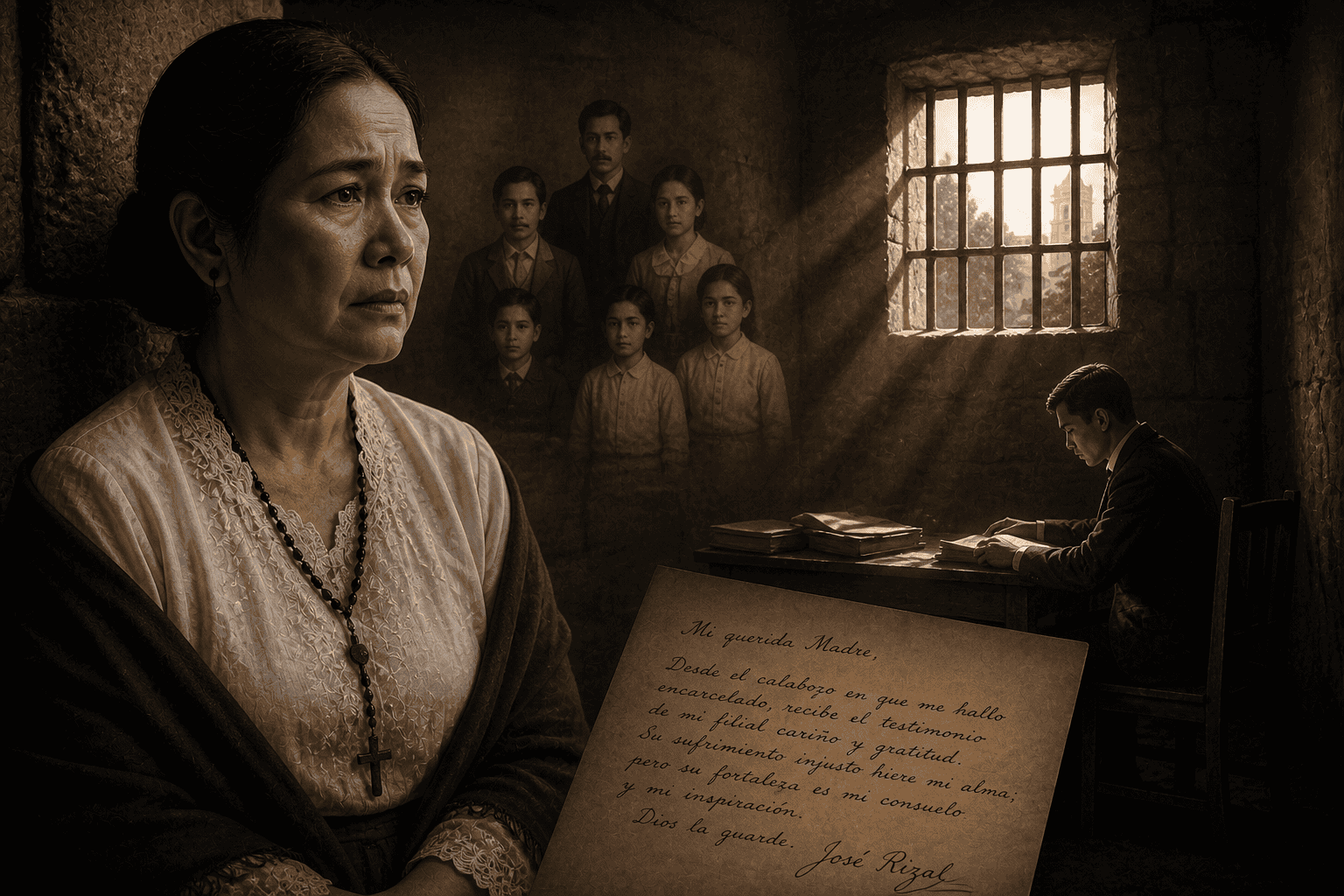
The imprisonment lasted approximately two and a half years. During that time, Francisco Mercado exhausted himself in legal petitions, traveling long distances to appeal to authorities who had little incentive to acknowledge the injustice they were perpetuating. The family spent money they could not easily replace. The children grew up in a household missing its center.
Teodora herself endured the prison with the same composure she had shown on the road to Santa Cruz. She did not collapse. She continued, in whatever ways were available to her, to be herself — a woman whose sense of who she was did not depend on the colonial government’s recognition of her innocence.
Her release, when it finally came, was the result of the legal charges simply failing to hold — not of the colonial system acknowledging what it had done. The system was not capable of that. It moved on to the next case.
What He Did With It
The imprisonment of Teodora Alonso appears, transformed, in nearly everything Rizal later wrote. The most direct echo is Sisa in Noli Me Tangere — a mother who loses her sons to the same indifferent colonial machinery, who searches for them through a system that has no mechanism for acknowledging her loss, who is driven to the edge of sanity not by any personal failing but by the simple application of colonial power to an ordinary family. Sisa does not go mad because she is weak. She goes mad because the world she lives in has no place for her grief.
That is precisely what the colonial system tried to do to Teodora — to make her grief illegible, her innocence irrelevant, her dignity a thing that could be stripped by a walk of forty kilometers under armed guard. It did not succeed with her. But Rizal never forgot what it had tried.
The novels are, among many other things, a long reckoning with what it means to live inside a system that treats people the way colonial authority treated his mother. He wrote about cruelty not as a researcher observing a phenomenon from a distance but as someone who had watched it happen in his own house, to a woman he loved, when he was ten years old.
What Teodora Left Behind
She outlived the imprisonment and, eventually, outlived most of what the colonial system had intended. She continued teaching her children. She watched Rizal become the most consequential writer in Philippine history. She was present at his execution in 1896 — she came despite having difficulty walking, because she was his mother and she was not going to let him die without her there. He held her hands and told her he was ready.
She had taught him that. Not the readiness for death specifically, but the readiness to stand in something without breaking — to walk a road that should not have to be walked and arrive at the other end still yourself.
The chains were his mother’s. The lesson was his.