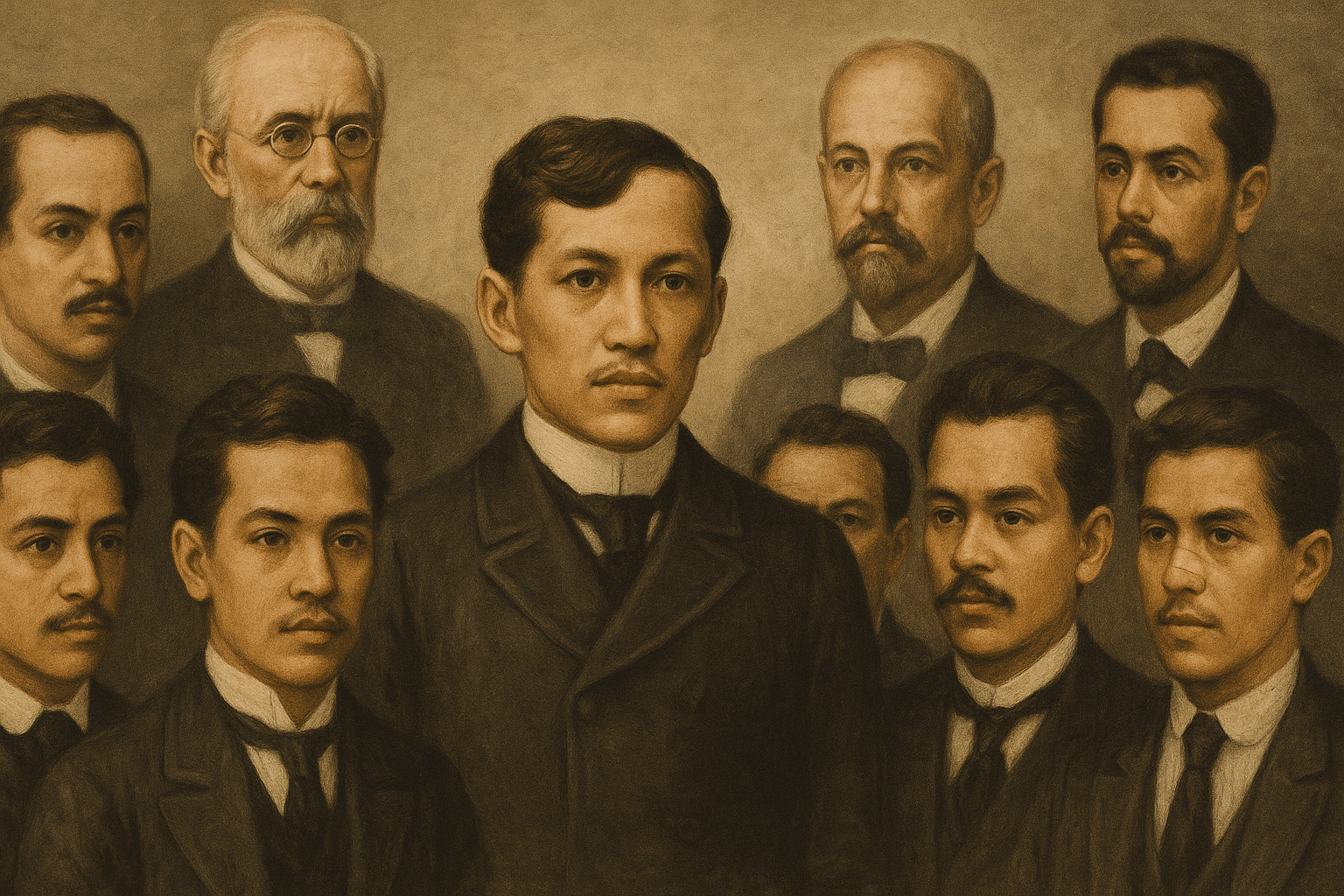
José Rizal did not become the conscience of a nation alone. Behind every novel, every letter, and every act of principled defiance stood a circle of friends, rivals, and allies — companions in exile, intellectual sparring partners, and quiet believers who shaped the man before history did.
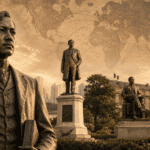
The statues lie. They show us a man in stillness — coat pressed, gaze fixed on some middle distance of national destiny. What they cannot show is the noise around him: the arguments in cramped Madrid apartments, the letters crossing the Atlantic for weeks only to arrive dog-eared and urgent, the laughter over wine in Paris, the silences of Dapitan evenings. Rizal’s friends and allies were not background figures. They were the pressure that formed him.
To read his biography as the story of one extraordinary man is to miss the story entirely. What Rizal became, he became in relationship — and understanding those relationships is the only way to understand why a doctor from Calamba became the conscience of a nation.
The First Teachers
The earliest people to matter in Rizal’s life were not philosophers or revolutionaries but teachers and schoolmates. At Ateneo Municipal in Manila, a Jesuit named Francisco Paula Sanchez recognized something in the quiet, disciplined boy from Laguna and chose to cultivate it with care. Sanchez encouraged Rizal’s poetry, sharpened his Latin, and modeled an intellectual seriousness that Rizal would carry for the rest of his life.
These early years also gave Rizal something subtler: an understanding of how communities of learning work, how ideas pass between people who respect each other, and how the simplest act of being taken seriously by a teacher can alter the entire trajectory of a life. When Rizal later mentored students in Dapitan, he was repaying a debt.
A Brotherhood in Exile
When Rizal sailed for Europe in 1882, he entered a world of Filipino expatriates bound together less by affection than by purpose. They were far from home, monitored by colonial authorities, short of money, and sustained almost entirely by the conviction that the Philippines deserved better than what Spain had given it. From this pressure, the friendships and alliances that would define the Propaganda Movement were forged.
Marcelo H. del Pilar wrote like a man on fire — polemical, urgent, built for confrontation. Rizal wrote like a surgeon. Their approaches clashed constantly, yet each recognized in the other something the movement needed. When the leadership of La Solidaridad fell into dispute between them, both eventually stepped back. The cause mattered more than the credit.
Graciano López Jaena founded La Solidaridad and brought to it the rarest of gifts: the ability to make serious ideas entertaining. His charisma drew readers; his humor disarmed opponents. Rizal admired him deeply, though he sometimes worried that Jaena’s appetite for life exceeded his appetite for discipline — a loving concern rather than a judgment.
Antonio Luna was younger, more volatile, and ferociously intelligent — the kind of person who makes every conversation feel like a contest. With Rizal, that contest was productive. They debated science, nationalism, and the shape of European thought, two quick minds pushing each other toward sharper conclusions.
When Juan Luna won the gold medal at the Madrid Exposition and Félix Hidalgo a silver, Rizal delivered a toast that transformed the moment into a political statement: Filipino artists, he argued, had proven that colonial inferiority was a lie. Their studios became salons — places where paint and politics were equally at home.
Their disagreements were a feature, not a flaw — the kind of productive friction that separates a real movement from a comfortable consensus.
The Europeans Who Took Him Seriously
Rizal’s most important allies were not always Filipino. In Spain, the liberal academic Miguel Morayta championed Filipino students and lent institutional weight to their cause. In Germany, Rudolf Virchow — one of the era’s most distinguished scientists — welcomed Rizal as a colleague and supported his anthropological research. That an eminent European would treat a Filipino as an intellectual peer was, in the context of 1880s colonialism, a radical act.
His ophthalmology mentors, Dr. Otto Becker in Heidelberg and Dr. Louis de Wecker in Paris, trained him with rigor and respect. Rizal absorbed their technique — and their model of what serious, disciplined expertise looks like. When he later operated on his own mother’s eyes in Calamba, restoring her sight, it was their teaching made personal and urgent.
Ferdinand Blumentritt, the Austrian ethnologist who became perhaps Rizal’s closest ally outside the Filipino circle, deserves particular attention. The two never met in person during Rizal’s active years, yet their letters — hundreds of them, spanning continents and decades — constitute one of the great intellectual friendships of the nineteenth century. Blumentritt defended Rizal publicly in European academic circles, translated his ideas for German readers, and wept when news of the execution arrived. He was the rare friend who loved the man and the ideas with equal sincerity.
The Uses of Rivalry
Rizal was not an easy man to like when principle was at stake. Within the expatriate community, he named behaviors he found corrosive to the cause — the factionalism, the gambling, the tendency to treat reform as theater rather than obligation. Some took this personally. Some were right to. The criticism was pointed because it was accurate.
His rivalry with del Pilar over the direction of La Solidaridad has sometimes been portrayed as a personality clash, but it was more interesting than that. It was a genuine strategic disagreement: del Pilar believed the path forward ran through political agitation and direct pressure on the colonial government; Rizal believed it ran through education, moral example, and the slow cultivation of national consciousness. Neither was wrong. The Philippine revolution would eventually need both. Their inability to fully resolve the tension was not a failure — it was an honest reckoning with a genuinely hard problem.
Friendship at the End of the World
Exile strips away the casual acquaintances. In Dapitan, on the northwestern tip of Mindanao, Rizal had no expatriate circle, no European salons, no movement to lead. What he had were neighbors, students, patients, and a commanding officer named Captain Ricardo Carnicero who turned out to be — against all expectation — a decent and fair-minded man. Their friendship, built across the distance of captor and captive, says something important about Rizal’s capacity to meet people exactly where they were.
His students in Dapitan knew him not as the celebrated novelist but as a teacher who built a school with his own hands, drained the swamp that bred malaria in the town, and treated the sick for free. These relationships were quieter than the friendships of the Propaganda years, but they were no less genuine for it. Perhaps more so.
Josephine Bracken arrived in Dapitan in 1895, accompanying her ailing stepfather in search of treatment. She stayed. Their relationship — intimate, complicated, sustained through the hardest years of his life — offered Rizal something that politics and reform could not: a private self, a life that was simply his own.
The Revolutionaries He Never Led
Rizal kept his distance from the Katipunan. He believed that revolution, launched before the Filipino people were ready for self-governance, would fail — and that failure would cost more than patience. When Andres Bonifacio founded his secret society and gave it revolutionary purpose, he did so in explicit debt to Rizal’s novels. The man who wrote Noli Me Tangere had not intended to spark an uprising. He had intended to make one possible, someday, by first creating the consciousness that an uprising requires.
Bonifacio understood this, even if Rizal didn’t intend it. He idolized a man he had never met, through words alone — which says something remarkable about both of them. The generation of leaders who carried the revolution forward drew sustenance from the idea of Rizal as much as from any particular instruction he gave. His name became, after his death, what it could never quite be during his life — a point of unity above faction, region, and personal ambition.
No one shapes a nation alone. Behind every line Rizal wrote stood a friend who argued with him, a mentor who trained him, a rival who forced him to think harder, and a community that gave him something worth fighting for.
Among all of Rizal’s friends and allies, what stands out is not any single relationship but the pattern they form together — a portrait of a man who was never finished becoming himself, always sharpened by the people around him. The circle made the man. The man, in turn, helped make the nation.