The Crossing
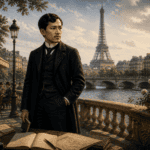
He traveled under the name José Mercado — his family’s original surname, dropped in favor of Rizal to protect his brother Paciano, who had been associated with the martyred priest Father Burgos and whose connection to the Rizal name had already attracted unwanted colonial attention. His parents did not know he was going until the ship had sailed. The secrecy was his brother’s idea, and it was prudent.
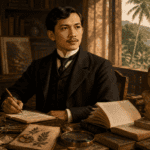
He sailed from Manila on May 3, 1882, aboard the Salvadora, stopping at Singapore, Colombo, Aden, and Suez before entering the Mediterranean. He kept a diary throughout — observing the other passengers, the ports, the food, the behavior of the Spanish officers aboard with the precise, faintly ironical attention that would later define his prose style. He arrived in Barcelona in late June, thin from the journey and immediately alert to everything around him.
Barcelona: The First Months
Barcelona in 1882 was in the middle of its own complicated argument with Madrid. Catalan nationalism was gaining momentum, the industrial working class was organizing, and the city’s intellectual culture was considerably more open and combative than anything Rizal had encountered in Manila. He found it immediately stimulating.
Within weeks of arriving he had written Amor Patrio — Love of Country — a short essay published in the Manila newspaper Diariong Tagalog under the pen name Laon Laan. It was his first published prose work, and it is striking not for its literary accomplishment — he was twenty years old and still finding his voice — but for its directness. A Filipino student, newly arrived in the metropolitan center of the empire that colonized his country, writing about what it means to love a homeland that has been taken from you. He had been in Spain less than two months.
He also wrote, from Barcelona, a letter to the editor of El Diario de Manila responding to a Spanish writer who had claimed that Filipinos were incapable of civilization without Spanish guidance. The response was measured, well-documented, and devastating. He was twenty years old.
He moved to Madrid in the autumn of 1882 to begin his university studies. Barcelona had been an arrival; Madrid would be the education.
Madrid: The Universidad Central
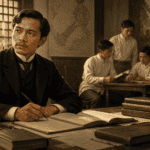
The Universidad Central de Madrid — now Complutense University — was one of the largest and most intellectually serious universities in Spain. Rizal enrolled in the Faculty of Medicine and simultaneously in the Faculty of Philosophy and Letters, a combination that would have been demanding for any student and that he pursued alongside fencing lessons, painting, sculpting, theatre-going, and the intensive social and political life of the Filipino expatriate community in Madrid.
His academic record was excellent. He completed his licentiate in medicine and his licentiate in philosophy and letters, both with distinction. The philosophy and letters degree was not incidental — it gave him formal training in rhetoric, history, and classical literature that sharpened the analytical and stylistic tools he would bring to his novels. He was not merely memorizing medical anatomy. He was building a complete intellectual instrument.
His medical training focused increasingly on ophthalmology — the decision to specialize in eye surgery was deliberate and personal. His mother Teodora had been losing her sight for years, and he intended to return to the Philippines and treat her. He did, eventually, operating on her eyes successfully after his return in 1887. The practical and the filial were inseparable in him.
The Ateneo de Madrid and the Filipino Community
The social center of Rizal’s Madrid years was not the university but the Ateneo de Madrid — one of the great cultural institutions of 19th-century Spain, a club and forum where writers, scientists, politicians, and intellectuals gathered to debate, lecture, and argue about everything. Rizal became a member and participated actively. He entered and won literary competitions. He gave speeches. He encountered Spanish intellectuals who were willing to engage with him as an equal — an experience that was, by the standards of colonial Manila, genuinely unusual.
He also moved through the Filipino expatriate community in Madrid — a world of students, reformists, and intellectuals who gathered in boarding houses, cafés, and rented rooms to discuss the condition of the Philippines and what might be done about it. This was the incubating environment of what would become the Propaganda Movement. The conversations in these Madrid rooms — about representation in the Cortes, about the friars, about the gap between Spain’s stated values and its colonial practice — were the raw material from which La Solidaridad and everything that followed would eventually be made.
Rizal was not yet the movement’s central figure in these years — that role would crystallize later, with the novels. But he was already its most intellectually formidable participant, already thinking more rigorously about the colonial system than most of his contemporaries, already writing with a clarity and force that set him apart.
Daily Life: The Material Reality
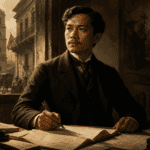
The Madrid years were not comfortable. Rizal lived on money sent from the Philippines by Paciano — money that was inconsistent, often insufficient, and always dependent on the colonial economic conditions that made his family’s farming income unpredictable. He moved between different lodgings, sometimes sharing rooms to reduce costs, sometimes going hungry when remittances were delayed. He wrote to Paciano with a mixture of gratitude and urgency about money that runs through the correspondence of the entire European period.
He managed this material precariousness with considerable discipline. He kept meticulous accounts of his expenses. He ate simply. He limited entertainment to what cost nothing or almost nothing. When he could not afford a fencing instructor he practiced alone. When he could not afford new books he borrowed them or spent hours in libraries.
What he did not limit was his reading. The evidence of his Madrid years is that he read constantly and across everything — medicine, history, political philosophy, literature, science, anthropology. The Biblioteca Nacional in Madrid held materials unavailable anywhere in the Philippines. He used it systematically. By the time he left Spain in 1885, he had read his way through most of the significant European scholarship on the Philippines that existed at the time, and had developed a framework for understanding his country’s history that the colonial system had done its best to prevent Filipinos from constructing.
The Spain He Was Watching
The Spain of the early 1880s was itself in political transition. The Restoration of 1874 had returned the Bourbon monarchy after the upheavals of the preceding decade, and the constitutional system that followed — the turno pacifico, the peaceful alternation of Liberal and Conservative governments — gave Spain a functional if imperfect parliamentary democracy. Rizal watched it with intense interest.
He attended sessions of the Cortes. He followed the political newspapers. He engaged with Spanish liberals who were sympathetic to colonial reform and with conservatives who were not. He observed, close up, how a parliamentary system actually operated — its procedures, its compromises, its capacity for both progress and obstruction — and he thought carefully about what it would mean for the Philippines to have representation within it.
He also observed the limits of Spanish liberalism. The liberals who supported reform in Spain’s domestic politics were not necessarily willing to extend those principles to the colonies. The gap between what Spain professed and what it practiced was visible everywhere, and Rizal documented it — in his essays, in his letters, in the analytical framework that would eventually produce the novels.
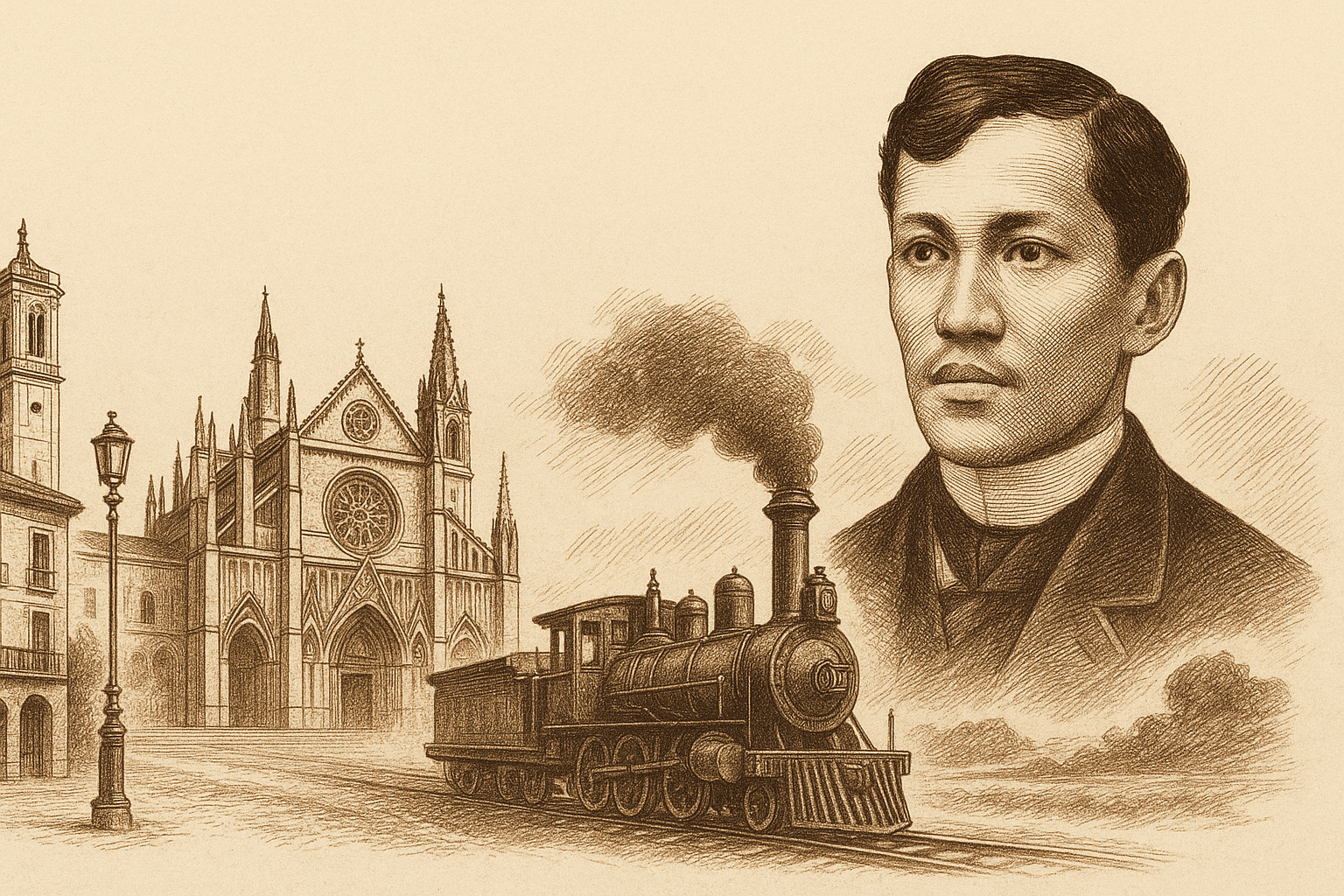
He traveled when he could. Toledo impressed him with its medieval density and the weight of its history — he sketched there. He visited Valencia, Zaragoza, and the Basque coast. These journeys were not tourism. They were a systematic effort to understand the country that governed his own, to see what Spain actually was rather than what the colonial mythology claimed it to be.
The First Return and the Second Departure
Rizal left Spain for Paris and then Germany in 1885, following his ophthalmology training. He returned briefly to Spain in December 1886, passing through Madrid and Barcelona to meet del Pilar and other members of the Filipino reform community before crossing back to Germany. Noli Me Tangere was nearly finished. He was trying to arrange its publication and running out of money.
He passed through Spain again on multiple occasions over the following years — in 1891, on the way from Belgium, where he had been revising El Filibusterismo for publication in Ghent; in 1892, briefly, before his final return to the Philippines. Each visit was shorter than the last. His relationship to Spain was changing — from a place of formation to a place of transit, from a source of intellectual possibility to a colonial capital whose refusal to reform was becoming increasingly clear.
By 1892 he had been in Europe for a decade. He had written two novels, published a re-annotated edition of a 17th-century colonial history, contributed dozens of essays to the reform press, and built one of the most extensive intellectual networks of any Filipino of his generation. Spain had given him the education he came for. It had also, through its treatment of the reform movement’s demands, given him the political education he had not anticipated: the lesson that a colonial empire does not reform itself in response to reasoned argument, regardless of how well-documented or eloquently made.
He returned to the Philippines in 1892 and was exiled to Dapitan within weeks of arriving.
What Spain Made of Him
The Spain years — from the arrival in Barcelona in the summer of 1882 to the final departures of the early 1890s — were the period in which Rizal became Rizal. Not the martyr, not the national hero, not the face on the currency. The writer. The thinker. The person who had read enough, traveled enough, and argued enough to understand, with unusual precision, what was being done to the Philippines and what it would take to change it.
He arrived in Barcelona at twenty, writing his first essay about love of country in a city he had reached for the first time. He left Spain for the last time at thirty, carrying the completed draft of a second novel and the hard-won conviction that the campaign to reform the colonial system through reason and petition was running out of time.
Spain gave him the tools. What he built with them is the rest of the story.
Read next: Rizal in London — what he was doing at the British Museum during the year he spent in England between his two main periods in Spain.