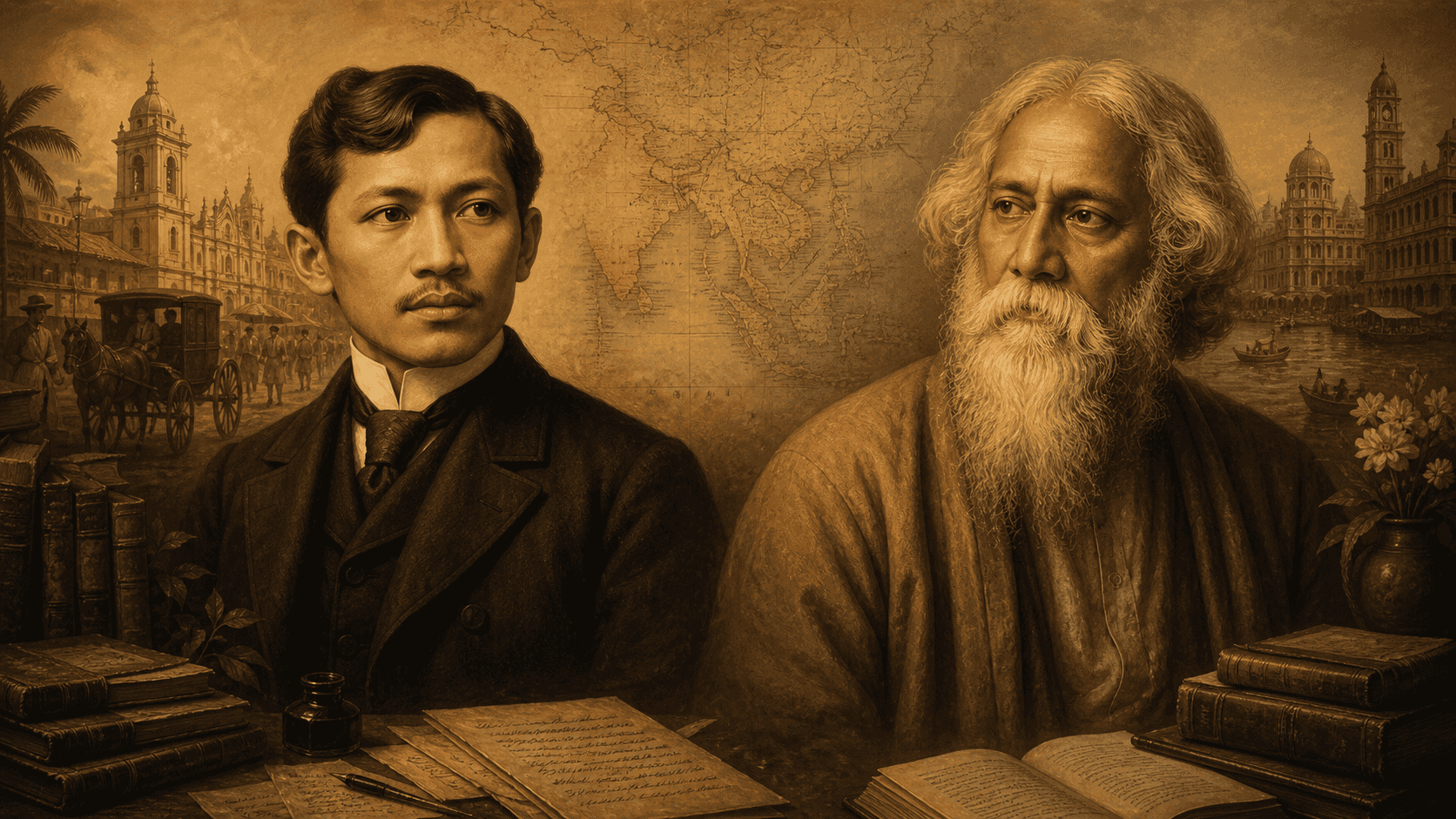
José Rizal and Rabindranath Tagore were born the same year. It was 1861, and both were born into relatively comfortable families in colonized Asian countries — Rizal in Calamba, Laguna, under Spanish rule; Tagore in Jorasanko, Calcutta, under British rule. Both were educated partly in Europe. Both wrote literature that made their colonizers uncomfortable. Both spent their lives arguing, in different ways and with different conclusions, that their people deserved something better than what they had.
They almost certainly never met. There is no record of correspondence between them. And yet the parallels between their lives, their ideas, and the problems they were each trying to solve are close enough that putting them side by side illuminates both men more clearly than studying either one alone.
Two Colonies, Two Colonial Systems
The differences in the colonial situations Rizal and Tagore faced are important, because they shaped the different directions their thinking took.
Rizal lived and wrote under Spanish colonialism in its late, weakened phase. Spain’s grip on the Philippines in the 1880s was maintained primarily through the Catholic religious orders — the friars — who controlled education, land, and local administration in ways that the formal colonial government often did not. The system Rizal attacked in Noli Me Tangere and El Filibusterismo was not simply political. It was clerical, social, and psychological: a system that taught Filipinos to be ashamed of themselves, to defer to their superiors, and to mistake their own subjugation for the natural order of things.
Rizal was the first intellectual in Southeast Asia to think systematically about social and political issues, and his analysis of Filipino colonial society was so precise and so structurally rigorous that scholars have described it as the foundation of an original Southeast Asian sociology of colonial life.¹ His novels were not just stories. They were social diagnoses — documented accounts of how colonial power actually functioned in the daily lives of ordinary people.
Tagore faced a different colonial system: the British Raj, which was more bureaucratically organized, more economically extractive, and in some ways more sophisticated in its methods of maintaining control. Both men identified the same core mechanism at work. Colonial education, Tagore argued, was not designed to enlighten — it was designed to produce dependency. Its purpose was to train a colonized population to be useful to the empire: to staff its offices, internalize its hierarchies, and feel ashamed of their own culture and intellectual traditions.² Rizal had made exactly the same argument a decade earlier, working from the Philippine context. The institution was different; the logic was identical.
Literature as the Primary Weapon
Both men chose literature as their central instrument of resistance, and both believed that the most powerful thing a writer could do was hold a mirror up to colonial society and force it to see itself clearly.
Rizal did this with almost surgical precision. Noli Me Tangere, published in 1887, exposed the abuses of the friars, the corruption of colonial institutions, and the suffering of ordinary Filipinos through characters so recognizable that readers saw their own neighbors, priests, and town officials on every page. It was only the second novel ever written by a putative Filipino — and nothing comparable existed elsewhere in colonized Asia or Africa for another three quarters of a century.³ The Spanish colonial authorities banned it almost immediately, which was, in retrospect, the surest possible confirmation of how accurately it had aimed.
Tagore’s literary output was vastly larger — poetry, novels, plays, short stories, songs, and essays across six decades — and its relationship to colonial resistance was more oblique. He did not write novels that named the abuses of specific institutions the way Rizal did. He was more interested in the interior life: in what colonialism did to the soul of a people, to their capacity for joy, creativity, and self-understanding. His 1916 novel The Home and the World examined the tensions within Indian nationalism itself, warning against the kind of fervent anti-colonial movement that simply replaces one form of intolerance with another.
Where Rizal’s literature was primarily diagnostic — here is the disease, here is how it works, here is what it costs — Tagore’s was primarily philosophical. He was less interested in documenting the specific mechanics of British colonialism than in articulating an alternative vision of human flourishing that colonialism prevented.
On Education: The Deepest Agreement
If there is one place where Rizal and Tagore converge most completely, it is on education — specifically, on what colonial education does to a people and what genuine education could do instead.
Rizal’s critique of colonial education runs through both novels. In El Filibusterismo, the scenes set in classrooms run by Spanish friars are among the most devastating in the book: students humiliated for asking questions, curiosity punished, rote memorization rewarded, and an entire generation trained to be useful to the colonial system rather than to themselves. Isagani’s line — “You strip him and then scoff at his nakedness” — is the sharpest possible statement of the dynamic: deny people education, then mock them for being uneducated.
Tagore arrived at the same diagnosis from a different direction, and spent far more of his life building an institutional alternative to it. He developed an intense dislike of conventional colonial schooling and founded a school at Shantiniketan — and later Visva-Bharati University — where he sought to replace the rigidity and submission of colonial education with something genuinely liberating: learning built around freedom, creativity, cooperation, and close engagement with the natural world.⁴ The principles he embedded there — freedom of inquiry, joy in learning, the integration of artistic and intellectual life — were a direct repudiation of everything the British colonial curriculum stood for.⁵
The contrast with Rizal’s approach is telling. Rizal argued for education primarily as a tool of national awakening — the means by which a colonized people could reclaim the capacity to govern themselves. He tried to build a school in Dapitan during his exile, and when colonial authorities destroyed the project, he interpreted the loss as part of the broader pattern of suppressing Filipino intellectual life. Education, for Rizal, was a political instrument.
For Tagore, it was something broader. His philosophy of education was rooted in what he called spiritual humanism — the belief that genuine learning was not about producing useful citizens or competent clerks, but about helping human beings become fully themselves: curious, creative, connected to the world around them, and capable of something beyond obedience.⁶ His critique of colonial education was that it produced people who were functional but not free.
Both men were right. They were simply looking at the same problem from different distances.
On Nationalism: The Sharpest Difference
This is where the two men diverge most sharply, and where the divergence is most worth examining.
Rizal was a nationalist in the sense that he believed the Filipino people constituted a people — with a shared history, a shared culture, a shared experience of injustice — and that this people had a right to dignity, representation, and eventually self-governance. His novels were acts of nation-building: they gave Filipinos a story about themselves that was not written by their colonizers.
Tagore was far more ambivalent about nationalism, and grew more ambivalent with time. He was not opposed to Indian independence — he supported it clearly and consistently. But he worried that anti-colonial nationalism, if it simply adopted the territorial, competitive logic of European nationalism, would reproduce the very structures it was trying to dismantle. His essays on nationalism, particularly those collected and published in 1917, argued that a society built on narrow national interest — prioritizing territorial boundaries, ethnic solidarity, and collective power over individual human values — was not a society worth building, whatever flag flew over it.⁷
This was not a comfortable position. Many of his contemporaries regarded it as anti-nationalist, even as a form of collaboration.⁸ His friendship with Gandhi was genuine and warm, but their disagreements about the nature of freedom and the proper means of achieving it were equally genuine. Tagore believed Gandhi’s campaign to reject foreign goods and return to hand-spinning romanticized poverty and turned away from the modernization India needed. Gandhi believed Tagore was too detached from the practical realities of the independence struggle. Both were partly right.
Rizal’s position on nationalism was shaped by the fact that he died before he had to reckon with its excesses. He was executed in 1896, at thirty-five, before the Philippine Revolution had fully played out and long before the question of what kind of nation the Philippines would become had been answered. His most prescient warning — the line from El Filibusterismo, “Why independence, if the slaves of today will be the tyrants of tomorrow?” — suggests he was not naive about the risks. But he did not live to see whether his warnings would be heeded.
Tagore lived until 1941 and watched nationalism in Asia and Europe alike reveal its most destructive possibilities. His skepticism about it, by the end of his life, had become something closer to grief.
On Reform Versus Transformation
Another significant difference between the two men lies in their relationship to the existing colonial order and what they believed should be done about it.
Rizal was, for most of his life, a reformist rather than a revolutionary. He argued for representation, equal rights, the expulsion of the abusive friars, and the treatment of Filipinos as equal subjects of the Spanish crown — not, at least initially, for full independence. He believed the colonial system could be improved from within, that the Spanish government, properly petitioned and presented with evidence, would respond to reason. The tragedy of his life, and the central argument of El Filibusterismo, is the gradual collapse of that belief against a system that was structurally incapable of the reforms he was asking for.
Tagore was similarly not a revolutionary in any political sense. He supported Indian independence but maintained distance from the more confrontational tactics of the independence movement. What he was committed to — and what he spent the most productive decades of his life building — was a kind of cultural and educational transformation that he believed had to precede, or at least accompany, political liberation. Freedom from colonial rule that left the internal structures of colonial thinking intact was, in his view, no freedom at all.
Both men, in other words, were asking not just whether their countries could be free, but what kind of freedom they were trying to build — and what kind of people would need to exist to sustain it.
What They Share, Finally
The most important thing Rizal and Tagore share is not a position or a conclusion but a method and a temperament. Both believed that the most powerful form of resistance available to a colonized intellectual was the most rigorous possible analysis of the world they were living in. Both believed that literature and ideas were not luxuries but necessities — that a people who could not articulate their own situation clearly were a people who could not change it. And both paid for this belief with the sustained hostility of the colonial authorities whose systems they were describing.
Rizal died at thirty-five. Tagore lived to eighty. The difference in the length of their lives meant that Tagore had decades to develop, refine, and sometimes revise his thinking in ways Rizal was never given the chance to do. We do not know what Rizal would have made of the Philippine Revolution, of American colonialism, of the twentieth century. We know only what he left: two novels, a body of essays and letters, a farewell poem written the night before his execution, and questions that his country is still working through.
Tagore, who outlived him by forty-five years, left an equally unresolved legacy — the question of whether a nationalism grounded in humanist values rather than territorial ambition is achievable, or whether it is simply a beautiful idea that the actual history of nations has never quite managed to sustain.
Both questions are still open. Both men are still worth reading.
For more on Rizal’s life and ideas, see our complete biography of José Rizal and our analyses of Noli Me Tangere and El Filibusterismo. For a similar comparison, see Rizal and José Martí: Two Writers Who Died for Their Nations.
Sources
- Syed Farid Alatas, “On Eurocentrism and Laziness: The Thought of Jose Rizal,” Global Asia, Vol. 6, No. 1 (March 2011).
- Tagore’s critique of colonial education as a system of trained dependency is developed across several essays and documented in his founding of Shantiniketan. See: “Tagore’s Critique of Colonial Education,” Scribd (based on primary Tagore sources).
- Benedict Anderson, as cited in the Europe Solidaire Sans Frontières review of Noli Me Tangere: “First Filipino.”
- Rabindranath Tagore, New Learning Online — “Rabindranath Tagore’s School at Shantiniketan,” drawing on Tagore’s own writings on education.
- “Tagore’s Critique of Colonial Education,” Scribd; and “Educational Philosophy Part 9: Tagore’s Shantiniketan,” Agastya Foundation (January 2025).
- “Rabindranath Tagore: Freedom, Education and Spiritual Humanism,” Anantam IAS (2025), drawing on Tagore’s philosophical writings.
- Rabindranath Tagore, Nationalism (1917). Published as a collection of essays on Japan, the West, and India.
- “Beyond Nationalism: The Significance of Rabindranath Tagore’s Concept of Nationalism,” Academia.edu (November 2024).