JoseRizal.com is a comprehensive English-language resource on the life, works, and legacy of José Rizal — the Filipino novelist, physician, and nationalist who was executed by Spanish colonial authorities on December 30, 1896, and is today recognized as the national hero of the Philippines.
The site exists because Rizal deserves more than a summary. He was one of the most intellectually restless figures of the nineteenth century: a novelist who wrote two books that helped awaken a nation, a physician who practiced in exile, a polyglot who read and wrote in more than a dozen languages, an essayist who made the case for Filipino dignity in the pages of a Madrid reform newspaper, and a man who faced execution at thirty-five with a composure that struck even his enemies as remarkable. The standard biographical sketch does not do justice to the scale of what he left behind. This site tries to.
The Life of José Rizal
Rizal was born on June 19, 1861, in Calamba, Laguna, the seventh of eleven children. His mother, Teodora Alonso, was his first teacher, and by the time he left for Manila to study at the Ateneo, he had already written poetry in Tagalog and Spanish. His childhood was marked by early intellectual precocity and an early encounter with colonial injustice — his mother was briefly imprisoned on a fabricated charge when he was a boy, an experience that shaped his understanding of how power worked in the Philippines.
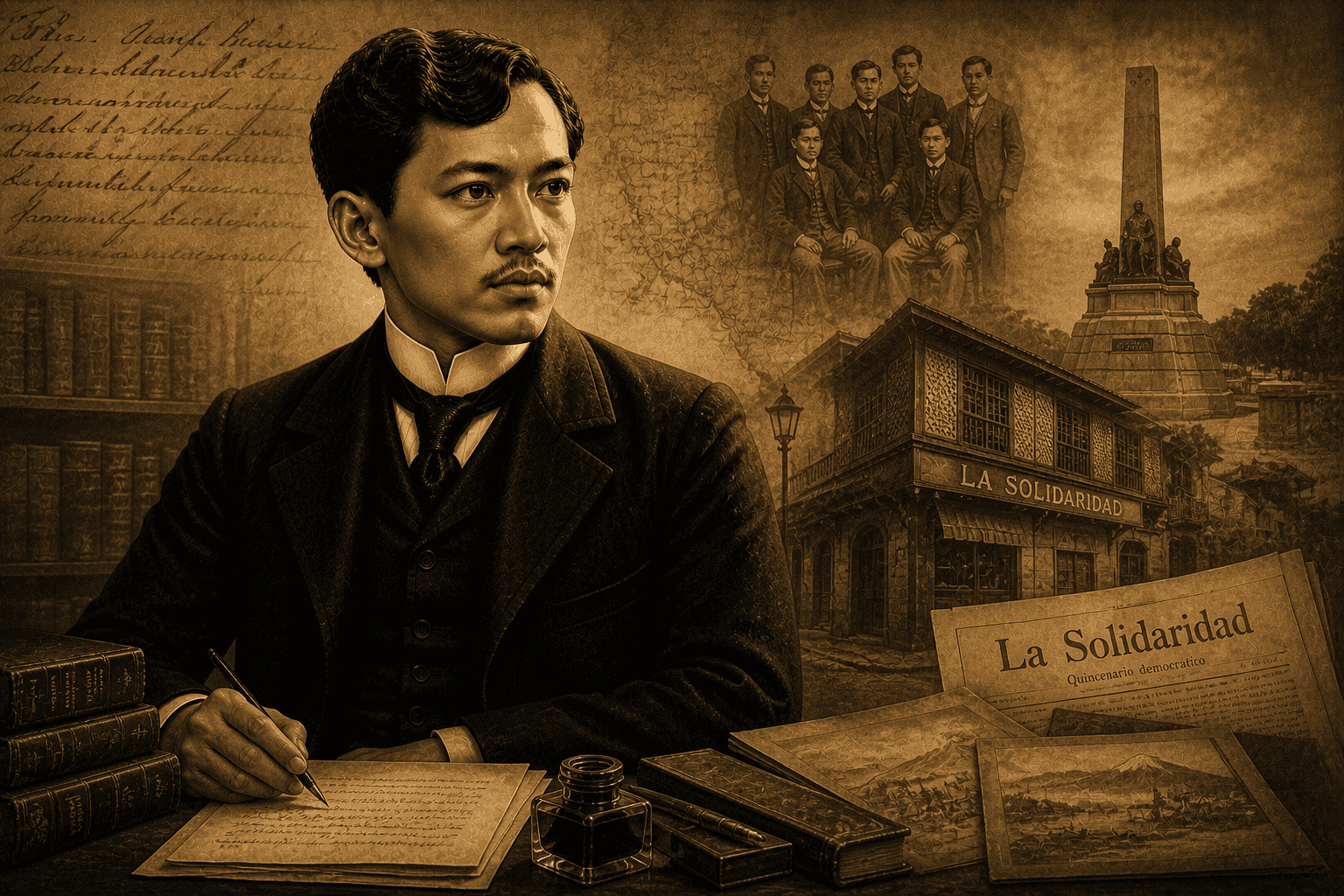
He studied at the Ateneo Municipal de Manila and later at the University of Santo Tomás before leaving for Europe in 1882, where he continued his education in Madrid, Paris, and Heidelberg. His years abroad were enormously productive: he completed his medical degree, deepened his knowledge of ophthalmology, learned several European languages, annotated a sixteenth-century account of the Philippines, wrote essays for the reform publication La Solidaridad, and — most consequentially — wrote the two novels that would define his legacy.
He returned to the Philippines, was exiled, returned again, was arrested, tried, and executed. The full arc of that life is told in the complete biography of José Rizal, and the key dates and turning points are laid out in the José Rizal timeline. For readers who want a shorter introduction, Who Was José Rizal? covers the essentials without requiring a long commitment.
The site also goes deeper into specific periods and episodes that are often glossed over in standard accounts: his childhood and early life in Calamba, his year in London at the British Museum annotating Antonio de Morga’s Sucesos de las Islas Filipinas, and the final chapter — his trial and execution and the circumstances of his death at Bagumbayan.
The Works of José Rizal
Rizal’s output is remarkable for both its range and its quality. Most readers come to him through the two novels, but his literary and intellectual legacy extends well beyond them.
Noli Me Tangere, published in Berlin in 1887, was Rizal’s first novel and one of the most consequential books ever written about colonialism. It follows Crisóstomo Ibarra’s return to the Philippines after seven years in Europe, and through his story — and the stories of the people around him — it exposes the abuses of the Spanish friars, the corruption of colonial institutions, and the suffering of ordinary Filipinos with a precision that no one had achieved in print before. The novel was banned by the colonial authorities almost immediately. It was also, for that reason, almost impossible to stop. The full summary of Noli Me Tangere traces the novel chapter by chapter. The analysis of Noli Me Tangere goes further, examining its themes, characters, and significance.
El Filibusterismo, published in Ghent in 1891, is the darker sequel. Ibarra returns as Simoun, a wealthy jeweler with a plan for violent revenge against the colonial system. The novel is harder and more morally ambiguous than Noli — it gives serious weight to the argument for revolution while ultimately questioning whether hatred can build anything worth living in. The full summary of El Filibusterismo and its analysis are both available on the site. For readers who want to understand how the two novels relate to each other, the comparison of Noli and Fili is a useful starting point.
Beyond the novels, the site covers Rizal’s poetry, including the farewell poem he completed the night before his execution — Mi Último Adiós — as well as earlier works like A la Juventud Filipina. A full inventory of everything he wrote — novels, essays, poems, translations, plays, and more — is gathered in the complete works of José Rizal.
The Historical Context
Rizal did not emerge from a vacuum. He was shaped by — and helped to shape — one of the most consequential periods in Philippine history.
The intellectual and political movement he was part of, the Propaganda Movement, brought together Filipino reformists in Europe who argued through newspapers, pamphlets, and public speeches for equal rights, representation, and an end to friar abuses. Rizal was its most prominent voice. The movement ultimately failed to achieve reform through peaceful means, and the revolution that followed — which Rizal neither led nor endorsed but whose spirit owed a great deal to his writing — changed the course of Philippine history.
Understanding Rizal fully means understanding the world he was writing about: the structure of Spanish colonial rule, the role of the Catholic religious orders, the class divisions of Philippine society, and the emerging Filipino national consciousness that his novels both reflected and accelerated. The history section of the site provides that context.
The Legacy of José Rizal
Rizal’s execution did not silence him. It amplified everything he had written. Within months, the Philippine Revolution had begun. Within a decade, the country had fought two colonial powers in succession. His face eventually appeared on the Philippine peso. His name was given to a province, a park, a law, countless streets and schools.
The Rizal Law — formally the Republic Act 1425 — requires Noli Me Tangere and El Filibusterismo to be read by every Filipino high school student. It has been in effect since 1956 and has generated controversy ever since, with critics arguing that mandatory reading turns living literature into an obligation and defenders countering that some books are too important to leave to chance.
The site’s legacy section covers how Rizal has been remembered, interpreted, and sometimes misappropriated in the century and more since his death. It includes the full account of his influence and legacy, the story of Rizal Park in Manila, and the various adaptations of his life in film, theater, and other forms.
The People Around Rizal
No one becomes who they are alone. The people section of the site profiles the figures who shaped Rizal’s life and work — his allies, his rivals, his family, and the women he loved. It includes an overview of Rizal’s friends and associates, the circle of reformists and intellectuals who worked alongside him during the Propaganda Movement years.
Quotations
Rizal was a quotable writer — not in the way that produces hollow inspirational phrases, but in the way that produces lines so precisely observed that they stay with you. The quotations section gathers the most significant of them, with context for each. The two most substantial collections are the quotes from Noli Me Tangere and the quotes from El Filibusterismo, both organized by theme rather than listed in isolation.
How This Site Is Written
The articles on JoseRizal.com aim for the standard a careful reader would expect from a well-researched book: accurate, specific, honest about what is known and what is disputed, and written in prose that respects the intelligence of the person reading it. Where scholarly consensus is clear, we reflect it. Where questions remain open — the attribution of certain early works, the precise details of contested events — we say so.
Rizal was an extraordinarily precise writer who chose his words with care and held himself to a high standard of intellectual honesty. We try to extend him the same.
Start Here
If you are new to Rizal, Who Was José Rizal? is the best place to begin — a complete introduction to his life, significance, and ideas in a single readable article. The complete biography goes deeper for readers who want the full story, and the timeline is useful for keeping the sequence of events clear.
For the novels, the summaries of Noli Me Tangere and El Filibusterismo are the best entry points. And for Rizal’s most famous poem, written the night before his execution and smuggled out of Fort Santiago in an alcohol stove, Mi Último Adiós is here.