
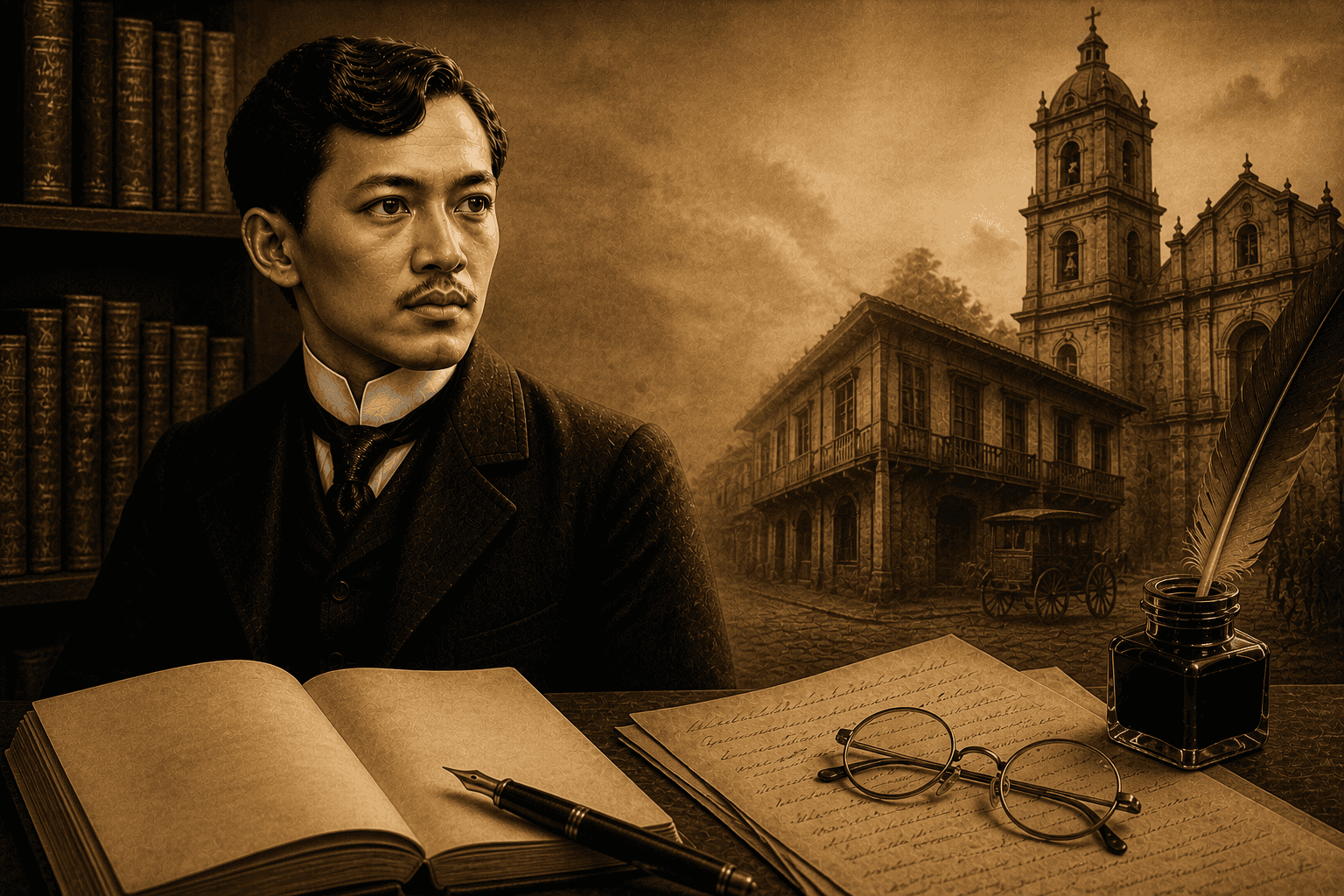
Noli Me Tangere was written to disturb. Rizal said as much in its dedication — he wanted to lift the veil hiding the ills of Philippine colonial society and sacrifice everything to truth. The quotes that survive from the novel carry that same quality. They are spare, precise, and often quietly devastating: the kind of lines that lodge in the mind long after the page is turned.
This collection gathers the most significant quotes from the novel, grouped by theme, with context for each — where it comes from, who speaks it, and why it still resonates.
On the Suffering of the People
“The people do not complain because they have no voice; do not move because they are lethargic, and you say that they do not suffer because you have not seen their hearts bleed.”
This is arguably the most important line in the novel. It is Rizal’s direct rebuke of the colonial argument that Filipinos were content — that their silence proved acceptance. He dismantles that logic completely. Silence, he shows, is not consent. It is the sound of a people who have been denied every instrument of protest: voice, movement, redress. To mistake their stillness for satisfaction is not a misunderstanding. It is a refusal to look.
“Our young people think about nothing more than love affairs and pleasure. They spend more time attempting to seduce and dishonor young women than in thinking about their country’s welfare. Our women, in order to take care of the house and family of God, forget their own.”
This passage is often misread as mere social criticism, a conservative lament about morality. It is sharper than that. Rizal is describing the effect of colonial miseducation on an entire generation — people trained to be passive, distracted, and turned inward, leaving no energy for the larger question of what kind of country they wanted to live in. The indictment falls not on the people themselves but on the system that produced them.
On Power, Justice, and Honesty
“It is not the criminals who arouse the hatred of others, but the men who are honest.”
Few lines in the novel cut as cleanly as this one. In a colonial system built on impunity — where the powerful confessed their sins on Sundays and resumed their abuse on Mondays — honesty was the most threatening thing a person could practice. Ibarra’s tragedy is built on exactly this logic. He tries to work within the system, to reform rather than revolt, and the system destroys him precisely because he cannot be bought.
“I can concede that the government has no knowledge of the people, but I believe the people know less of the government. There are useless officials, evil, if you like, but there are also good ones, and these are not able to accomplish anything because they encounter an inert mass, a population that takes little part in matters that concern them.”
This is one of the novel’s most uncomfortable observations, because it implicates everyone. Rizal refuses to make the colonial critique easy. Yes, the system is corrupt. But a population that has been conditioned into passivity cannot simply blame its rulers for everything. Reform, in Rizal’s view, requires the governed to wake up — to care, to participate, to demand accountability. The quote sits uncomfortably between solidarity and challenge.
“I honor the father in his son, not the son in his father. Each one receives a reward or punishment for his deeds, but not for the acts of others.”
Ibarra speaks this line in response to those who judge him by his father’s reputation. It is a rejection of inherited guilt and inherited prestige alike — a remarkably modern principle of individual accountability in a society where bloodlines determined almost everything. Rizal was making an argument not just about personal ethics but about the kind of society the Philippines could become.
On Freedom, Reform, and the Long Game
“A people’s prosperity or misery is in direct proportion to its liberties or its prejudices and, accordingly, to the sacrifices or the selfishness of its forefathers.”
Ibarra delivers this observation as a traveler comparing nations. It is the novel’s clearest statement of political philosophy: freedom is not a gift, it is a condition earned or forfeited across generations. The societies that prosper are those whose people were willing to sacrifice for something beyond themselves. The societies that suffer are those whose ruling class protected its own comfort at the expense of everyone else. The application to colonial Philippines was unmistakable.
“If your enterprise fails, you will have to be consoled by the thought that you have done as much as you could, and even then, something will have been won. Put in the first stone, sow the seeds. After the storm is unleashed, perhaps some grain will germinate, survive the catastrophe, save the species from annihilation and serve thereafter as the seed for the children of the late sower.”
This is the novel’s quiet argument for beginning things you will not live to finish. Ibarra’s school is destroyed. His name is ruined. He flees. And yet this passage suggests that none of it was wasted — that the act of beginning something worthwhile plants something in the world that outlasts the person who started it. For Rizal, writing in 1887, nine years before his own execution, the passage reads as something more than fiction.
“I am not writing for this generation but for those yet to come. If this one could read what I have written, it would burn my books, my whole life’s work. But the generation that deciphers these characters will be a learned generation; it will understand me.”
Rizal speaks here almost as himself rather than through a character. It is a statement of extraordinary confidence and patience — the belief that the work matters even if the moment is not ready for it. He was right. Noli Me Tangere was banned by Spanish authorities shortly after publication. It is now required reading for every Filipino high school student.
On Fate, Miracles, and God
“Believing in accidents is like believing in miracles — both presuppose that God does not know the future.”
This line does double duty. It rejects fatalism from two directions at once: the secular fatalism that calls suffering random chance, and the religious fatalism that calls it divine will. For Rizal, what happened to the Filipino people was neither accident nor miracle. It was the result of human decisions made by human beings who could be held accountable. To call it anything else was simply a way of avoiding that reckoning.
On Exile and the End of Hope
“I am nothing but a fugitive… on the run. Soon they will discover my escape…”
These words belong to Ibarra near the end of the novel, after everything he tried to build has been dismantled. He arrived in the Philippines full of hope — educated abroad, in love, determined to prove that reform was possible. By the time he speaks these words, that faith is gone. What makes the line so striking is not its desperation but its clarity. Ibarra does not rage. He simply states what he has become: a man who tried to work within a broken system and was broken by it in return.
“I die without seeing the dawn brighten over my native land. You who have it to see, welcome it — and forget not those who have fallen during the night!”
This is the novel’s most emotionally direct passage, and its most enduring. It is spoken by someone facing death while the country around them has not yet awakened to what it is and what it could be. The instruction to those who survive is not simply to celebrate. It is to remember — to carry the names of those who died in the dark forward into the light. Read against the arc of Rizal’s own life, it becomes almost unbearable.
Why These Quotes Still Matter
The quotes from Noli Me Tangere were not written to be framed and displayed. They were written to disturb — to make colonial subjects recognize their condition, and to make the institutions responsible for that condition feel exposed. The Spanish colonial authorities understood this. The novel was banned shortly after publication in 1887.
What Rizal accomplished in Noli was to take the private suffering of an entire people and give it language precise enough to be undeniable. The quotes are fragments of that larger project. To read them now is to understand something about what the novel was asking its first readers to feel — and to do.
For more on the novel, read our full summary of Noli Me Tangere and our long-form analysis.