The Question This Article Asks
There is a loose canon of novels that changed the political world they described — books that didn’t just reflect a social reality but intervened in it, that gave the oppressed a language for their situation and the comfortable a mirror they couldn’t look away from. Uncle Tom’s Cabin. Les Misérables. Things Fall Apart. These titles circulate in global literary conversation as touchstones of what literature can do when it takes injustice seriously.
Noli Me Tangere belongs in that conversation. It belongs there on the merits — literary, historical, and political — and its absence from it says more about the geography of cultural prestige than about the quality of the work. This article makes the case for why.
What Kind of Novel It Is
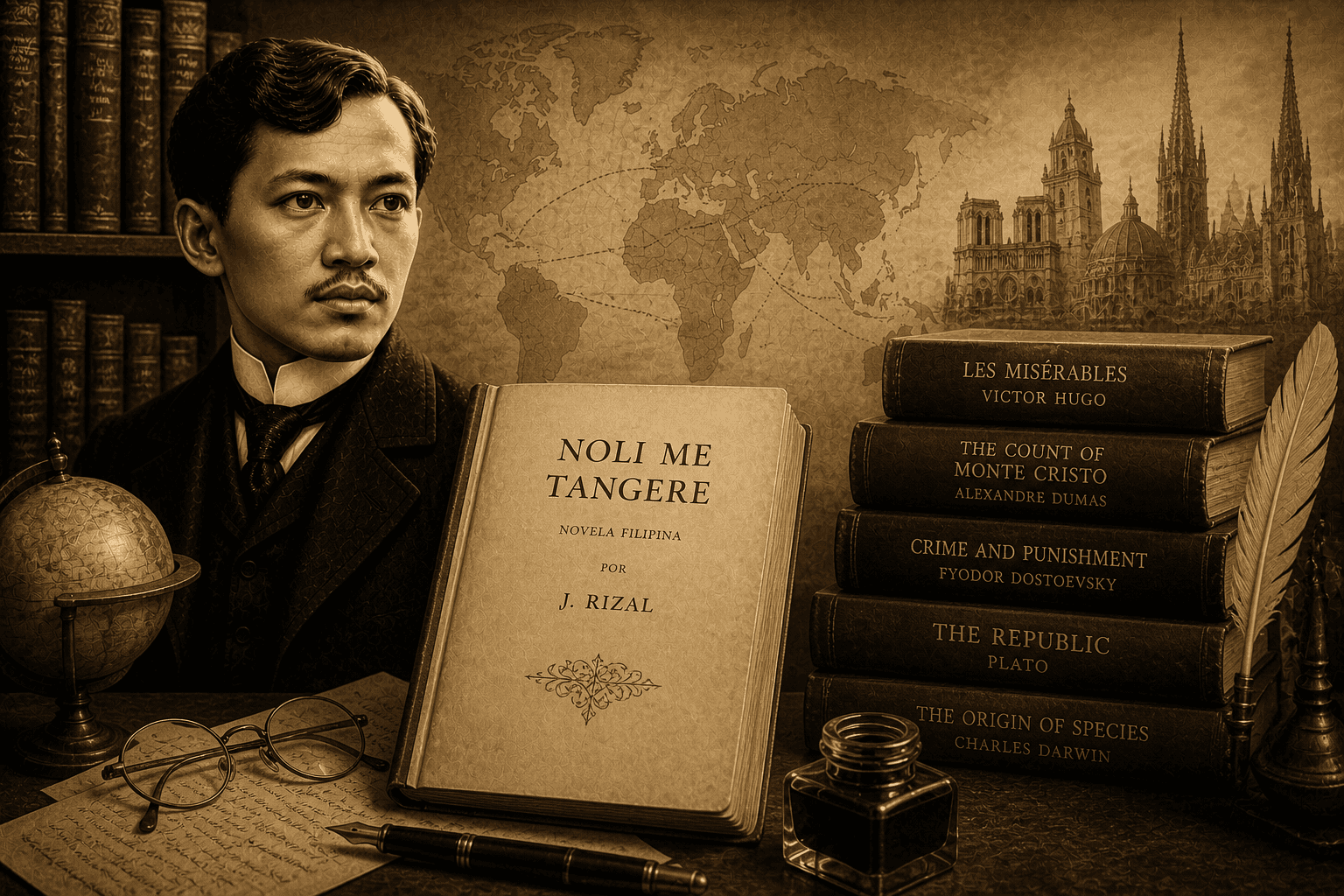
José Rizal published Noli Me Tangere in Berlin in 1887 at his own expense, having borrowed money from a friend to cover the printing costs. He was 25 years old. He had been studying medicine in Europe, moving between Madrid, Paris, and Germany, watching his country from the outside and growing increasingly angry at what distance made visible.
The novel he wrote is not a pamphlet dressed up as fiction. It is a genuine novel — populated, layered, satirical, and at times darkly funny — that follows a young Filipino named Crisostomo Ibarra as he returns home from Europe full of reformist ideals and runs headlong into the machinery of colonial corruption. Corrupt friars. Pliable officials. A society organized to protect those at the top and grind everyone else into compliance or ruin. Ibarra’s idealism doesn’t survive the encounter. Neither does almost everyone he loves.
The title comes from the Gospel of John — Christ’s words to Mary Magdalene after the resurrection: touch me not. Rizal was reaching for something specific with the choice. The Philippines, he wrote in the novel’s dedication, was a social cancer — a wound so infected that touching it caused agony, but that could not be healed without being touched. The book was the touch.
The Debt to Uncle Tom’s Cabin
Rizal was not shy about his influences. When he read Harriet Beecher Stowe’s 1852 novel about slavery in the American South, he recognized something immediately: a template for what literature could do that political argument alone could not. Stowe had not merely described slavery — she had made readers feel it, from the inside, through characters whose suffering was specific and human rather than statistical and abstract. The novel had reached people who would never read an abolitionist tract.
In 1884, Rizal proposed to a group of Filipino friends in Madrid that they collaborate on something similar — a novel that would do for the Philippines what Stowe had done for enslaved Americans: show the colonial system not as an abstraction but as a lived experience, inflicted on people with names and faces and inner lives. His friends agreed in principle, disagreed in practice, and the project stalled. Rizal eventually wrote it alone, in rented rooms in Madrid and Berlin, finishing the manuscript at the end of 1886.
The debt to Stowe is real but the resemblance is partial. Where Uncle Tom’s Cabin is earnest, evangelical, and structurally loose, Noli Me Tangere is satirical, architecturally controlled, and considerably more cynical about the possibility of moral transformation from within a corrupt system. Rizal had read too much European realism — Dickens, Zola, the Russian novelists — to settle for sentiment as a substitute for analysis. The novel exposes; it does not reassure.
The Benedict Anderson Argument
The most serious scholarly case for Noli Me Tangere as a work of global significance was made not by a Filipino critic but by Benedict Anderson, the Irish-American political scientist whose 1983 book Imagined Communities became one of the most influential works of the 20th century on nationalism and culture.
Anderson’s central argument was that national identity is not something people are born into — it is something they come to share through culture, and specifically through the experience of reading the same stories. A novel, in this framework, does political work that no manifesto or census can replicate: it creates the feeling of belonging to a collective, of being part of a “we” that extends beyond the people you can see or touch.
Anderson used Noli Me Tangere as one of his primary examples. Rizal’s novel, he argued, performed a remarkable act: it imagined the Philippines as a unified community — not the collection of islands and languages and ethnic groups that Spanish cartography had assembled, but a single people with shared grievances, shared dignity, and a shared future worth fighting for. The readers of the novel became, in the act of reading it, Filipinos in a sense that colonial subjects had not previously been.
Anderson was so taken with Rizal that he taught himself Spanish in order to read Noli Me Tangere in the original, and spent the latter part of his career writing about it — including a close linguistic study of the novel, Why Counting Counts, that tracked the precise frequency with which Rizal used words like Filipino, patria, and nacion, charting the novel’s political vocabulary with the care of a code-breaker. He affectionately referred to Rizal as Lolo José — Grandfather José. He understood him as one of the central figures of 19th-century world history, not just Philippine history.
The Comparison to Les Misérables
The parallel with Victor Hugo’s 1862 novel is not decorative. It is structural.
Both novels use a cast of characters spread across different social classes to anatomize a society in crisis. Both center on idealistic young men who are destroyed or transformed by systems too corrupt and entrenched to be reformed by individual goodness. Both are simultaneously love stories and political arguments, using the personal to make the systemic visceral. Both were written by men in exile from the political realities they were describing — Hugo from Napoleon III’s France, Rizal from Spanish colonial Manila.
The crucial difference is that Hugo was writing about his own country from a position of relative safety and literary eminence. Rizal was writing about a colonized country, in the colonizer’s language, from a position of genuine danger. The Spanish authorities understood the novel immediately: it was banned in the Philippines upon publication, and its circulation — which happened anyway, hand to hand, in secret — was treated as seditious activity.
Hugo’s France did not execute him for Les Misérables. Spain executed Rizal nine years after Noli Me Tangere appeared. The book is, among other things, a measure of how seriously the colonial government took the power of fiction.
The Language Problem
One reason Noli Me Tangere has not achieved the international readership it deserves is linguistic and historical. Rizal wrote in Spanish — not because it was his first language (it wasn’t) but because it was the language of colonial administration and the only tongue in which he could address both his fellow Filipinos and the Spanish reading public simultaneously. He was writing, as Anderson put it, as much for the enemy as for the friend.
When the United States replaced Spain as the colonial power in the Philippines after 1898, English displaced Spanish as the language of education and government. Within a generation, the original Spanish of Noli Me Tangere had become inaccessible to most Filipinos, who could only read it in translation — into Tagalog, into English, into the other regional languages of the archipelago. This created a strange situation: the national novel of the Philippines is, for most Filipinos, a translated text. The satirical edge of Rizal’s Spanish — the humor, the register shifts, the precisely calibrated mockery of colonial pretension — is notoriously difficult to carry across into other languages without loss.
For international readers, the situation is further compounded by the simple accident of geography: the Philippines is not France, not Russia, not Latin America. Its literature has not benefited from the institutional machinery — the prizes, the publishers, the critics — that translates certain national literatures into global ones. Noli Me Tangere is available in English, most accessibly in Harold Augenbraum’s 2006 Penguin Classics edition, which was a significant step. But it remains far less read outside the Philippines than its historical importance warrants.
What Outsiders Actually Find There
Readers who come to Noli Me Tangere without the weight of mandatory school reading — without, in other words, the experience of being assigned it as a patriotic duty — tend to find something more surprising than they expected.
The satire is sharp and often genuinely funny, particularly in the scenes involving Spanish officials performing colonial authority for each other’s benefit. The corrupt Padre Damaso is not a cartoon villain but a recognizable human type — self-justifying, self-important, and genuinely convinced of his own virtue. The doomed love story between Ibarra and María Clara is handled with more psychological complexity than its melodramatic surface suggests. And the novel’s final movement — the chase, the deaths, the Christmas Eve scene in the forest — achieves a bleakness that earns its power rather than demanding it.
The comparison to Dickens is apt in some ways and misleading in others. Rizal shares Dickens’s satirical gift, his ability to render social systems through individual characters, and his moral seriousness. But Rizal is colder. He does not believe in the redemptive individual — the benefactor who breaks through, the villain who reforms, the system that responds to goodness. El Filibusterismo, the 1891 sequel, makes this even clearer. If Noli Me Tangere is a diagnosis, El Filibusterismo is a verdict.
Why It Belongs on the Shelf
The novels that endure as world literature are not the ones that resolve neatly into allegory or that carry their politics so openly that the fiction collapses under the weight. They are the ones that make a specific world so densely and precisely realized that it opens outward — that the more local and particular they are, the more universal they become.
Noli Me Tangere is set in a specific Manila, in a specific colonial moment, among characters who speak specific dialects of power and subservience. And yet what it describes — the corruption of institutions that claim moral authority, the destruction of idealism by systems designed to protect themselves, the way ordinary people are caught between forces larger than their lives — is not specific at all. It is, in the plainest sense, a human subject.
The novel that helped end Spanish colonialism in the Philippines, that Benedict Anderson called a landmark act of nation-building, that Penguin Classics placed alongside Hugo and Stowe and Tolstoy — this is a book worth reading, and a writer worth knowing.
Read next: Noli Me Tangere: A Long-Form Analysis — a deeper look at the novel’s themes, structure, and characters.