Calamba, 1861
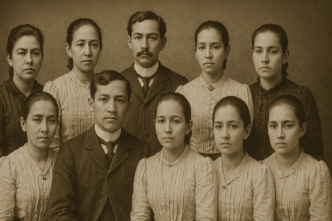
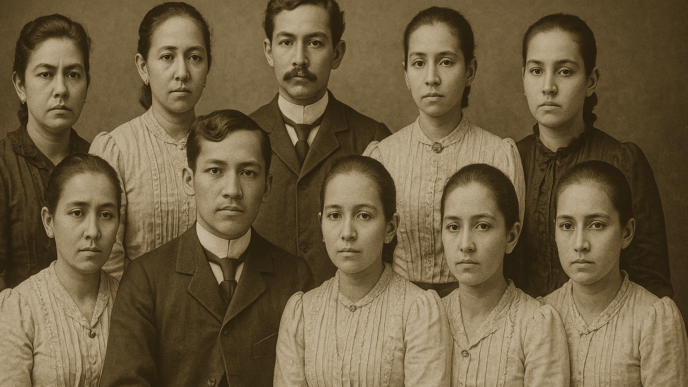
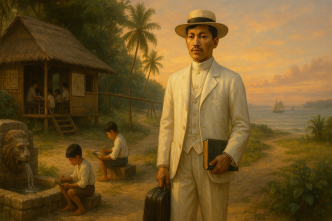
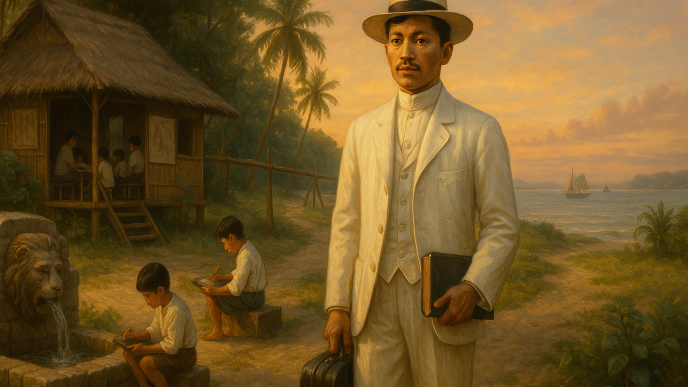
José Rizal was born on June 19, 1861, in Calamba, a market town on the southwestern shore of Laguna de Bay in the province of Laguna, about 54 kilometers southeast of Manila. He was the seventh of eleven children born to Francisco Mercado and Teodora Alonso — a family of mixed Chinese, Spanish, and Malay ancestry that had been farming the same fertile region for generations.
The Mercados were not wealthy by Spanish colonial standards, but they were prosperous by local ones: educated, landowning, and devout. Francisco managed the family’s lands with careful discipline. Teodora, his wife, had attended the College of Santa Rosa in Manila and could read, write, and play music at a time when most Filipino women received no formal education at all. The house in which the family lived — reconstructed today as the Rizal Shrine in Calamba — was large by provincial standards: two stories, with an azotea where the family gathered in the evenings for prayers, and enough room for the books, musical instruments, and visitors that were part of daily life.
Into this house and this family, Rizal was born the seventh child. He would be the one who changed everything.
A Mother’s Teaching
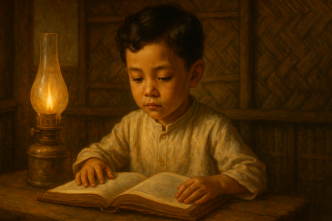
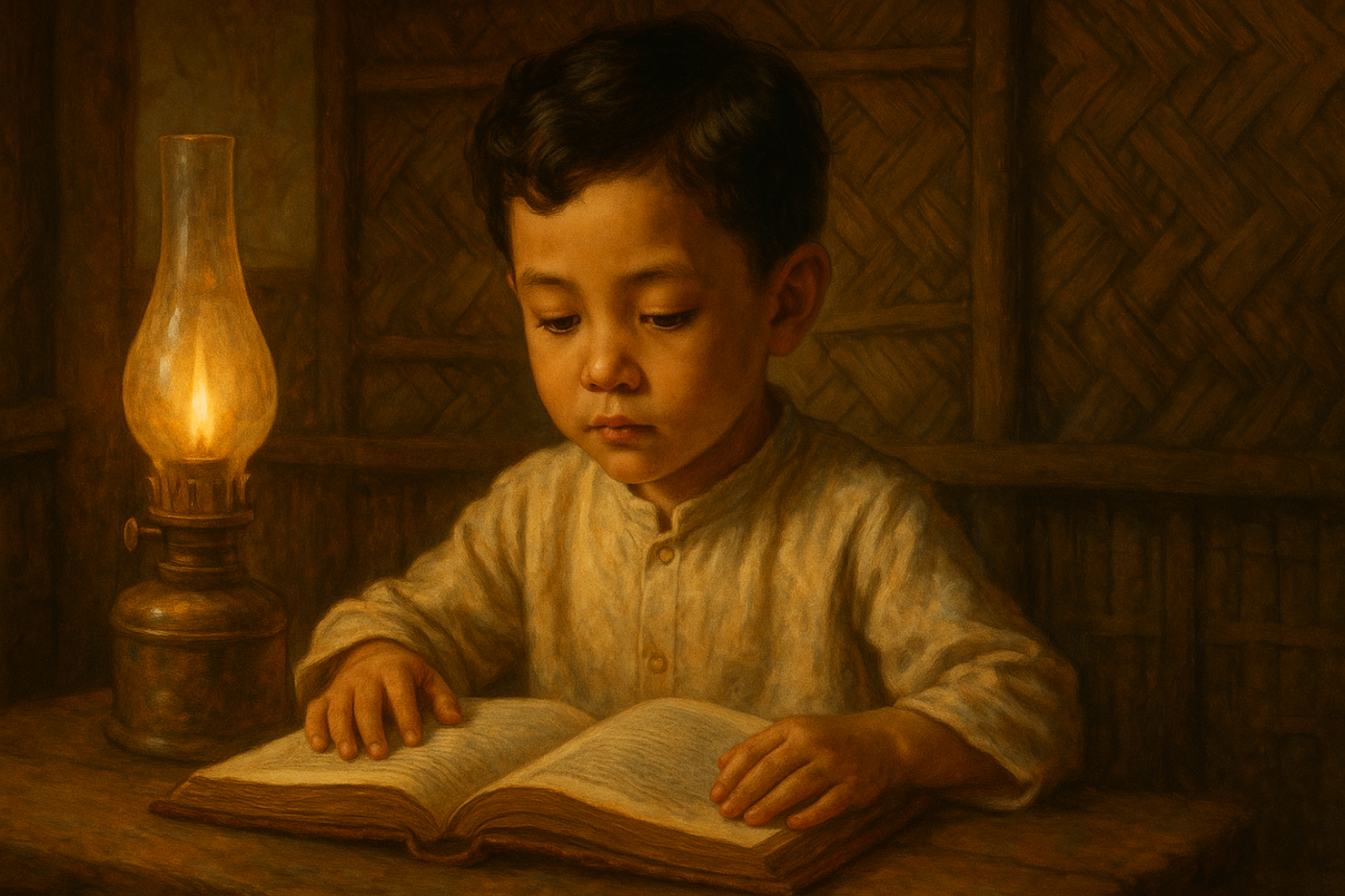
Teodora Alonso was the most important person in Rizal’s early life, and he knew it. In memoirs written in adulthood, he credited her with teaching him to read, to think critically, and to feel the weight of injustice — not as an abstraction but as something that happened to real people, including people he loved.
She began teaching him at home before he was old enough for formal school: prayers, the alphabet, the stories of the saints, and then more demanding fare — Spanish, arithmetic, and the habit of careful observation that would serve him for the rest of his life. She was, by all accounts, firm and exacting, but also genuinely warm. Rizal described her with unmistakable tenderness in his memoirs, and the maternal figures in his novels — complicated, strong, sometimes tragic — bear her imprint.
Alongside her teaching came his father’s example. Francisco Mercado was a man of few words and strong principles: he farmed his land, paid his debts, dealt honestly with the Dominican friars who controlled much of the surrounding hacienda, and modeled the kind of quiet dignity that colonial subjects were not supposed to possess. Rizal watched both parents carefully. He learned from both.
The Uncles, the Tutors, and the Household
Before formal school, Rizal received an unusually rich informal education from the extended family network around him. Three maternal uncles contributed in distinct ways: José Alberto cultivated his interest in the arts; Gregorio encouraged his reading and study habits; Manuel took charge of his physical development — teaching him to ride, swim, and use his body with confidence. The image that emerges from Rizal’s own recollections is less of a lone prodigy than of a boy intensively cultivated by a clan that understood what education could do.
Private tutors came and went through the household. One, an elderly man who had been a classmate of Francisco’s, lodged with the family for a time and taught Rizal the rudiments of Latin. Another introduced him to drawing. By the time he left for formal school, he could already read with unusual fluency, write with precision, and sketch with a confidence that surprised adults who encountered his work.
His first recorded sorrow came early. At age four he lost his younger sister Concha to illness. He wrote about it decades later with the particular precision of a grief that never quite fades — the small body, the household’s silence, the child’s helpless grief. The experience sharpened something in him. He became, from early on, a person who paid close attention to the suffering of people around him.
The World Outside the House
Calamba itself was an education. The town sat in a landscape of exceptional beauty — rice fields, lake water, the forested slopes of Mount Makiling visible to the south — but it also carried the tensions of a place where the land was largely controlled by the Dominican friars of the Biñan hacienda and the people who worked it were tenants living under a system of extraction they had not chosen and could not easily escape.
Rizal heard the adult conversations about land disputes, arbitrary rent increases, and the impossible position of families trying to maintain dignity within a colonial economy designed to prevent it. He was too young to fully analyze what he heard, but he was old enough to absorb it. The countryside around Calamba, the people who worked it, the grievances that circulated in hushed voices at the dinner table — all of it went into the notebooks of his memory, to resurface decades later in the pages of his novels.
In 1868, when he was seven, his father took him on a pilgrimage to Antipolo via the Pasig River — his first significant journey away from home. He wrote later about the experience with the delight of a child discovering that the world was larger and stranger and more beautiful than he had imagined. The observational habit that would define his intellectual life was already active.
Biñan: First Formal School (1869–1871)
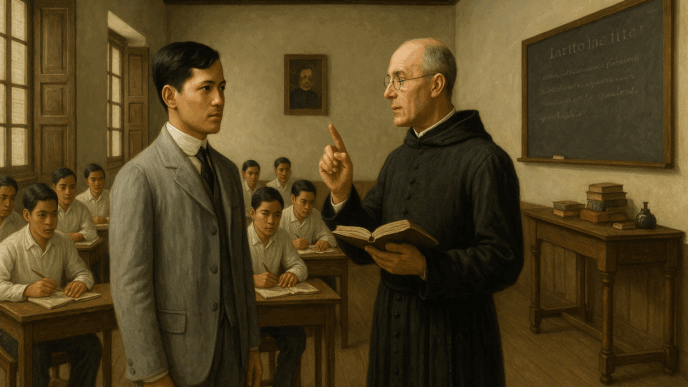
At nine years old Rizal was sent to the neighboring town of Biñan to study under Maestro Justiniano Aquino Cruz, a strict and demanding teacher who ran one of the better primary schools in the region. The move marked his first sustained separation from his family, and his memoirs record it with unusual vividness — the farewell from his mother, the journey, the strangeness of the new household where he boarded.
Under Maestro Justiniano he studied Spanish, Latin, writing, geometry, and the basics of arithmetic. The classroom was competitive, the discipline rigorous, and the social dynamics among the boys — different ages, different backgrounds, the inevitable hierarchies of a school where some students had been there longer and were larger — were an education in themselves. Rizal remembered a confrontation with an older classmate named Pedro, which he handled with more composure than the older boy expected. He was not physically imposing — small for his age, slight — but he had the kind of self-possession that tends to disarm people who rely on intimidation.
He excelled. Maestro Justiniano, who had initially received him with the polite skepticism a teacher extends to an unknown new student, quickly recognized that this particular child was something unusual. Rizal left Biñan at the end of 1870 or early 1871 having compressed years of ordinary schooling into a fraction of the expected time.
He also found, in Biñan, a neighbor who let him draw and paint — an elderly man named Juancho, a painter, who gave the boy access to materials and the freedom to experiment. The combination of strict academic drilling and small artistic freedoms suited Rizal precisely. He left Biñan with his intellect sharpened and his artistic instincts confirmed.
1872: The Year That Changed Everything
Two events fell in the year Rizal turned eleven, and together they broke something open in him that never entirely closed.
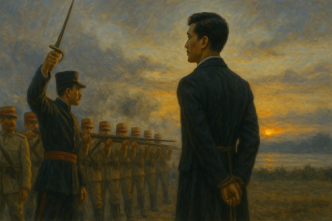
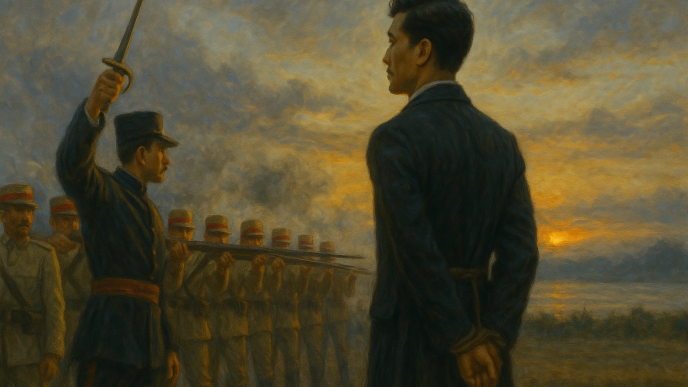
In February 1872, the colonial government executed three Filipino priests — Fathers Gómez, Burgos, and Zamora, known together as Gomburza — on charges of complicity in the Cavite Mutiny, a military uprising that the Spanish authorities used as a pretext to eliminate reformist clerics who had been advocating for Filipino rights within the Church. The executions were carried out by garrote in public. Rizal was too young to attend, but the news reached Calamba and he understood what it meant. He later dedicated his second novel, El Filibusterismo, to the memory of the three priests.
Around the same time, his mother was arrested. The charge was fabricated — a distant relative had been accused of attempting to poison a woman, and Teodora was swept up in the investigation on the thinnest of pretexts. She was marched from Calamba to the provincial jail in Santa Cruz, a two-week ordeal for a woman who had done nothing wrong, carried out by officials who knew she had done nothing wrong. Rizal wrote about this episode in his memoirs under the heading “The Injustice Done My Mother” — a chapter that reads like a child’s first fully lucid encounter with power used arbitrarily and cruelly. She was eventually released without charge.
The two events together — the killing of priests who had advocated for justice, and the imprisonment of his own mother by a system that operated without accountability — gave the boy a political education that no school could have provided. His sense of injustice was no longer abstract. It was personal and documented and it had names.
Manila: The Ateneo Years Begin
In June 1872, his older brother Paciano brought eleven-year-old José to Manila to sit the entrance examinations for the Ateneo Municipal de Manila, a Jesuit school that was among the best educational institutions in the Philippines. There was some initial resistance from the school’s administrators — Rizal was small, looked younger than his age, and arrived with a surname that had already attracted unwanted colonial attention through Paciano’s association with the executed Father Burgos. The intercession of Father Magin Ferrando and a family connection to the nephew of the martyred priest eventually secured his admission.
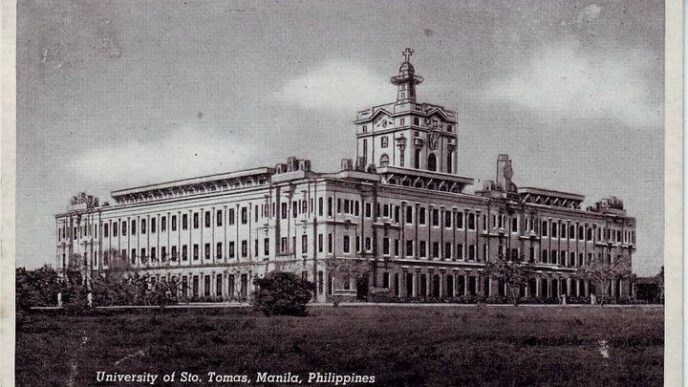
He entered the Ateneo and immediately began to distinguish himself. Within his first year he had established a pattern of academic excellence that would continue without interruption through the entirety of his Manila schooling. The Jesuit educators at the Ateneo recognized early that they had a student of uncommon ability on their hands, and they responded by challenging him with more demanding material.
But the significance of his arrival in Manila is not only academic. He arrived already formed in the most important ways — already curious, already angry, already carrying within him the twin experiences of Gomburza’s execution and his mother’s unjust imprisonment. The Ateneo would sharpen his mind. Calamba and Biñan and 1872 had already shaped his soul.
What Childhood Made
The Rizal who walked into the Ateneo Municipal in 1872 was a boy with an unusual combination of gifts and experiences: a prodigious intelligence cultivated by a remarkable mother, an artistic sensibility nurtured by patient adults who gave him access to materials and time, a physical confidence built by uncles who made sure he could handle himself, and a moral seriousness forged by witnessing, at an age when most children are still insulated from such things, what it actually looks like when power operates without conscience.
His childhood did not produce a revolutionary. It produced something more dangerous: a person who paid close attention, remembered everything, and had the gifts to make other people see what he saw.
The novels that would eventually alarm the entire Spanish colonial establishment — Noli Me Tangere and El Filibusterismo — were not invented at a desk in Berlin. They were observed, over many years, in the fields and households and courtrooms of Calamba, Laguna.
Read next: Rizal’s Education in Manila and Ateneo Years — how the Jesuit school shaped the student who graduated top of his class.