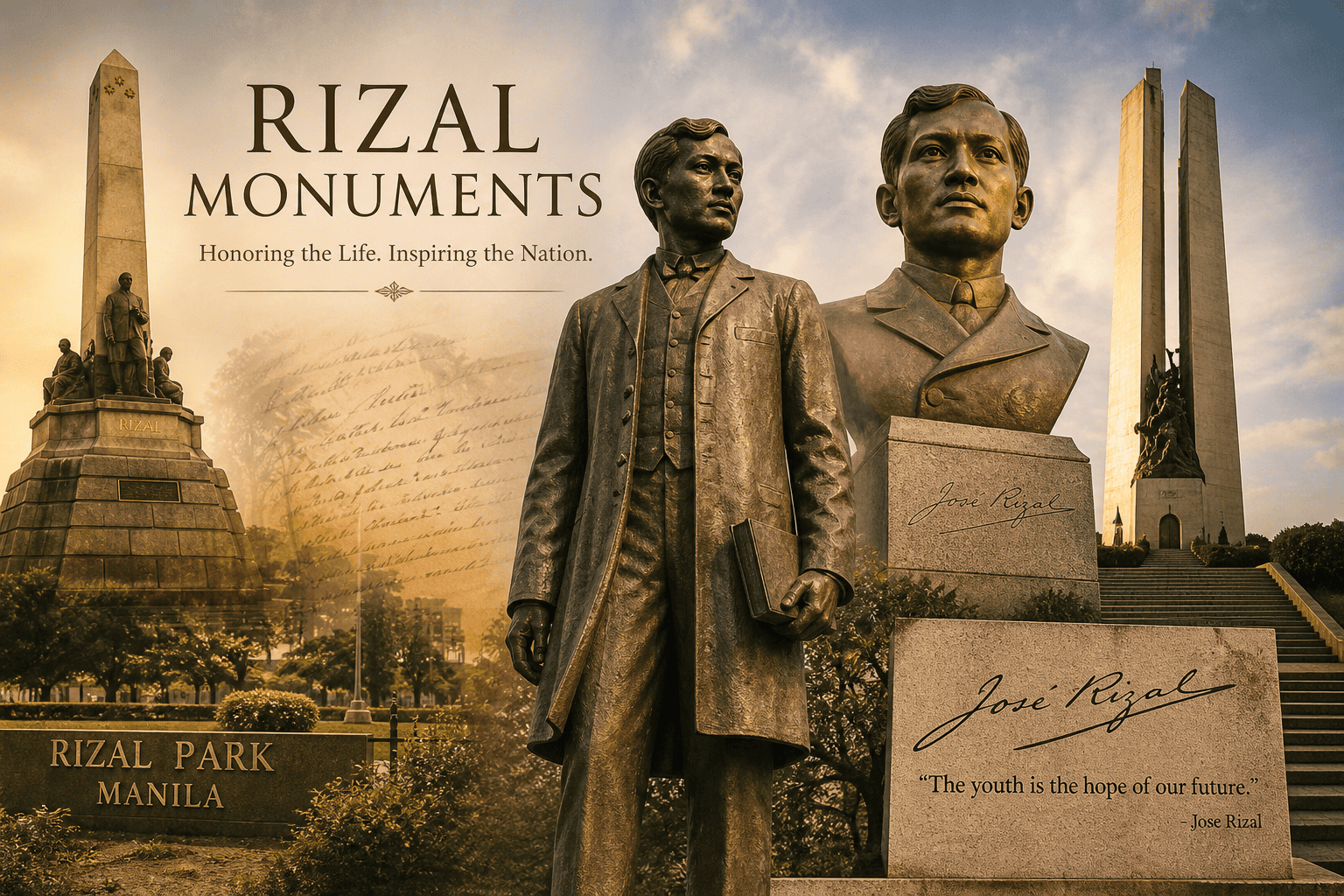
More than a century after his execution, Rizal is the most monumentalized figure in the Philippine landscape. His image stands in virtually every city and municipal plaza in the country. His name is on provinces, streets, schools, hospitals, and parks. Three separate shrines preserve the houses and sites most closely associated with his life. The national monument in Manila serves as Kilometer Zero — the point from which distances to all other Philippine cities are measured.
This article covers the major monuments and shrines in the Philippines: what they are, how they came to be built, and what each one reveals about how a country has chosen to remember its most significant historical figure.
The First Monument: Daet, Camarines Norte, 1898
The oldest surviving Rizal monument in the Philippines is not in Manila. It is in Daet, the capital of Camarines Norte in the Bicol region, and it predates the famous Luneta monument by fourteen years.
Construction began on December 30, 1898, exactly two years after Rizal’s execution at Bagumbayan, in compliance with a decree by General Emilio Aguinaldo declaring that date a national holiday of mourning in the Free Philippines. The monument was designed by Lieutenant Colonel Antonio Sanz of the Philippine Revolutionary Army, a Freemason, and built through financial contributions from the people of Camarines Norte and the surrounding Bicol region. It was completed in February 1899, just as the Philippine-American War was breaking out.
The structure is unlike any other Rizal monument in the country. It bears no image of Rizal at all — no statue, no bust, no likeness. Instead it is a three-tiered stone pylon: a square base surmounted by a two-level triangle tapering to a point, standing about twenty feet tall. The base is inscribed with the titles and publication years of Rizal’s major works — Noli Me Tangere, El Filibusterismo, and Morga, his annotation of Antonio de Morga’s Sucesos de las Islas Filipinas. An eight-rayed sun and five-pointed star appear on the upper tiers, symbols of the Katipunero struggle. The phrase “A Jose Rizal” — To Jose Rizal — appears on two of its three faces.
There is a further detail worth noting: the mortar used in the monument’s construction is believed to have been taken from the demolished old Spanish jail in Daet, where Filipino patriots had been tortured and executed during the 1898 uprising. The monument stands on ground where Katipuneros had fought the Spanish less than a year earlier. The National Historical Commission declared it a historical landmark in 1961 and a national monument in 2008.
The Daet monument matters because it was built before the Americans arrived, before Rizal was institutionally elevated to national hero, and before any state apparatus was directing the commemoration. It was a community’s immediate, spontaneous act of grief and recognition — which makes it, in some ways, the most honest of all the monuments.
The National Monument: Rizal Park, Manila, 1913
The most recognizable monument in the Philippines stands at the western end of Rizal Park in Manila, near the spot where Rizal was executed on December 30, 1896. Formally titled Motto Stella — Latin for “guiding star” — it is the work of Swiss sculptor Richard Kissling and was unveiled on December 30, 1913, the seventeenth anniversary of Rizal’s death.
The monument’s history is worth knowing in detail. In September 1901, the United States Philippine Commission passed Act No. 243, authorizing the use of public land at the Luneta for a Rizal monument and stipulating that his remains be interred within it. A committee was formed that included Paciano Rizal, José’s older brother, along with several prominent Filipinos. Between 1905 and 1907, they ran an international design competition that attracted forty entries from sculptors across Europe and the United States.
The first prize went to Italian sculptor Carlo Nicoli for a design titled Al Mártir de Bagumbayan — elaborate, marble-intensive, and unmistakably European. The second prize went to Swiss sculptor Richard Kissling for a simpler, more restrained design in bronze and unpolished granite. When Nicoli failed to sign the contract and post the required bond, the commission awarded the project to Kissling. Some critics at the time called his design vulgar y tosco — lousy — and there were proposals to bring in the Filipino painter Félix Resurrección Hidalgo to modify it. The bronze figures had already been cast in Switzerland, and the changes never happened. In retrospect, Kissling’s restraint has served the monument well.
The monument depicts Rizal standing in an overcoat, holding a book inscribed with the title of Noli Me Tangere. Figures on the surrounding base — a woman with an infant, a man and a boy reading — emphasize education. The granite obelisk rises behind the central figure. His remains, which his sister Narcisa had tracked to an unmarked grave at Paco Cemetery by bribing the caretaker to mark the site with Rizal’s initials in reverse, were transferred to the base in 1912. The monument was unveiled one year later.
In 1961, for the centennial of Rizal’s birth, architect Juan Nakpil superimposed a stainless steel pylon over the granite obelisk, increasing the structure’s height from 12.7 meters to 30.5 meters. The addition was almost universally criticized as incompatible with the original’s solemnity, and it was removed two years later at the request of Education Secretary Alejandro Roces. Today the monument stands as Kissling designed it, guarded around the clock by the Philippine Marine Corps, and designated by Executive Order No. 487 as Kilometer Zero — the reference point from which road distances across the Philippines are measured.
About 100 meters northwest of the monument, a sculptural tableau by Eduardo Castrillo marks the exact ground where Rizal fell. An evening light-and-sound program dramatizes his final hour.
The Rizal Shrine, Fort Santiago, Manila
Rizal spent his last fifty-six days imprisoned at Fort Santiago in Intramuros, the walled city that was the center of Spanish colonial power in the Philippines. He arrived on November 3, 1896, and walked out on the morning of December 30 to his execution at Bagumbayan.
The Museo ni Jose Rizal, also known as the Rizal Shrine, occupies the reconstructed wing of the barracks where he was held. It was established in 1953 and renovated in 2014 by the National Historical Commission. The museum houses original manuscripts, personal items, correspondence, books, and artwork — including shells he collected in Dapitan and objects from the final months of his life. It is also where, in the cell he occupied during his last night, he completed Mi Último Adiós and hid the handwritten poem inside an alcohol stove to be retrieved by his sister Trinidad.
The most distinctive feature of the shrine is the path from the cell to the exit: bronze footprints set into the ground mark the route Rizal walked from his imprisonment toward Luneta on the morning of his execution. Visitors trace those footsteps. The effect is quiet and specific in a way that the grand monument at Luneta, for all its civic weight, is not.
Fort Santiago functions differently from Rizal Park. The park is a space of ceremony and commemoration. The fort is a space of confrontation — with the documented reality of what was done to him, in this building, in these rooms, by this system.
The Rizal Shrine, Calamba, Laguna
Calamba, Laguna is where Rizal was born on June 19, 1861, and the shrine there is a reconstruction of the family home — a bahay-na-bato, a traditional stone house with wide capiz-shell windows — that was destroyed during World War II. The reconstruction was completed and opened in 1950. The National Historical Commission painted its exterior green, which was the original color of the Rizal family home.
The shrine contains memorabilia from Rizal’s childhood and family life, and the remains of his parents — Francisco Mercado and Teodora Alonso — are interred on the grounds. Adjacent to the house is a gallery with exhibits on his early years and an open lawn.
Nearby stands Calamba’s large bronze Rizal statue — a 22-foot figure on a base bringing the total height to approximately 43 feet — unveiled in 2011 for the 150th anniversary of Rizal’s birth. It is among the tallest Rizal statues in the country.
The Calamba shrine is the most domestic of the three major shrines. Where Fort Santiago confronts the violence of his death and Dapitan celebrates the productivity of his exile, Calamba returns him to childhood — to the house where Teodora Alonso taught him to read, where he first heard the stories that would eventually become the emotional landscape of his novels, and where the colonial injustice he would spend his life writing about first became personal.
The Jose Rizal Memorial Protected Landscape, Dapitan
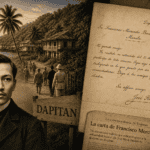
The Dapitan shrine is the largest and the most immersive of the three, covering approximately sixteen hectares of land that Rizal purchased with his share of a Manila Lottery prize in 1893 during his exile. He built three main structures on the property — Casa Residencia, his main house; Casa Redonda, an octagonal building used as clinic and dormitory for his students; and Casa Cuadrada, a six-sided barn — along with a waterworks system, a dam, an aqueduct, and a reservoir that he designed himself to bring clean water to the town.
The full site includes Mi Retiro Rock, where he wrote poems by the sea; an amphitheater; a museum containing artifacts from the exile years; and the surrounding landscape he planted and cultivated during the four years he spent there. All the structures are preserved or reconstructed on their original sites.
Dapitan is where the Rizal who is most often overlooked comes into focus: not the novelist or the martyr, but the physician who treated hundreds of patients in a remote coastal town, the engineer who designed water infrastructure for a community that had none, the teacher who ran a school for local boys, the naturalist who collected specimens later recognized as new species, and the farmer who planted cacao, coconut, sugarcane, and fruit trees on land he had won in a lottery. The exile was forced and the circumstances were unjust. What he made of it was remarkable.
Provincial Monuments: A Nationwide Presence
Beyond the four major sites, Rizal’s image stands in virtually every city and municipal plaza in the Philippines. The practice of placing Rizal statues at the center of town squares was formalized during the American colonial period, when Act No. 243 and the broader institutionalization of Rizal Day gave local governments a civic framework for commemoration. Most were erected in the early twentieth century, with additional waves of monument-building around significant anniversaries — particularly the 1961 birth centennial and the 1998 centennial of Philippine independence.
The monuments vary widely in quality, scale, and artistic approach. Some are formally commissioned bronze sculptures. Others are simpler painted concrete figures that have stood in provincial plazas for decades. A significant number replicate or reference the Kissling design from Luneta — the overcoat, the book, the upright stance — which has become a kind of visual template for how Rizal is expected to look. Others, particularly those commissioned in later decades, take more interpretive approaches.
A few provincial monuments deserve particular mention. The Rizal statue in Zamboanga City stands near the site where he departed for Manila in 1896 at the end of his Dapitan exile, making it a monument to a departure that ended in execution. Provincial capitals that Rizal visited or passed through during his years in the Philippines — including Cavite, Cebu, and Iloilo — have their own monuments connected to specific episodes in his biography.
Paco Park, Manila
Paco Cemetery — now Paco Park — is where Rizal was secretly buried after his execution, without a coffin and without any marker, on the orders of the Spanish colonial authorities who presumably hoped an unmarked grave would prevent his burial site from becoming a place of pilgrimage. His sister Narcisa searched the cemetery until she found freshly turned earth, bribed the caretaker to mark the site with the letters RPJ — Rizal’s initials in reverse — and kept vigil over the location for years. His remains were eventually exhumed, kept by the family in Binondo, and finally transferred to the base of the Luneta monument in 1912.
The original burial site in Paco Park is marked today with a memorial. The park itself — a former Spanish-era cemetery enclosed by circular columbarium walls — has become one of Manila’s quieter historic spaces. It is not a monument in the formal sense, but it is one of the most historically significant Rizal sites in the country: the place where the Spanish colonial government tried to erase him, and where his family’s persistence ensured that it failed.
Rizal Day and the Living Geography of Memory
Every December 30, the Philippines observes Rizal Day — a national holiday anchored by the ceremony at the Luneta monument, where the president or a designated official lays a wreath and flag ceremonies are held across the country. The ritual has been performed continuously since the American colonial period, with only wartime interruptions.
What the monuments, shrines, and annual ceremonies together constitute is something harder to name than simple commemoration. They are the material form of a country’s ongoing argument with itself about what it values and what it owes its past — an argument that Rizal himself anticipated when he wrote, in his final years, that the generation that would understand him had not yet arrived.
Whether that generation has arrived is a question each Rizal Day poses anew.
For the full account of the national monument and the park surrounding it, see Rizal Park: A Visitor’s Guide. For Rizal monuments outside the Philippines, see our separate article on international Rizal monuments. For more on how Rizal came to be the national hero, see How Rizal Became the National Hero of the Philippines.