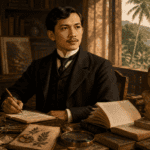
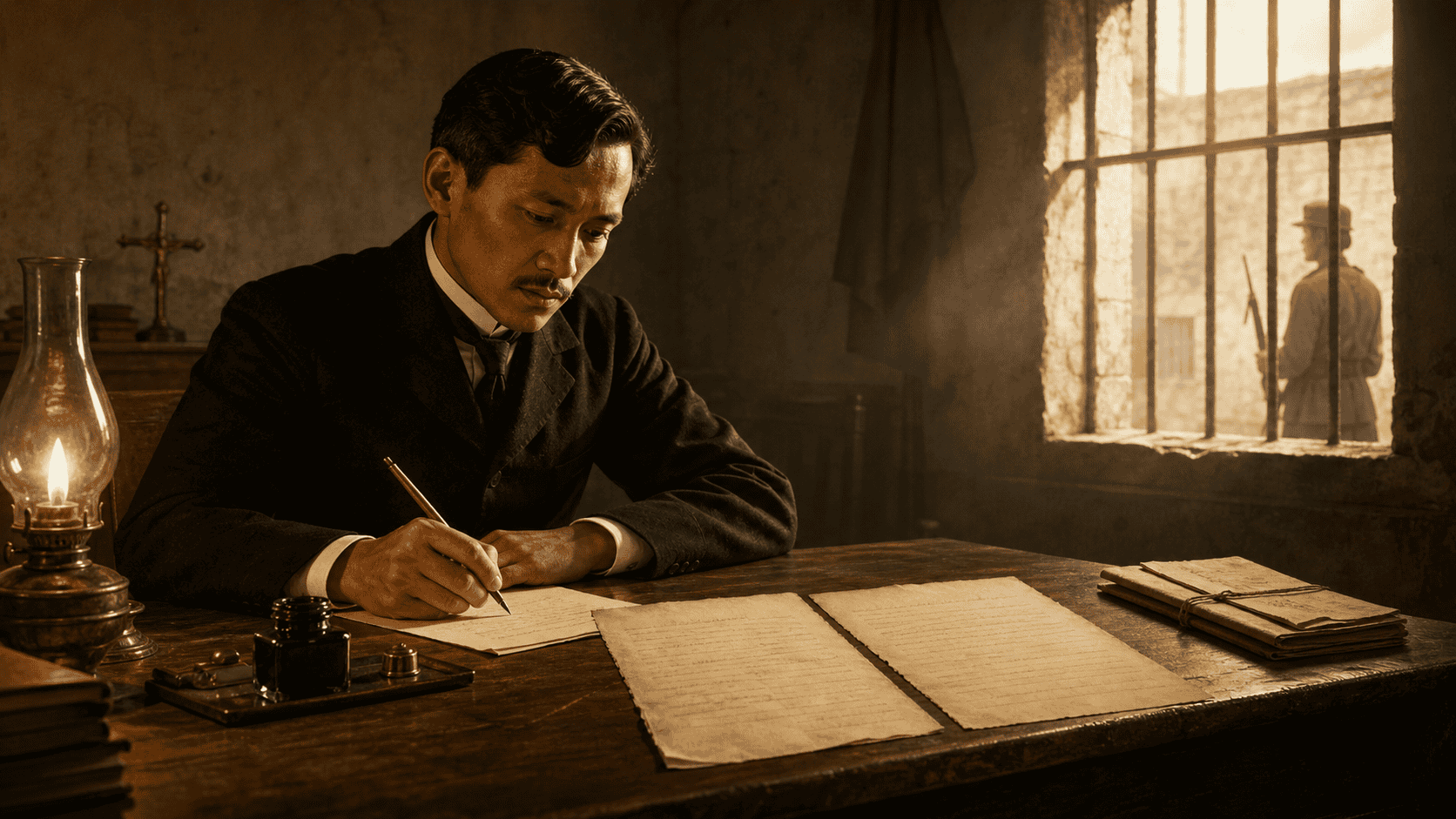
Jose Rizal wrote the poem in his cell at Fort Santiago on the night of December 29, 1896. He was thirty-five years old. He would be executed at dawn. He folded the handwritten pages and hid them inside a small alcohol stove, which he gave to his family during their final visit. His sister Trinidad carried the stove out of the prison. When the family opened it after his execution, they found the poem inside.
He had left it untitled. The title Mi Último Adiós — My Last Farewell — was given to it afterward by his friend and fellow reformist Mariano Ponce, who arranged for its first publication in Hong Kong in 1897. It has since been translated into more than forty languages and is recognized as one of the most significant poems written in the nineteenth century.
What follows is the complete Spanish original beside the English translation by Charles Derbyshire, published in 1912 as part of his collection The Poems of Jose Rizal. Derbyshire’s translation remains the most widely read English version and the one most commonly used in Philippine classrooms under the Rizal Law.
A note on stanza order: Derbyshire’s translation rearranges the stanzas slightly from the original Spanish. In Rizal’s manuscript, the poem opens with the address to the patria adorada — the beloved homeland — and closes with the farewell to parents and friends. Derbyshire opens with the farewell to the fatherland and closes with the farewell to parents, reversing the emotional arc. Both versions are presented here in their own order, with brief notes on each stanza to help readers follow the poem’s movement.
The Poem: Spanish and English, Stanza by Stanza
Stanza 1 (Rizal’s original opening)
Mi Último Adiós — José Rizal
¡Adiós, Patria adorada, región del sol querida,
Perla del mar de oriente, nuestro perdido Edén!
A darte voy alegre la triste mustia vida,
Y fuera más brillante, más fresca, más florida,
También por ti la diera, la diera por tu bien.
My Last Farewell — Charles E. Derbyshire
Farewell, dear Fatherland, clime of the sun caress’d,
Pearl of the Orient seas, our Eden lost!
Gladly now I go to give thee this faded life’s best,
And were it brighter, fresher, or more blest,
Still would I give it thee, nor count the cost.
The poem opens not with grief but with gladness — the word alegre in the Spanish, translated by Derbyshire as “gladly.” Rizal is not lamenting his death. He is offering it. The Philippines is named three times in different registers: patria adorada (beloved homeland), región del sol querida (beloved region of the sun), and perla del mar de oriente (pearl of the Orient seas) — a phrase that had appeared in reformist writing and would eventually enter the Philippine national anthem. The image of a “lost Eden” sets up the poem’s central tension: a paradise that has been taken, and a death that is a contribution toward its recovery.
Stanza 2
En campos de batalla, luchando con delirio,
Otros te dan sus vidas sin dudas, sin pesar;
El sitio nada importa, ciprés, laurel o lirio,
Cadalso o campo abierto, combate o cruel martirio,
¡Lo mismo es si lo piden la patria y el hogar!
On the field of battle, ‘mid the frenzy of fight,
Others have given their lives, without doubt or heed;
The place matters not—cypress or laurel or lily white,
Scaffold or open plain, combat or martyrdom’s plight, ‘
Tis ever the same, to serve our home and country’s need.
Rizal positions his death alongside those of soldiers who died fighting — not above them, not below them, but equal. The place does not matter: battlefield or scaffold, cadalso (gallows) or open plain. What matters is the reason. This is a quiet but significant claim: that an execution ordered by a colonial government is as honorable a death as a soldier’s death in combat, provided both are given in service to the country. The Spanish authorities who ordered his execution would not have agreed.
Stanza 3
Yo muero cuando veo que el cielo se colora
Y al fin anuncia el día tras lóbrego capuz;
Si grana necesitas para teñir tu aurora,
Vierte la sangre mía, derrámala en buen hora
Y dórela un reflejo de su naciente luz.
I die just when I see the dawn break,
Through the gloom of night, to herald the day;
And if color is lacking my blood thou shalt take,
Pour’d out at need for thy dear sake,
To dye with its crimson the waking ray.
One of the poem’s most vivid stanzas. The execution was scheduled for dawn — Rizal would have known this — and here he transforms the literal time of his death into an image: his blood dyeing the dawn red, coloring the sky as the Philippines wakes into a new day. The image is precise and deliberately double: the crimson of a sunrise and the crimson of blood are the same color, and Rizal is offering one to make the other possible.
Stanza 4
Mis sueños cuando apenas muchacho adolescente,
Mis sueños cuando joven ya lleno de vigor,
Fueron el verte un día, joya del mar de oriente,
Secos los negros ojos, alta la tersa frente,
Sin ceño, sin arrugas, sin manchas de rubor.
My dreams, when life first opened to me,
My dreams, when the hopes of youth beat high,
Were to see thy lov’d face, O gem of the Orient sea,
From gloom and grief, from care and sorrow free;
No blush on thy brow, no tear in thine eye.
The poem shifts into autobiography. Rizal is remembering what he wanted when he was young — not personal success or recognition, but a specific image of the Philippines: eyes dry, forehead high, no frown, no wrinkles, no flush of shame. The last image is the most precise: sin manchas de rubor, without stains of embarrassment. He had spent his adult life writing about what colonial rule had done to Filipino dignity — the shame that the system induced, the self-contempt it cultivated. This stanza names what he had been writing against all along.
Stanza 5
Ensueño de mi vida, mi ardiente vivo anhelo,
¡Salud te grita el alma que pronto va a partir!
¡Salud! ¡Ah, que es hermoso caer por darte vuelo,
Morir por darte vida, morir bajo tu cielo,
Y en tu encantada tierra la eternidad dormir!
Dream of my life, my living and burning desire,
All hail! cries the soul that is now to take flight;
All hail! And sweet it is for thee to expire;
To die for thy sake, that thou mayst aspire;
And sleep in thy bosom eternity’s long night.
The poem reaches its emotional peak here. Salud — health, a toast, a greeting — is what the soul cries out as it departs. There is no bitterness in it. The dying is described as beautiful: que es hermoso caer por darte vuelo — how beautiful it is to fall in order to give you flight. The paradox — death as the gift of life, falling as the act that enables flight — is at the heart of what the poem is doing. Rizal is not dying despite his love for the Philippines. He is dying because of it, and for it.
Stanza 6
Si sobre mi sepulcro vieres brotar un día
Entre la espesa yerba sencilla, humilde flor,
Acércala a tus labios y besa al alma mía,
Y sienta yo en mi frente bajo la tumba fría,
De tu ternura el soplo, de tu hálito el calor.
If over my grave some day thou seest grow,
In the grassy sod, a humble flower,
Draw it to thy lips and kiss my soul so,
While I may feel on my brow in the cold tomb below
A breath of thy tenderness, a warmth of thy power.
The poem slows and quiets here, moving from the grand gestures of sacrifice to something intimate and small: a single humble flower growing over his grave, pressed to the lips of the homeland he loved. The cold tomb below the warm breath above. This stanza is the closest the poem comes to tenderness in the conventional sense, and it earns that tenderness because it follows five stanzas of sustained dignity.
Stanza 7
Deja a la luna verme con luz tranquila y suave,
Deja que el alba envíe su resplandor fugaz,
Deja gemir al viento con su murmullo grave,
Y si desciende y posa sobre mi cruz un ave,
Deja que el ave entone su cántico de paz.
Let the moon beam over me soft and serene,
Let the dawn shed over me its fleeting light,
Let the wind with sad lament over me keen;
And if a bird descends on my cross and is seen,
Let the bird sing forth a song of delight.
The word deja — let, allow — repeats four times in the Spanish, giving this stanza a liturgical quality, like a series of permissions or blessings. Moon, dawn, wind, bird: the natural world is invited to continue its rhythms over his grave. The bird singing on his cross is the poem’s most Christian image — and also its most peaceful. The man who will be executed at dawn asks only that the world keep turning, that its ordinary beauties continue, that a bird be allowed to sing.
Stanza 8
Deja que el sol, ardiendo, las lluvias evapore
Y al cielo tornen puras, con mi clamor en pos;
Deja que un ser amigo mi fin temprano llore
Y en las serenas tardes cuando por mí alguien ore,
¡Ora también, oh Patria, por mi descanso a Dios!
Let the burning sun the raindrops vaporize,
And with my sighs return pure to the sky;
Let a friend shed tears over my early demise;
And in the still evening a prayer arise,
On the holy hour a prayer to the sky.
The deja sequence continues. His sighs rising with evaporated rain to the sky — transformed, purified, part of the natural cycle. A friend weeping. An evening prayer. And then the most remarkable request in this stanza: he asks the Philippines itself to pray to God for his rest. Not a priest. Not his family. The country.
Stanza 9
Ora por todos cuantos murieron sin ventura,
Por cuantos padecieron tormentos sin igual,
Por nuestras pobres madres que gimen su amargura;
Por huérfanos y viudas, por presos en tortura
¡Y ora por ti que veas tu redención final!
Pray for all those that hapless have died,
For all who have suffered the unmeasured pain;
For our mothers that bitterly their woes have cried,
For widows and orphans, for captives by torture tried,
And then for thyself that redemption thou mayst gain.
Having asked the Philippines to pray for him, Rizal immediately expands the prayer outward. Pray for those who died without luck. For those who suffered without measure. For poor mothers. For orphans and widows. For prisoners under torture. The catalogue is the catalogue of colonial suffering that his novels had documented in detail. And at the end: pray for yourself, Philippines, that you may see your final redemption. The poem turns the act of mourning him into an act of political aspiration.
Stanza 10
Y cuando en noche oscura se envuelva el cementerio
Y solos sólo muertos queden velando allí,
No turbes su reposo, no turbes el misterio,
Tal vez acordes oigas de cítara o salterio,
¡Soy yo, querida Patria, yo que te canto a ti!
And when the dark night wraps the graveyard around
With only the dead in their vigil to see,
Break not my repose or the mystery profound,
And perchance thou mayst hear a sad hymn resound— ‘
T is I, O my country, raising a song unto thee.
The dead keeping vigil — a reversal of the usual image, where the living keep vigil over the dead. And then the moment that must have cost him something to write: Soy yo, querida Patria, yo que te canto a ti. It is I, beloved homeland, I who sing to you. From inside the grave. Still singing. The poet does not stop at death.
Stanza 11
Y cuando ya mi tumba de todos olvidada
No tenga cruz ni piedra que marquen su lugar,
Deja que la are el hombre, la esparza con la azada,
Y mis cenizas, antes que vuelvan a la nada,
El polvo de tu alfombra que vayan a formar.
And when my grave by all is no more remembered,
With neither cross nor stone to mark its place,
Let it be ploughed by man, with spade be upturned,
That my ashes may carpet earthly space
Before into nothingness at last they are scattered.
Rizal asks to be forgotten in the most complete sense — not mourned, not commemorated, but literally turned over by a plow, his ashes scattered into the soil of the Philippines itself. This is either the poem’s most selfless moment or its most quietly proud one: the man who knew his name would not be forgotten asking the world to forget him, so that what remains is not a monument but a country.
Stanza 12
Entonces nada importa me pongas en olvido.
Tu atmósfera, tu espacio, tus valles cruzaré.
Vibrante y limpia nota seré para tu oído,
Aroma, luz, colores, rumor, canto, gemido,
¡Constante repitiendo la esencia de mi fe!
Then will oblivion bring to me no care;
Over thy vales and plains I’ll sweep;
Throbbing and cleansed in thy space and air,
With color and light, with song and lament I fare,
Ever repeating the faith that I keep.
Oblivion does not frighten him. He will be in the atmosphere, in the space, crossing the valleys. He will be a note of music, an aroma, a color, a sound, a song, a lament — the full sensory catalogue of a country’s experience. And through all of it he will be repeating the essence of his faith. The faith is not specified. It does not need to be.
Stanza 13
Mi patria idolatrada, dolor de mis dolores,
Querida Filipinas, oye el postrer adiós.
Ahí te dejo todo, mis padres, mis amores.
Voy donde no hay esclavos, verdugos ni opresores,
Donde la fe no mata, donde el que reina es Dios.
My Fatherland ador’d, that sadness to my sorrow lends,
Beloved Filipinas, hear now my last good-by!
I give thee all: parents and kindred and friends;
For I go where no slave before the oppressor bends,
Where faith can never kill, and God reigns e’er on high!
The second-to-last stanza in Rizal’s original is where the poem’s political statement is most explicit: Voy donde no hay esclavos, verdugos ni opresores — I go where there are no slaves, executioners, or oppressors. And: donde la fe no mata — where faith does not kill. The last phrase is one of the most direct indictments of the colonial religious establishment in the entire poem. Faith — as practiced by the friars in the Philippines, as used to justify his execution — kills. Where he is going, it does not.
Stanza 14 (Rizal’s closing stanza)
¡Adiós, padres y hermanos, trozos del alma mía,
Amigos de la infancia en el perdido hogar!
¡Dad gracias que descanso del fatigoso día;
Adiós, dulce extranjera, mi amiga, mi alegría!
¡Adiós, queridos seres, morir es descansar!
Farewell to you all, from my soul torn away,
Friends of my childhood in the home dispossessed!
Give thanks that I rest from the wearisome day!
Farewell to thee, too, sweet friend that lightened my way;
Farewell, dear ones, farewell! To die is to rest.
The final stanza turns from the Philippines to the people. Parents, brothers, sisters, childhood friends, the sweet friend — Josephine Bracken, almost certainly — who lightened his way. And the closing line: morir es descansar. To die is to rest. The weary day is over. The man who had been writing and fighting and traveling and suffering for fifteen years is tired, and he is not ashamed to say so. Death as rest — not defeat, not surrender, but the end of a long day’s work.
On the Two Existing Translations
Derbyshire’s 1912 translation is the most widely used in the Philippines and the one students encounter in schools. It is a competent translation that preserves the poem’s dignity and most of its imagery, but it takes liberties with the stanza order and occasionally smooths over the Spanish in ways that soften the poem’s edges.
The site does not have Nick Joaquin’s English translation, a more recent translation that attempts a closer fidelity to the original Spanish, preserving the stanza order and rendering some of the more politically charged lines more literally. Readers who want to compare multiple English versions will find both there.
For the Spanish original with full literary analysis of the poem as a whole — its structure, its imagery, its place in Rizal’s life and in Philippine literature — see the dedicated Mi Último Adiós page.
For more on the night Rizal wrote this poem, see The Death of José Rizal: What Happened on December 30, 1896 and Rizal’s Trial and Execution.