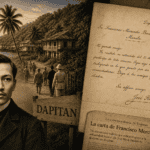

Ignorance was not, for Rizal, a passive condition. It was an instrument — something that colonial systems cultivated deliberately, maintained carefully, and deployed against the people subject to them. He returned to the subject throughout his writing life, in letters, essays, and novels, and from different angles each time: ignorance as servitude, ignorance as a barrier to reform, ignorance as something passed from one generation to the next, ignorance as the precondition for tyranny.
The quotes gathered here are drawn from across his work, with context for each. Together they form something closer to an argument than a list — a sustained, consistent position that Rizal developed over more than a decade of writing about the Philippines and what it would take to change it.
“Ignorance is servitude, because as a man thinks, so he is; a man who does not think for himself and allows himself to be guided by the thought of another is like the beast led by a halter.”
— Letter to the Young Women of Malolos, February 22, 1889
This is the most famous of Rizal’s statements on ignorance, and it earns that status. The argument is compressed but complete: ignorance produces dependence, dependence produces servitude, and the person who has been taught to receive truth from others rather than seek it is not free in any meaningful sense — whatever their legal status.
The letter was written to a group of women in Malolos, Bulacan who had petitioned the colonial governor-general for the right to open a night school where they could study Spanish. The petition was initially approved, then reversed under pressure from the local parish priest. The women persisted. Rizal, learning of their situation from Europe, responded with a letter written in Tagalog — deliberately, so it would be readable without the Spanish that the colonial education system controlled access to.
The image he reaches for — a beast led by a halter — is deliberately unglamorous. It strips away any dignity from intellectual dependence and makes it impossible to romanticize. A person who has been educated into deference is not a humble person or a faithful one. They are an animal on a rope.
“No good water comes from a muddy spring. No sweet fruit comes from a bitter seed.”
— Letter to the Young Women of Malolos, February 22, 1889
This line from the same letter operates differently from the first. Where the halter image describes what ignorance does to the individual, this one describes what it does across generations. Rizal’s central argument to the women of Malolos was not simply that they deserved education for their own sake — though he believed that — but that the education of mothers was the precondition for the education of children. A woman who had been taught to defer without questioning could not raise children who questioned. A woman who had been trained to accept the interpretation of authorities could not model the habit of independent thought.
The colonial system understood this, which is why the education of Filipino women was so carefully controlled. Rizal understood it too. His letter to Malolos was, at one level, a letter about a night school. At another level it was an argument that the most effective long-term strategy for keeping a people subordinate was to keep its mothers in the dark.
“The gift of reason with which we are endowed must be brightened and utilized.”
— Letter to the Young Women of Malolos, February 22, 1889
This line completes the trilogy from the Malolos letter. The first quote named the problem, the second described its intergenerational mechanism, and this one states the obligation: reason is a capacity, not a given. It can be cultivated or it can be allowed to dim. The choice, Rizal insists, is not neutral — it is a moral one.
In the context of colonial Philippines, where the Catholic religious orders had spent centuries cultivating deference to priestly authority as a form of piety, the claim that reason must be exercised rather than surrendered was a direct challenge to the dominant framework. Rizal was not arguing against faith. He was arguing against the use of faith as a pretext for the suppression of thought — a distinction his enemies in the church were not always willing to acknowledge.
“Without education and liberty, which are the soil and the sun of man, no reform is possible, no measure can give the result desired.”
— “On the Indolence of the Filipinos,” La Solidaridad, 1890
This quote comes from a completely different source and context — a long polemical essay published in the reformist newspaper La Solidaridad — which makes the consistency of the underlying argument all the more striking. A year after the Malolos letter, writing in a different register for a different audience, Rizal arrives at the same position from a different direction.
The essay was a response to the Spanish colonial claim that Filipinos were naturally indolent — lazy by disposition, unfit for self-governance. Rizal’s rebuttal was systematic: he argued that what looked like indolence was in fact the rational response of a people who had been given no incentive to produce, no protection for what they produced, and no education to help them imagine alternatives. The indolence was induced, not inherent.
The quote belongs to that argument. Education and liberty are not luxuries that a society earns once it has reformed itself. They are the conditions without which reform becomes impossible. Remove them — as the colonial system had — and you create exactly the stagnation you then use as justification for continued control.
“There can be no tyrants where there are no slaves.”
— El Filibusterismo, 1891
This is the political consequence of ignorance stated in its starkest form. Simoun speaks a version of this line in El Filibusterismo, and the novel’s architecture gives it full weight: by the time the reader encounters it, they have watched the entire colonial system — its priests, its officials, its courts, its prisons — operate as a machine for producing exactly the kind of people this line describes.
Tyranny, Rizal argues, is not imposed from outside on an unwilling population. It requires the cooperation of the governed — their deference, their silence, their willingness to accept the interpretations handed to them. That cooperation is not natural. It is produced: through controlled education, through the suppression of critical thought, through the cultivation of a religious culture that equated questioning with sin. Ignorance, in other words, is not simply the absence of knowledge. It is the presence of a particular kind of manufactured dependency that makes the whole colonial enterprise possible.
The line also contains an implicit challenge. If there can be no tyrants where there are no slaves, then the path to ending tyranny runs through the people who are being oppressed — through their willingness to think, to question, and to refuse the role that has been assigned to them. This is the political payoff of everything Rizal argued about education. It is not simply that educated people are better off. It is that an educated people is one that cannot be governed by fear alone.
What These Quotes Have in Common
Read together, these quotes form a consistent argument that Rizal developed across more than a decade of writing in different forms and for different audiences. Ignorance is not a neutral condition. It is a political one — produced by systems that benefit from it, maintained by institutions that depend on it, and most effectively challenged by the education of those it is designed to keep subordinate.
The women of Malolos who petitioned for a night school in 1888 understood this instinctively. Rizal’s letter told them they were right.
For more on the Letter to the Young Women of Malolos and Rizal’s other essays, see the complete works of José Rizal. For more of his most significant quotations, see the collections from Noli Me Tangere and El Filibusterismo.