Quick Summary
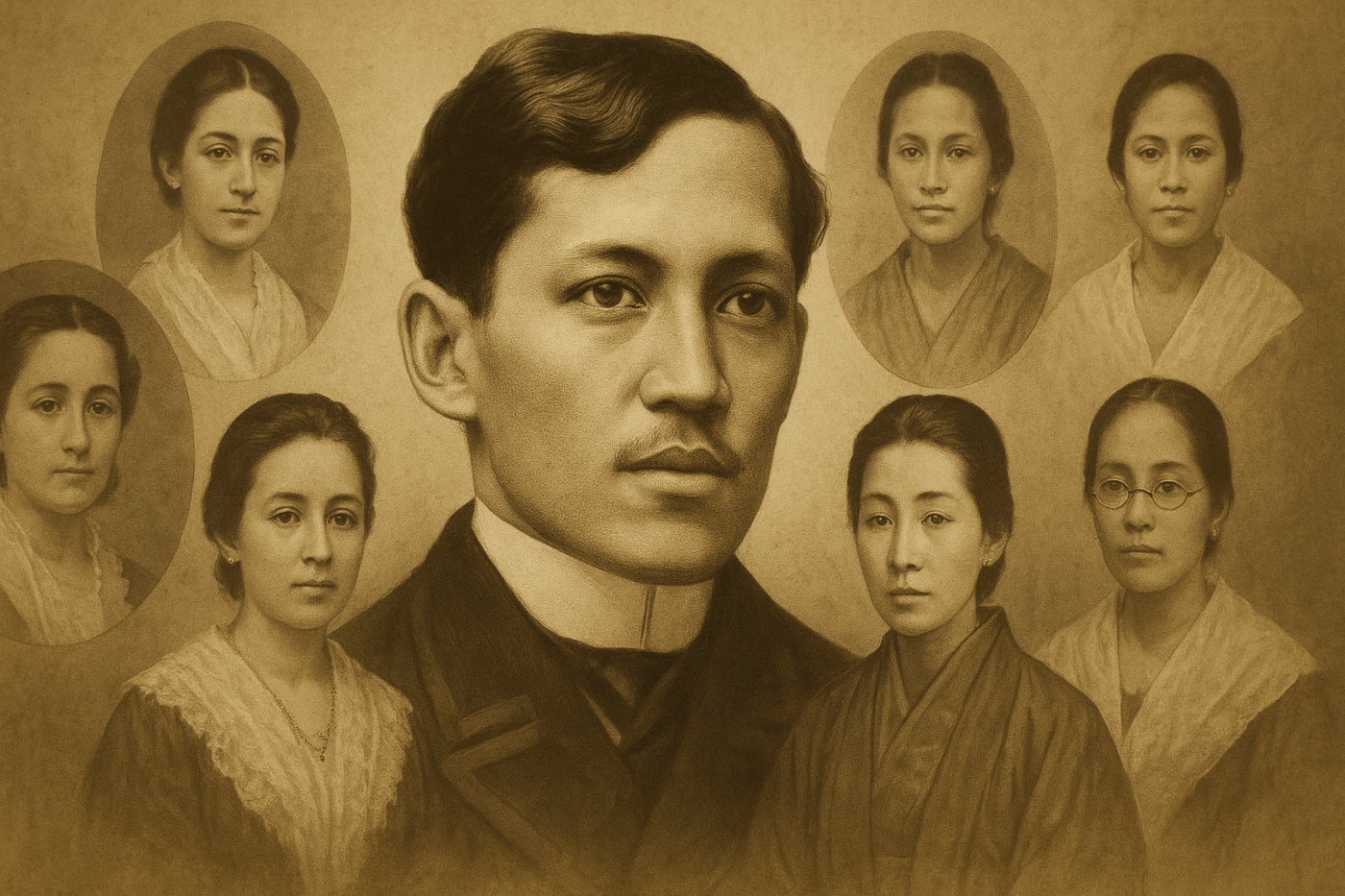
Rizal’s life was shaped by several remarkable women who inspired his writings, challenged his beliefs, and anchored his emotional world. Their stories reveal the softer, more personal dimensions of a man often viewed only as a hero or martyr.
Introduction
Jose Rizal, remembered as a reformist and thinker, was also a man who loved deeply, lost painfully, and formed relationships that influenced his writing and worldview. The women who entered his life came from different countries, cultures, and social backgrounds. Some became romantic interests; others were intellectual companions or figures who awakened his artistic imagination. Each left an imprint on Rizal’s emotional and creative journey.
To explore these women is to see Rizal as a human being — capable of longing, tenderness, and vulnerability. Through their stories, we encounter a side of the hero that textbooks often overlook.
Segunda Katigbak: First Love and First Heartbreak
In 1877, Rizal met Segunda Katigbak, the young, charming girl from Lipa. She was described as petite, intelligent, and modest — qualities that quickly drew the teenage Rizal in. Their meetings took place in the refined environment of Manila visiting salons and homes, where young people were carefully chaperoned.
Their connection was genuine but short-lived. Segunda was already engaged to another man, a reality that Rizal quietly accepted. Years later, he would write that his first love “died a natural death,” a gentle acknowledgment that youthful affection must sometimes bow to circumstance.
Her memory stayed with him, a quiet reminder of innocence and longing.
Leonor Valenzuela: The Sweet Interlude
During his years at the University of Santo Tomas, Rizal briefly courted Leonor Valenzuela, known as “Orang.” Their romance was light and affectionate. Rizal, ever inventive, wrote her letters in invisible ink made from table salt and water, which she had to warm over a lamp to read.
This period was more of youthful courtship than deep attachment. While they cared for each other, the relationship faded when Rizal left for Europe. Still, Orang’s role in his life is a glimpse of Rizal as a playful young man experimenting with the language of love.
Leonor Rivera: The Silent, Steadfast Love
No woman shaped Rizal’s emotional life more deeply than Leonor Rivera, his cousin and long-time sweetheart. She was the inspiration for Maria Clara, the idealized heroine of Noli Me Tangere. Their relationship spanned eleven years, sustained by letters filled with tenderness, loyalty, and dreams for the future.
However, Leonor lived under immense pressure. Her mother disapproved of Rizal’s political writings and feared his growing notoriety. While Rizal was in Europe, Leonor’s mother intercepted his letters. Believing he had abandoned her, Leonor eventually married Henry Kipping, an English engineer.
Rizal learned of her marriage months later and was devastated. Friends described him as withdrawn, carrying grief quietly but deeply. Leonor’s story remains one of the most tragic chapters of Rizal’s life — a love broken not by betrayal but by manipulation and circumstance.
Consuelo Ortiga y Rey: A Warm Madrid Memory
While living in Spain, Rizal became close to Consuelo Ortiga, daughter of a prominent Madrid family. She admired Rizal’s intelligence and charm, and he was equally drawn to her kindness and culture. Rumors suggest that she fell deeply in love with him.
Rizal, however, stepped back when he realized his friend Eduardo de Lete also courted Consuelo. He valued their friendship more than a fleeting romance. In his diary, he noted that he admired Consuelo’s personality but did not wish to complicate the friendship within the Filipino expatriate circle.
His poem “A la Señorita C. O. y R.” is believed to have been written for her — a trace of affection and gratitude for a warm connection that ended gracefully.
O-Sei-San: The Woman He Might Have Married
In Japan, Rizal encountered O-Sei-San (Seiko Usui), a refined, educated, and graceful woman who captivated him profoundly. Their relationship remains one of the most romantic in Rizal’s life — quiet, respectful, and filled with mutual appreciation for culture and learning.
Rizal described Japan as one of the happiest periods of his life, largely because of O-Sei-San. He saw in her a partner who brought joy and peace at a time when he was restless and searching. Their walks through gardens, conversations about art, and shared cultural exchanges formed a memory cherished by Rizal long after he left.
He later wrote that leaving Japan meant leaving behind “a woman who loved me and whom I loved.” In another life, he might have stayed. But his mission for the Philippines beckoned, and he chose duty over personal happiness.
Gertrude Beckett: Affection in London
During his time in London, Rizal stayed with the Beckett family. The second daughter, Gertrude “Gettie” Beckett, developed strong feelings for him. She admired his intelligence and took great interest in his scholarly work.
Rizal was fond of her and appreciated her affection, but his heart was still entangled with Leonor Rivera and his political mission. When he sensed Gettie’s deepening feelings, he gently distanced himself, leaving her with a carved bust and a painted gift — thoughtful tokens that signaled respect rather than romance.
Gettie’s story reflects Rizal’s ability to form friendships grounded in kindness, without exploiting admiration.
Nellie Boustead: A Love Almost Fulfilled
Rizal’s European travels brought him to the Boustead sisters, Nellie and Adelina, daughters of a wealthy Filipina mother and an English businessman. Among them, Nellie grew especially close to Rizal. She was intelligent, principled, and spirited — a woman who debated politics, religion, and reform with him.
Their relationship came close to engagement. Nellie admired him deeply, and Rizal admired her independence. However, her family’s Protestant faith created tension. Nellie wished Rizal to convert, but he refused out of conviction.
Another factor was the shadow of Leonor Rivera’s lingering memory. Although Rizal was emotionally wounded, he may not have been ready to commit again. Their parting was cordial yet bittersweet — two admirable people who could not reconcile differences in faith and emotional timing.
Josephine Bracken: Companion in Exile and Grief
In Dapitan, Rizal met Josephine Bracken, the woman who would become his final partner. Their life together was grounded in companionship rather than youthful infatuation. Josephine brought warmth into his exile, assisted with his work, and shared household responsibilities.
Their love faced great challenges — religious opposition to their marriage, the loss of their infant son, and the looming threat of political persecution. Yet Josephine stayed with him until his final days, visiting him in Fort Santiago and holding what is believed to be a quiet, last-minute union blessed by a priest.
Josephine’s loyalty during Rizal’s darkest chapter reflects a love that was steadfast and courageous.
Conclusion
The women in Rizal’s life reflect a spectrum of emotion and experience — first love, youthful affection, intellectual companionship, cultural fascination, romantic possibility, and deep partnership. Through these relationships, Rizal emerged as not only a thinker but a deeply feeling man, capable of profound connection.
These women inspired characters in his novels, shaped his emotional evolution, and supported him through exile, heartbreak, and sacrifice. Their stories help us understand Rizal not as a distant symbol but as a human being touched by love, loss, and longing.
To read Rizal’s full life story, see Jose Rizal: A Complete Biography.