
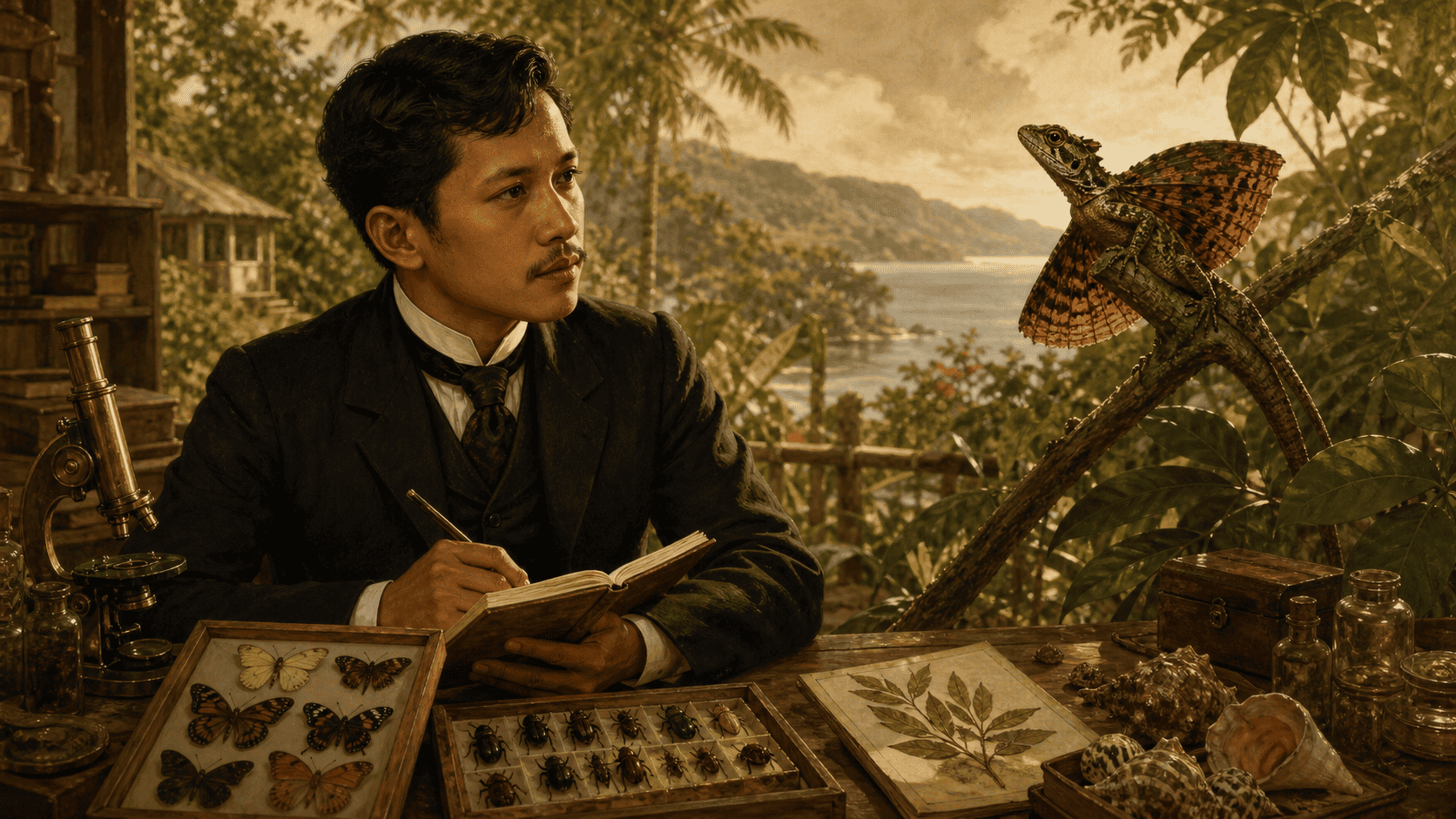
The Island at the End of the World
When the Spanish colonial government exiled José Rizal to Dapitan in July 1892, they chose the location carefully. Dapitan was a small coastal town in the Zamboanga peninsula of Mindanao — far from Manila, far from the ilustrado circles he moved in, far from the printing presses and correspondence networks that had made him dangerous. The intention was isolation. What they could not have anticipated was what Rizal would do with four years of enforced proximity to one of the most biodiverse environments on earth.
He arrived as a novelist and a doctor. He left — or rather, was taken from Dapitan to his execution in Manila — as something else as well: a naturalist of genuine standing, whose specimens had traveled from the forests and shores of Mindanao to the great natural history museums of Europe, and whose name had been permanently attached to creatures the scientific world had not yet catalogued.
He wrote to his friend Ferdinand Blumentritt from exile: “My country can offer him [Dr. Adolf Bernhard Meyer, a German scientist and naturalist] treasures yet undiscovered. There are many species still unknown in zoology and botany, judging by the discoveries that are being made.” He was not merely observing. He was one of the people making those discoveries.
What He Was Working With
Rizal had no laboratory. He had no university library, no professional colleagues within reach, no scientific instruments beyond what he could barter from European contacts in exchange for specimens. He was a deportee, which meant he could not move freely, could not carry a gun — even for scientific collecting — and was subject to the whims of the local garrison commander.
He made do with remarkable ingenuity. He combed the shoreline and forests around his small estate, catching reptiles, insects, birds, fish, and crustaceans with whatever tools he could fashion or obtain. He preserved specimens in alcohol — which was difficult to source in Dapitan — and packed them for the long journey to Europe, routing shipments through a German businessman acquaintance in Manila who forwarded them onward from there. One shipment went down with its boat. Most made it.
The accounting, when tallied by later scholars, is astonishing: 45 reptiles, 9 mammals, 13 birds, 9 fish, 68 crustaceans, and a shell collection of more than 200 species — all gathered in four years, by one man, without institutional support, in political exile. He sent seahorses and scorpions, boa constrictors and flying lizards, beetles and butterflies and frogs. In October 1894 alone, he packed and dispatched 165 butterflies to the Dresden Museum, along with assorted other specimens. His payment for all of this was not money but books and scientific instruments — which tells you something about what he was actually after.
The Dresden Connection
The central relationship in Rizal’s scientific life was with Dr. Adolph B. Meyer, director of the Royal Zoological and Anthropological Museum in Dresden — a man Rizal had first met during his years in Europe and with whom he maintained an active correspondence throughout his Dapitan exile. Meyer was not merely a recipient of specimens but a genuine collaborator, asking Rizal to seek out particular creatures, acknowledging that his contributions were indispensable to ongoing research, and urging him not to stop gathering even when the conditions were difficult.
The specimens Rizal sent to Dresden did not simply disappear into storage. They were examined, classified, and in several cases identified as species previously unknown to European science. When that happened, the zoologists doing the classifying followed the convention of their era: they named the new species after the man who had found them.
The results of that convention are still on the books today.
The Species
Draco rizali — the Flying Lizard. The most dramatic of the creatures named after Rizal is also the most visually striking. Draco rizali is a small arboreal lizard found only in the Philippine forests, belonging to a genus known for an extraordinary adaptation: elongated ribs that extend outward from the body and support a thin membrane of skin, forming a pair of wings the lizard can spread to glide between trees. It cannot flap these wings or gain altitude — it glides, using the membrane to slow its descent across gaps that would be impassable on foot. Males carry blue membranes; females, yellow. The lizard feeds on ants and termites and can cover up to nine meters in a single glide.
German biologist Benno Wandolleck formally named the species in 1893, working from specimens Rizal had sent to Dresden. In subsequent taxonomy the species has also been recorded under the name Draco guentheri, after the German herpetologist Albert Günther, and the two names have been used in parallel depending on the source. By whichever name it is filed, it is the same creature: a small winged dragon, found only in the Philippine forests, carrying in its scientific record a permanent trace of the man who first collected it.
Rhacophorus rizali — the Harlequin Tree Frog. The second species bearing Rizal’s name is a tree frog, formally described from a specimen he sent to Frankfurt. The German amphibiologist Oskar Boettger named it Rhacophorus rizali — a name now also recorded under the synonym Rhacophorus pardalis, the harlequin tree frog. It is an orange-brown amphibian marked with patches of white, yellow, and blue, found not only in the Philippines but across parts of Borneo, Indonesia, Malaysia, and Thailand. It lives in forest canopy and freshwater margins. Its webbed feet are among the largest relative to body size of any frog species — the better to grip wet leaves and branches as it moves through the trees.
Its habitat is under increasing pressure from deforestation across its range.
Apogonia rizali — the Flying Beetle. German zoologist Karl M. Heller formally classified this small beetle in 1897, naming it after Rizal in recognition of the specimens he had contributed from Dapitan. Apogonia rizali is a member of the beetle order Coleoptera — a flying beetle roughly an inch in length at full maturity. Among the species named after Rizal, it holds a particular distinction: it is the only one whose original scientific name has remained consistently in use, neither superseded by a synonym nor reclassified under a different genus. When entomologists catalog it today, they still file it as Rizal named it, which is to say, as Rizal found it.
Spathomeles rizali — the Handsome Fungus Beetle. The fourth species is a fungus beetle whose name tells its own story. Spathomeles rizali was given the informal English designation “handsome fungus beetle” — a name that would surely have amused Rizal, who was not indifferent to his own appearance. The species was described from specimens he forwarded to Germany for identification, and while it appears less frequently in contemporary literature than the flying lizard or the tree frog, its entry in the scientific record is genuine.
Cardiodactylus rizali and Pachyrrhynchus rizali. Two further species round out the catalogue of creatures named in Rizal’s honor. Cardiodactylus rizali is a cricket, named by the entomologist Robillard. Pachyrrhynchus rizali is a weevil, named by Banks. Both were described from Philippine specimens and both carry his name as a formal part of their scientific designation.
What This Actually Means
The convention of naming a newly described species after the collector who found it is one of the oldest traditions in natural history. It is, in the language of taxonomy, a permanent act — species names, once formally established and accepted, endure in the scientific literature essentially forever, even as common names shift and synonyms accumulate. When a zoologist anywhere in the world opens a database and searches for Draco rizali, they are retrieving a record that connects, through an unbroken chain of scientific notation, to a specific lizard collected by a specific man in Dapitan in the early 1890s.
Rizal wrote to Blumentritt that he longed to live among the indigenous peoples of Mindanao to study them — that he was convinced the island still held treasures the scientific world had not yet found. He was right, and he found some of them himself. The irony is characteristic: the Spanish government sent him to Dapitan to silence him, and he used the time to extend his name permanently into the scientific record of the country they were trying to prevent him from serving.
A Note on the Specimens Today
Many of the specimens Rizal collected in Dapitan remain in European museum collections. The Dresden Museum, whose storage facility was named in honor of Meyer, still holds items from the Rizal correspondence. The National Historical Commission of the Philippines has documented the extent of what was sent; some specimens made it into scientific catalogues of the era, others did not, lost in the gaps between collection and classification that were common in 19th-century natural history.
The forests of Dapitan where he worked still exist, though under different pressures than in his time. The shoreline where he gathered shells is still there. The flying lizard he found in those forests still glides between its trees — still carrying, in the formal notation of science, the name of the man who first looked up and noticed it.
Read next: José Rizal: A Complete Biography — the full story of the man who was also, in the forests of Dapitan, a naturalist.