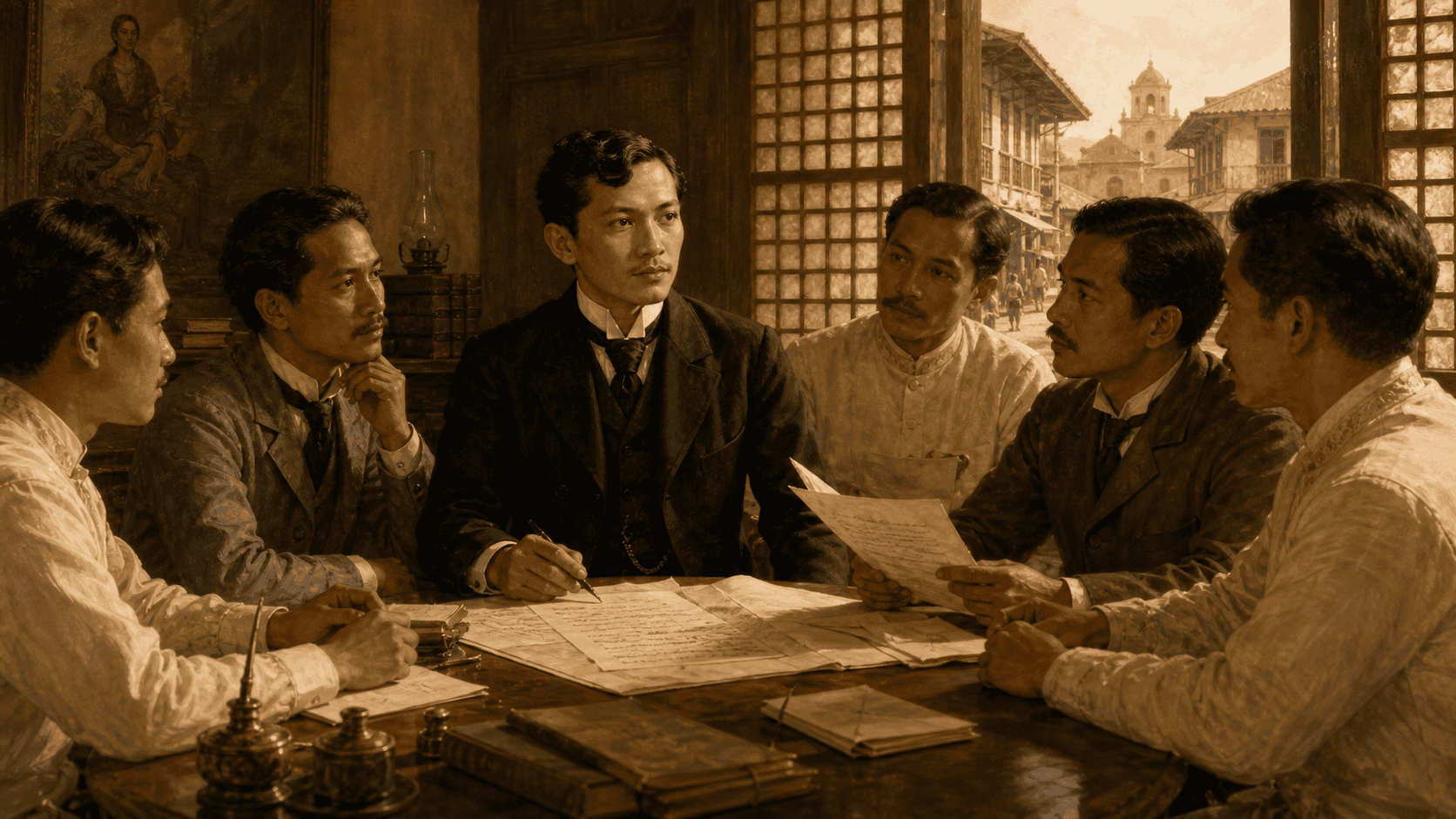
On July 3, 1892, José Rizal gathered a group of Filipinos in a house on Ilaya Street in Tondo, Manila, and founded La Liga Filipina — the Philippine League. It was the most direct civic action he had ever taken on home soil: a formal organization, a written constitution, elected officers, a dues structure, and a program of mutual aid, legal defense, scholarships, and economic cooperation. Reform, organized and sustained, from the ground up.
Four days later, Spanish authorities arrested him and deported him to Dapitan.
La Liga Filipina in its original form was finished before it had properly begun. What happened next is the part worth understanding.
What Rizal Was Trying to Build
By 1892, the Propaganda Movement had been running for nearly a decade from Europe — publishing essays, circulating La Solidaridad, petitioning the Spanish government, arguing in print for reforms that the colonial administration in Manila showed little interest in granting. The movement had produced ideas and influential writing. It had not produced institutions.
Rizal’s insight was that reform needed infrastructure. Not just persuasion but organization — a body of people coordinated enough to pool resources, defend members against legal harassment, fund education, and build the kind of economic independence that would make Filipinos harder to exploit. He envisioned La Liga as the domestic counterpart to the overseas Propaganda Movement: less eloquent, more useful.
The constitution he wrote set out five goals — uniting Filipinos into a cohesive body, mutual protection in times of need, defense against injustice, the encouragement of education and commerce, and the study and application of reforms. A tiered structure connected a Supreme Council at the national level down through provincial and town councils. Members paid ten centavos a month, building a fund for scholarships, legal aid, and small loans. It was, in its design, a civic cooperative as much as a reform movement — practical help for ordinary people, sustained by collective action, pointed toward systemic change.
It was also, by any reasonable measure, loyalist. Rizal was not calling for independence. He was calling for Filipinos to be treated as Spanish subjects with the rights that status was supposed to confer — representation, equal protection under the law, an end to the worst abuses of the friar orders. La Liga was organized around working within the colonial system, not overturning it.
The colonial system did not care about the distinction.
The Arrest and What It Set in Motion
Rizal’s arrest on July 6, 1892, and his banishment to Dapitan, was the colonial government’s response to the threat it perceived in a man who had written two banned novels, led a reform movement, and now appeared to be organizing on the ground. The Liga was barely formed. Most of its members had barely met. The Spanish authorities did not wait to see what it would do.
The effect was the opposite of what they intended.
Within months, Domingo Franco and Andrés Bonifacio reorganized what remained of the Liga and began channeling its dues and networks toward the reform press — funding La Solidaridad and sustaining the advocacy work from the Filipino side. But the arrest had done something to the membership that the colonial government had not calculated: it had demonstrated, concretely and unmistakably, that the peaceful reform path had a ceiling. Rizal had done everything right. He had organized legally, with a written constitution, with civic rather than revolutionary aims. He had been arrested anyway.
The lesson was not lost on everyone who had been in that room on Ilaya Street.
The Katipunan
On July 7, 1892 — one day after Rizal’s arrest — Andrés Bonifacio and a small group of men founded the Katipunan: a secret society committed to independence from Spain by armed force if necessary. Many of its founders had Liga connections. The organizational skills, the networks, the habits of secrecy developed in the Liga’s short life migrated directly into the revolutionary underground.
The historical coincidence of the dates is almost too neat, but it is accurate. La Liga Filipina and the Katipunan were born within days of each other, from the same circumstances, among many of the same people — one the last serious attempt at peaceful reform, the other the beginning of armed revolution.
As the Liga’s remnants split, the division that emerged would shape the entire trajectory of Philippine independence. The Cuerpo de Compromisarios — the reformist wing — continued financing the Propaganda Movement and advocating through legal channels. The revolutionists, following Bonifacio, built the organization that would launch the uprising of 1896. Both groups had been radicalized, to different degrees, by the same event: the arrest of a man who had tried to do everything peacefully.
What the Liga Left Behind
La Liga Filipina lasted, in its original form, approximately four days. Its actual influence extended across decades.
The organizational model Rizal designed — dues-funded mutual aid, tiered civic structure, practical community services combined with reform advocacy — anticipated the shape of Filipino civic organizing for generations. Its members became the cadre of the revolution. Its failure under repression made the case, more powerfully than any essay could, that the colonial system was not capable of the reforms it had been asked to make.
There is a particular kind of historical significance that comes not from success but from instructive failure. La Liga Filipina is a case study in what happens when a colonial power responds to a lawful, loyalist civic organization with arrest and exile: it converts reformists into revolutionaries, and it gives the people who have been watching the clearest possible evidence of what they are dealing with.
Rizal did not live to see the revolution he had spent his life trying to prevent and his death helped make inevitable. But the Liga he founded in four days in July 1892, and the arrest that followed, were the hinge on which that history turned.