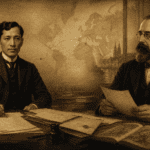

Writing under your own name in colonial Philippines carried real risks. The Spanish authorities monitored reformist publications, pressured printers, and moved against writers whose work challenged the church or the colonial administration too directly. Rizal understood this. He was not reckless about it. Alongside his full name, he used a small set of pseudonyms — each chosen for a specific purpose, each with a meaning that was itself a quiet act of defiance.
The verified pen names are five: Laong Laan, Dimasalang, P. Jacinto, Agno, and the simplified signature J. Rizal. What follows is an account of each — what it meant, when he used it, and what it reveals about how he thought about writing in public under a system that punished honesty.
Laong Laan
This was Rizal’s most frequently used pseudonym in La Solidaridad, the reformist newspaper published in Barcelona and Madrid that served as the main publication of the Propaganda Movement. The phrase comes from old Tagalog and carries the meaning of “ever prepared” or “one who has long been ready” — a name that positioned its bearer not as an agitator but as someone who had been thinking seriously about these problems for a long time and was simply, finally, saying so.
The tone of pieces signed Laong Laan tended to match the name: measured, analytical, persuasive rather than combative. Rizal used this persona for essays on education, national character, and the case for peaceful reform — arguments that required the reader to trust the writer’s seriousness and continuity of purpose. Laong Laan was the voice of a man who had done his homework.
Dimasalang
Dimasalang is probably the best known of Rizal’s pen names, and its meaning — “untouchable” or “one who cannot be stained” — was a provocation as much as a pseudonym. It was also the name he used within Freemasonry, where it served as his Masonic identity and connected his reformist writing to the fraternal network of enlightenment and brotherhood that the Masons represented in colonial-era Philippines.
Essays signed Dimasalang tended to be bolder and more direct than those under Laong Laan — less concerned with persuading the undecided and more focused on naming what was wrong with clarity and force. The name itself communicated something to readers who recognized it: that whoever was writing could not be silenced, bought, or compromised. Whether that was entirely true of any human being is a separate question, but as a declaration of intent, it was effective.
P. Jacinto
This pseudonym is the most personal of the five, and the one that gives readers the clearest view of Rizal’s inner life. He used it primarily in his private journal written during his exile in Dapitan — a document known as the Diario de P. Jacinto — where he wrote about philosophy, solitude, the natural world around him, and the question of what patriotism meant when you were confined to a small coastal town in Mindanao with no clear path forward.
The contrast with his public pen names is striking. Where Laong Laan and Dimasalang were voices for an audience, P. Jacinto was a voice for himself — exploratory, uncertain in places, willing to sit with questions rather than answer them. For readers who know Rizal only through the novels and the essays, the Diario offers something rarer: the writer alone with his thoughts, not performing conviction but genuinely working something out.
Agno
Agno is the least documented of Rizal’s pen names, used sparingly in correspondence and a small number of early writings. The name most likely references the Agno River in Luzon — one of the longest rivers in the Philippines, running through Pangasinan and into Lingayen Gulf — which would make it a pseudonym rooted in geography and landscape rather than in a philosophical or political concept.
When Rizal used Agno, the writing tended toward the reflective and culturally grounded: pieces that engaged with Philippine identity and heritage rather than with direct political argument. It is the pen name that most clearly connects him to place — to the particular rivers, mountains, and coastlines of a country he spent much of his adult life writing about from a distance.
J. Rizal
Before Noli Me Tangere made his name politically charged, Rizal sometimes signed work simply as “J. Rizal” — a compressed version of his full name rather than a true pseudonym, but one that served a similar function in its early uses. It was recognizable enough to establish credibility with readers who already knew his work, while maintaining a degree of distance from the full exposure of his complete identity in publications that carried sensitive material.
It represents, in a sense, the transitional version of him: already a public writer, not yet the primary target of colonial scrutiny that he would become after 1887.
A Note on What Does Not Qualify
The pen names above are the verified ones — appearing in publications, journals, and correspondence that historians have authenticated. Several other names associated with Rizal do not belong in this list and are worth distinguishing clearly.
“Jose Mercado,” which he used on his 1882 passport, was a travel alias, not a literary pseudonym. It was drawn from his family’s original surname and served a purely practical purpose: allowing him to leave the Philippines without immediately alerting the authorities to who was traveling. “Pepe,” his childhood nickname, was a term of affection used by family and close friends. “Doctor Uliman,” a label attached to him by others in Germany based on a misunderstanding, was never his own invention. Historical accuracy requires keeping these categories separate from the deliberate, strategically chosen pseudonyms he published under.
What the Pen Names Reveal
Taken together, the five pen names tell a coherent story about how Rizal approached the problem of writing dangerous things in a dangerous time. He did not use a single alias and hide behind it consistently. He matched the voice to the purpose: a measured persona for reasoned argument, a bolder one for direct critique, a private one for genuine reflection, a geographic one for cultural writing, and a simplified version of his own name for work that sat between public and personal.
That flexibility was itself a form of intelligence. A writer who could only speak in one register was a writer who could only reach one kind of reader. Rizal wanted to reach all of them.
For more on Rizal as a writer, see the complete works of José Rizal and the Propaganda Movement context in which most of his pseudonymous writing appeared.
Sources: Wenceslao E. Retana, Vida y Escritos del Dr. José Rizal (Madrid, 1907); Ambeth R. Ocampo, Meaning and History: The Rizal Lectures (Ateneo de Manila University Press, 1999); Epistolario Rizalino, Vols. I–VI, National Historical Commission of the Philippines; Austin Coates, Rizal: Philippine Nationalist and Martyr (Oxford University Press, 1968); La Solidaridad archives (1889–1895); National Library of the Philippines, Manuscript Division.