
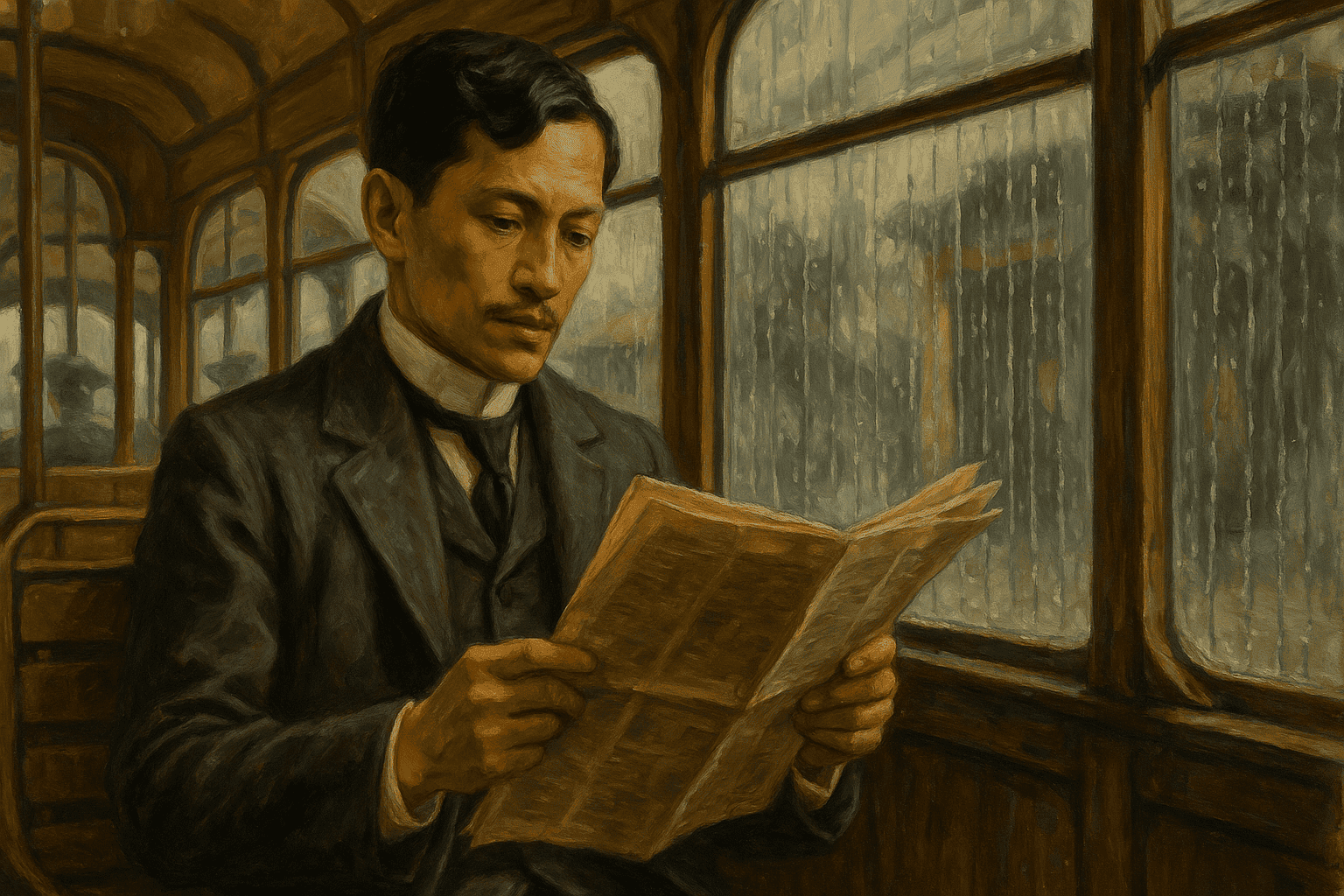
“Song of the Wanderer” (Canto del Viajero) was written during the years Rizal spent moving between Spain, France, Germany, and England as part of the Propaganda Movement. The external record of those years is one of accomplishment — medical training, finished novels, a growing reputation among European scholars and reformers. The poem records what ran alongside all of that: a persistent, specific homesickness that travel didn’t cure and intellectual purpose didn’t fully answer.
The poem is not a complaint. Rizal chose to leave the Philippines and understood why he had to stay away. But Canto del Viajero is honest about the cost of that choice in a way that his letters and political writings rarely were. It describes the wanderer’s life from the inside — the restlessness, the memories that follow you, the particular loneliness of returning home to find that home has moved on without you.
That last image — the pilgrim who returns to find ice where warmth was, strangers where family stood — gives the poem a quality that reads differently knowing how Rizal’s life ended. He did return. It was not to safety.
For many readers, the poem doubles as something more than biography. The experience it describes — loving a country from a distance, feeling the ground shift under your identity when you come back — has belonged to Filipinos in every generation since.
Full Poem: Song of the Wanderer
Dry leaf that flies at random
till it’s seized by a wind from above:
so lives on earth the wanderer,
without north, without soul, without country or love!
Anxious, he seeks joy everywhere
and joy eludes him and flees,
a vain shadow that mocks his yearning
and for which he sails the seas.
Impelled by a hand invisible,
he shall wander from place to place;
memories shall keep him company
of loved ones, of happy days.
A tomb perhaps in the desert,
a sweet refuge, he shall discover,
by his country and the world forgotten
Rest quiet: the torment is over.
And they envy the hapless wanderer
as across the earth he persists!
Ah, they know not of the emptiness
in his soul, where no love exists.
The pilgrim shall return to his country,
shall return perhaps to his shore;
and shall find only ice and ruin,
perished loves, and graves nothing more.
Begone, wanderer! In your own country,
a stranger now and alone!
Let the others sing of loving,
who are happy but you, begone!
Begone, wanderer! Look not behind you
nor grieve as you leave again.
Begone, wanderer: stifle your sorrows!
the world laughs at another’s pain.
Analysis
The poem is built around a single image: a dry leaf taken by the wind, with no direction of its own. It’s a deliberately diminished figure — not a hero, not a patriot, just something carried. Whatever Rizal was in his public life, the wanderer of this poem is not that. He is exhausted, unmoored, and aware that the world has no particular interest in his suffering.
What makes the poem work is that Rizal does not sentimentalize the condition. The wanderer is not nobly suffering for his people. He is simply suffering — seeking joy and finding it just out of reach, crossing seas after a shadow. The dignity, if there is any, is in continuing anyway.
The poem’s sharpest stanza is the one about return. The wanderer imagines going home and finding it gone: “perished loves, and graves nothing more.” This is not a fantasy of triumphant homecoming. It is the fear, which anyone who has been away long enough will recognize, that the place you left has become a different place — that the relationships that held you there have quietly closed around your absence, and there is no longer a space for you in them.
The closing stanzas take this further, into a kind of exile within the homeland itself. “In your own country, a stranger now and alone” — the wanderer is told to leave again, because his difference is unwelcome, because the world laughs at grief it didn’t cause and can’t fix. The address shifts here from the wanderer to the wanderer: Rizal speaks in the voice of the country sending him away, and it is not kind.
Read against the biography, the poem has a weight it might not carry otherwise. Rizal did return to the Philippines in 1892, knowing the risk. He was exiled to Dapitan, then arrested, tried, and executed in 1896. The line about a tomb in the desert — discovered, the poem says, as “a sweet refuge” — reads differently once you know how the story ends. The torment, in his case, was over at thirty-five.




when did rizal wrote this poem? what is the possible inspiration of this poem?