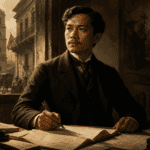
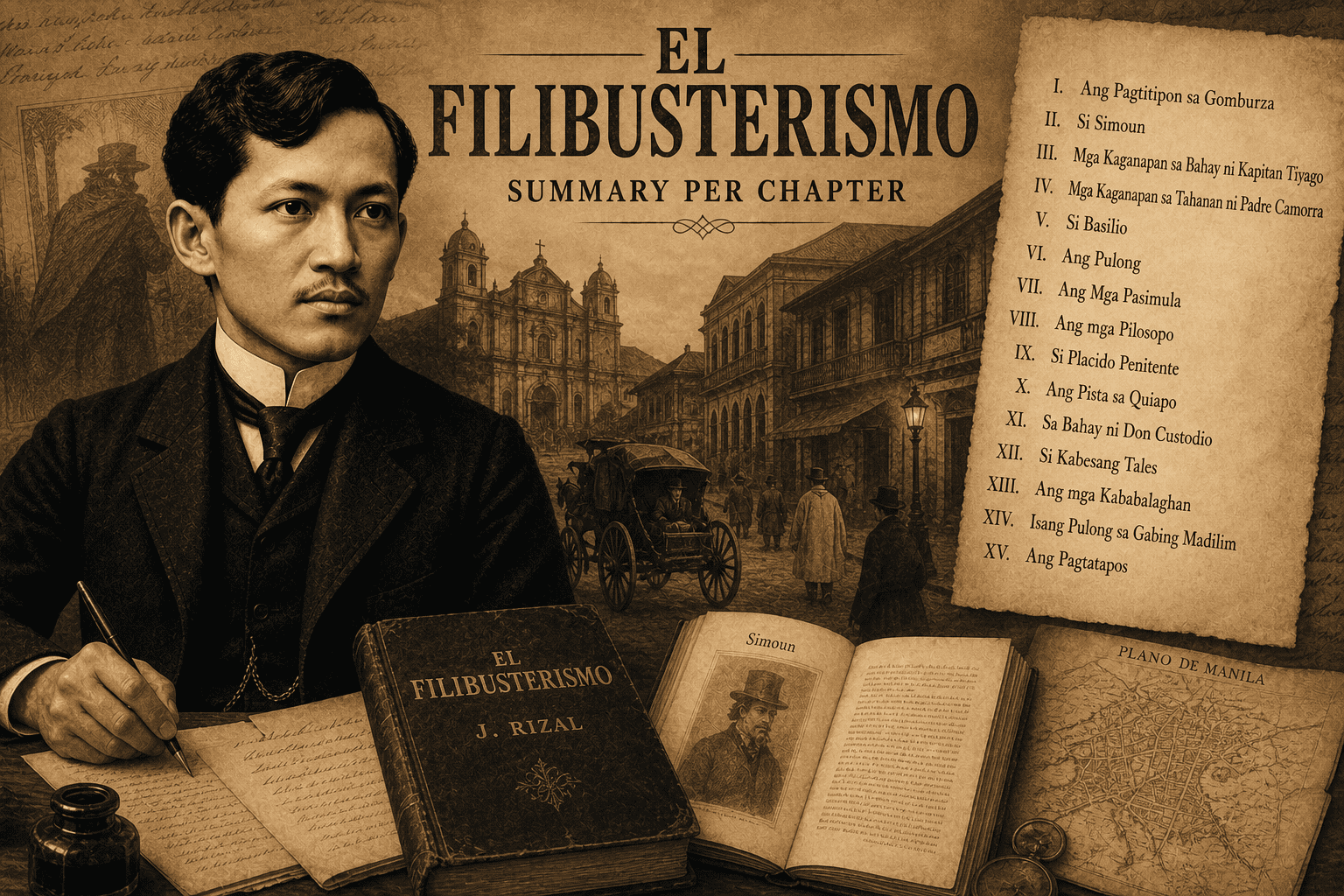
El Filibusterismo is José Rizal’s second novel, published in Ghent in 1891 as a sequel to Noli Me Tangere. It follows the same colonial Philippines, but thirteen years later, through a darker and more morally complicated lens. Where Noli had hope, Fili has exhaustion. Where Noli had Ibarra the idealist, Fili has Simoun the avenger.
The novel unfolds across 39 chapters. What follows is a complete chapter-by-chapter summary of the narrative — what happens, who is involved, and why each chapter matters to the whole.
For analysis of the novel’s themes, characters, and significance, see El Filibusterismo: A Literary Analysis. For the full cast of characters, see The People Rizal Put in His Darkest Novel.
Chapter 1: On the Upper Deck
The novel opens on the steamer Tabo, making its way along the Pasig River toward Laguna de Bay. On the upper deck — the deck of privilege — sit Spanish friars, colonial officials, and wealthy Filipinos. Their conversation is self-satisfied and revealing: they complain about uprisings, dismiss Filipino capacity for self-governance, and debate colonial appointments as though the lives of ordinary people are entirely beside the point.
Among them sits Simoun, a dark-glassed jeweler of mysterious origin and evident wealth who seems to know everyone and intimidate all of them. He says little but provokes much, steering conversations with small observations that expose the vanity and fragility of colonial power. The novel announces itself immediately: this is a world rotten at the top, and Simoun knows exactly where the rot is.
Chapter 2: On the Lower Deck
The lower deck is a different country. Cramped, hot, and full of ordinary Filipinos — laborers, students, farmers, small traders, mothers — it offers a direct counterpoint to the comfort above. Here the conversations are about actual suffering: forced labor, unjust taxes, land taken without recourse, and the kidnapping of Cabesang Tales, a farmer whose story will run through the novel like a wound.
Rizal constructs the steamer as a microcosm of colonial society, with its vertical hierarchy made literal. The two decks are not simply a spatial division; they are a moral one. The novel’s central tension — between those who benefit from the system and those who are crushed by it — is established in these first two chapters before a single plot point has been resolved.
Chapter 3: Legends
At Los Baños, the passengers disembark and travelers exchange local folklore — stories of supernatural beings, strange lights in the forest, and haunted places. Donya Victorina performs the tales with theatrical flair, but beneath the entertainment lies something more serious. The legends are encoded trauma: the ghost stories of a people who cannot speak directly about the violence done to them.
Simoun listens carefully, reading the legends as a sociologist might — as evidence of public sentiment, as indicators of where fear and resentment have accumulated. He is already taking the measure of the society he plans to destroy.
Chapter 4: Cabesang Tales
This chapter steps back to tell the full story of Cabesang Tales, and it is one of the most devastating in the novel. Tales spent years clearing land in the forest, turning wilderness into productive fields through sheer physical labor. When the land began to yield, the Dominican friars appeared with a claim of ownership and demanded rent. Tales refused. His family sold everything to pursue the legal case. They lost. The friars took the land.
Then bandits kidnapped Tales, demanding ransom his family could no longer raise. His son worked himself to death trying to help. His daughter Julì became a domestic servant to wealthy families in the city. When all alternatives were exhausted and the friars still would not relent, Tales disappeared into the mountains — and reappeared as Matanglawin, an outlaw. The chapter is Rizal’s most sustained documentary account of what colonial land policy actually meant for ordinary Filipino families, and it makes the subsequent violence in the novel feel not like a moral failure but like an inevitability.
Chapter 5: The Black Eminence
Simoun meets privately with the Captain General, and the nature of their relationship is clarified. The Captain General is not Simoun’s employer or patron — he is Simoun’s instrument. The man nominally in charge of the colony is insecure, fearful of the friars whose support he needs, and easily steered by Simoun’s calculated suggestions.
Simoun frames each piece of advice as loyal counsel, but each recommendation is designed to push colonial policy further toward the cruelty that will eventually break the system. The Captain General believes himself to be the one making decisions. The chapter establishes that he is wrong.
Chapter 6: Basilio
Basilio, who appeared as a boy in Noli Me Tangere — the child who buried his mother Sisa — has grown into a young man studying medicine at the university in Manila. He supports himself through small jobs, lives frugally, and endures the discrimination directed at Filipino students with the patient determination of someone who has survived worse. He visits the unmarked grave of his mother and reflects on how far he has come and how much further he has to go.
Basilio is the novel’s moral center — not Simoun, who drives the plot, and not Isagani, who acts from romantic impulse, but Basilio, who is simply trying to build something real within an unjust system. His presence throughout the novel asks the question that El Filibusterismo never fully answers: is that possible?
Chapter 7: Simoun
Basilio, wandering in the forest, comes upon Simoun unearthing a buried chest of jewels. He recognizes him immediately as Crisóstomo Ibarra — the idealist of Noli Me Tangere, now transformed into something harder and more dangerous. He says nothing. Simoun, sensing the recognition, says nothing either.
The moment is charged with everything that stands between the two novels: thirteen years of exile, of loss, of the slow collapse of the belief that reform was possible. Ibarra tried to build a school. They destroyed it. He tried to work within the system. It destroyed him. What stands before Basilio in the forest is what remains when idealism has been methodically dismantled.
Chapter 8: Merry Christmas
Christmas in the novel is not a celebration but a contrast. Wealthy homes are decorated and feasts are prepared; the poor struggle for the basics. Julì, working as a servant in the city, tries to find a way to help free her father Tales from captivity. Her employers treat her with the casual cruelty of people who have never had to consider the humanity of those who serve them. The chapter turns on the simple injustice of a holiday that means something entirely different depending on which deck of the steamer you are on.
Chapter 9: Pilato
Basilio approaches Simoun and asks for help raising the ransom money for Cabesang Tales. Simoun refuses the request outright. Instead he offers something else: an invitation to join the revolution he is planning. Basilio is deeply troubled. He understands the appeal of what Simoun is proposing — he has watched too many people suffer to believe that patience and study will fix anything quickly — but he also senses the cost of the path Simoun is describing.
The conversation is the novel’s first direct statement of its central argument. Simoun represents the case for radical action; Basilio represents the case for patience and reform. Neither has a fully satisfying answer.
Chapter 10: Wealth and Poverty
The preparations for the wedding of Paulita Gómez and Juanito Pelaez bring Manila’s elite into focus. Don Timoteo spends extravagantly, acquiring the finest goods and signaling his social position through consumption. Simoun moves through this world with ease, using the wedding preparations as an opportunity to deepen his connections with the powerful.
The chapter is not about the wedding itself — that comes later — but about the culture it represents: a Manila elite whose wealth is insulated from the misery that produces it, and whose social rituals are entirely disconnected from the lives of the people on the lower deck.
Chapter 11: Los Baños
The Captain General and several friars gather at the resort town of Los Baños for rest and informal discussion. Their conversations are revealing: they talk about colonial appointments as personal transactions, about the Philippines as an administrative inconvenience, and about their own ambitions without any apparent awareness that the people they govern have interests of their own.
Simoun is present, listening and guiding. The chapter exposes the colony’s leadership as a network of competing self-interests with no coherent policy beyond self-preservation.
Chapter 12: Placido Penitente
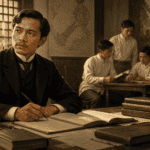
Placido Penitente arrives in Manila from the provinces, carrying his mother’s hopes and his own ambitions for an education that might lift their family. What he finds at the university is a system designed not to educate him but to manage him. His teachers are arbitrary and petty; the rules are applied differently to Filipino students than to others; and genuine intellectual curiosity is treated as a kind of insubordination.
Placido is a new character in this novel, but his story is immediately familiar from everything Rizal documented about his own experience at the University of Santo Tomás. He arrives with hope and begins, almost immediately, to lose it.
Chapter 13: The Class in Physics
The physics class taught by Professor Ben Zayb is a masterclass in institutional dysfunction. Ben Zayb insists on explanations that are demonstrably wrong and punishes students who offer correct ones. The class has developed a set of rituals designed to placate him rather than to learn anything. Placido, still new enough to expect that a class in physics will involve physics, gives a correct answer and is publicly humiliated for it.
The chapter is both darkly comic and genuinely disturbing — a precise account of how an educational system becomes a tool of subjugation when it is designed to produce compliant subjects rather than educated citizens.
Chapter 14: The Tribulations of a Chinese
A Chinese merchant in Manila faces a sustained campaign of harassment from colonial officials: arbitrary fines, extorted bribes, unfair taxes, and a legal system that offers him no recourse. Despite his diligence and legitimate business operations, he is treated as fundamentally outside the protection of any institution. His story adds another dimension to the novel’s survey of colonial victims — the discrimination is not limited to Filipinos but extends to anyone the system has decided does not deserve fairness.
Chapter 15: Señor Pasta
Isagani and Macaraig, student leaders, seek the support of Señor Pasta — a respected lawyer — for their proposal to establish a Spanish language academy at the university. Pasta’s response is a masterpiece of principled-sounding avoidance. He lists the dangers of confronting the friars, the risks to his career, the complexity of the political situation. He gives them nothing.
The chapter is Rizal’s portrait of the educated Filipino elite who understand injustice perfectly and do nothing about it — not out of ignorance but out of calculation. Pasta is not foolish. He is simply unwilling to pay the cost of being on the right side.
Chapter 16: The Tribulations of a Student
Students gather to share their experiences of humiliation and obstruction in the university system. Each account adds to the picture of a generation of young Filipinos who entered education with genuine hope and are being systematically ground down. The conversations move between anger and resignation, between the belief that something might still change and the growing suspicion that it will not.
Chapter 17: The Student Association
Macaraig hosts a meeting at his well-appointed home where students formalize their plans for the language academy. They divide responsibilities, draft documents, and encourage one another. The energy in the room is genuine — these are young people who still believe that organized, peaceful advocacy can produce change.
What they do not know is that the friars are already aware of their plans and are working to destroy them. The chapter’s optimism is retroactively painful.
Chapter 18: The Dogs
A dog suspected of rabies runs through a Manila street. The ensuing panic — people screaming, fleeing, the dog eventually hunted down and killed amid general confusion — is played for dark comedy but carries a pointed symbolic weight. A colonial government that cannot manage a stray dog without creating a small crisis is not a government capable of managing anything well. The incident also reflects the hair-trigger tension of a society in which any disturbance can rapidly escalate.
Chapter 19: The Fuse
Simoun continues his patient campaign of steering colonial officials toward harsher and more arbitrary policies. Each new injustice he encourages serves as another increment of pressure on a population that has been absorbing pressure for three centuries. The title names his strategy precisely: he is not trying to start a fire. He is extending a fuse, waiting for the moment when everything ignites.
Chapter 20: The Meeting
The students meet again, this time with what seems like good news: the academy’s approval appears to be close. Their plans become more elaborate. Their hope, briefly suppressed by the encounters with Pasta and the obstacles at the university, revives. The dramatic irony is painful — the reader understands, from Chapter 27, that the friars have already decided the academy will not happen.
Chapter 21: Manila Types
Rizal steps back from the main narrative to sketch a series of social portraits: the vain clerk, the incompetent official, the small trader caught between competing authorities, the worker who has learned to keep his opinions to himself. These are not major characters but background figures, and the chapter functions as a panoramic view of colonial Manila — the human landscape that surrounds the novel’s central conflicts.
Chapter 22: The Performance
A theater performance attended by students, officials, and friars becomes the trigger for a cascade of misfortune. A minor disturbance in the audience is misread by authorities as a deliberate act of political protest. Students are blamed despite having nothing to do with it. Arrests follow. The incident demonstrates with brutal clarity that in a climate of paranoia, any event can be reinterpreted to justify repression — and that young Filipinos are always the most convenient target for blame.
Chapter 23: A Corpse
Basilio is arrested and thrown into prison. He had no involvement in the theater incident, but his presence in Manila as a Filipino student is, in the current climate, sufficient grounds for detention. The arrest strips away everything he has been working toward: his final year of medical school, his plans for his future, the life he had painstakingly constructed over years of study and sacrifice. The news spreads through the student community like a second wave of panic after the theater arrests.
Chapter 24: Dreams
Isagani, separated from Paulita Gómez and aware that she is moving toward a marriage with Juanito Pelaez, drifts through a chapter of memory and longing. His dreams return him to happier moments and force him to consider what he might have done differently. The chapter gives Isagani an interior life that the plot rarely has time for — and it sets up his impulsive action at the novel’s crisis point by establishing how thoroughly Paulita occupies his thoughts.
Chapter 25: Smiles and Tears
Paulita, under the sustained influence of Doña Victorina, commits to marrying Juanito Pelaez. She tells herself the practical reasons: Juanito has better social standing, more security, a clearer path. She is not entirely wrong in her assessment of her options. But the chapter is also honest about the cost of her decision — the smiles and tears of the title are both hers, and neither is uncomplicated.
Isagani learns of her choice and experiences the kind of grief that reshapes a person. This grief is what drives him, weeks later, to act without thinking at the wedding.
Chapter 26: The Pasquinades
Anonymous pamphlets — pasquinades — attacking the friars appear posted on walls across Manila. No one knows who put them there. The friars, without investigation or evidence, immediately blame the students. The colonial authorities, responsive to friar pressure as always, intensify their crackdown. More arrests follow. The academy petition collapses entirely under the weight of the new suspicion. What began as a student reform movement has been transformed, through institutional paranoia, into a supposed seditious conspiracy.
Chapter 27: The Friars
In private, the friars meet to coordinate their response to the student movement. They decide to use the pasquinades as the pretext for demanding the academy’s permanent rejection and for tightening their control of the university. The chapter reveals the machinery of their power: not brute force but the sustained application of institutional influence, exercised through access to the Captain General and through control of information. Their success is total, and they know it.
Chapter 28: Correspondence
Letters move between families, officials, and institutions as everyone tries to understand what is happening and protect their own. The correspondence reveals a colony in a state of managed confusion: official reports distort events, families receive conflicting information about detained relatives, and rumors fill the gaps that truth has been pushed out of. Basilio’s imprisonment remains a source of desperate concern for those who know him.
Chapter 29: The Morning
Manila wakes to the full scope of the crackdown. Expulsions, arrests, lost scholarships. Families gather outside detention facilities. Students who had enrolled in the university with plans and hopes find those plans erased overnight. The chapter captures the specific texture of institutional punishment — not dramatic but grinding, replacing possibility with bureaucratic finality.
Chapter 30: Julì
This is the chapter the novel has been preparing for since Chapter 4. Julì, desperate to secure Basilio’s release, goes to Padre Camorra — the local friar — to beg for his intervention. When they are alone, Camorra attempts to assault her. Rather than submit, she throws herself from a window. She dies.
The chapter is the novel’s most direct statement of what clerical authority actually cost ordinary Filipino women. Julì is not a peripheral character who dies to motivate the plot; she is the daughter of Cabesang Tales, the woman who gave up her own life by inches trying to help her family, and her death is the consequence of asking for help from exactly the institution that claimed to exist to provide it. When Basilio learns what happened, the last reason he had to resist Simoun’s offer disappears.
Chapter 31: The High Official
The Captain General receives contradictory reports about the state of unrest and responds to all of them with the same mixture of bluster and paralysis. Simoun continues to feed him suggestions that serve the revolution’s purposes. The chapter makes clear that the colonial government at its highest level is less a deliberate force than a collection of insecurities in expensive uniforms — a fact that is both darkly comic and genuinely terrifying.
Chapter 32: Effect of the Pasquinades
The consequences of the crackdown continue to spread. More students are punished. Families who appealed for mercy receive none. The friars, having achieved their objectives, move on to other concerns. The public grows not more compliant in response to the repression but more quietly furious. The chapter documents the paradox that colonial governments consistently fail to understand: harshness does not suppress rebellion; it cultivates it.
Chapter 33: The Last Appointment
Basilio is eventually released from prison, but his release is not a restoration. His scholarship is gone. His path to a medical degree is blocked. His future, which he had built through years of sacrifice, has been effectively destroyed by an arrest that was never justified by any evidence of wrongdoing. He returns home to learn of Julì’s death.
This is the chapter where Basilio makes his decision. He finds Simoun and accepts the offer he had refused in Chapter 9. The reader understands the logic. So does Rizal — and so does Padre Florentino, who will deliver the novel’s final moral judgment.
Chapter 34: The Wedding
The wedding of Paulita Gómez and Juanito Pelaez is the social event of the Manila season. Every important figure in the colony’s upper tier attends. Simoun attends too, and he has brought a lamp — a beautiful, elaborate oil lamp that he presents to the couple as a wedding gift, which is then placed at the center of the reception hall.
The lamp contains a bomb. Outside the wedding venue, armed revolutionaries wait for the explosion that will be the signal to begin the uprising. The revolution that Simoun has spent years engineering is, at this moment, minutes from starting.
Chapter 35: The Lamp
The lamp is lit. The wick burns. Guests admire it. Simoun moves through the reception, calm and precise, monitoring the progress of what he has spent years setting in motion. Basilio is outside with the armed groups, waiting. The countdown is running. Everything is aligned.
Chapter 36: The Catastrophe
Isagani is also outside. He hears something — a rumor, a fragment of information — that the lamp inside is dangerous. He does not fully understand what Simoun has planned. What he knows is that Paulita is in that room, and that there is something wrong with the lamp.
He acts on impulse. He pushes through the crowd, seizes the lamp, and throws it into the river. There is no explosion. The revolution does not begin. Simoun’s plan — assembled over years, at enormous personal cost, through dozens of carefully managed interventions — collapses in a single impulsive act by a young man who was thinking about a woman he no longer has.
The irony is ferocious and entirely deliberate. The novel’s revolution is destroyed not by colonial force but by love — or rather, by the emotional residue of love that Isagani could not set aside even at the moment of maximum historical stakes.
Chapter 37: The Mystery
Simoun flees through the night, wounded and hunted. The city fills with rumor about who was behind the failed plot. Colonial authorities launch investigations that proceed in the usual colonial direction — toward the innocent and the convenient rather than toward the truth. Simoun moves through the darkness with everything he built in ruins around him.
Chapter 38: The Deranged
The aftermath of the failed revolution produces a kind of institutional hysteria. Officials interrogate anyone within reach. Innocent people are accused, detained, and punished for proximity to events they did not understand. Rumors propagate faster than facts. The colonial government’s response to the crisis it cannot explain mirrors its response to every crisis: maximum noise, minimum accuracy, and punishment directed primarily at those who are already vulnerable.
Chapter 39: Conclusion
Simoun, gravely wounded, finds his way to the home of Padre Florentino, a Filipino priest. He confesses everything — that he is Crisóstomo Ibarra, that he returned from exile consumed by the desire for revenge, that the jewels and the years of manipulation were all directed toward a single moment that was destroyed in an instant by a young man throwing a lamp into a river.
He dies shortly after his confession. Padre Florentino gathers Simoun’s accumulated treasure — the wealth that was meant to fund the revolution — and throws it into the sea. His reasoning is the novel’s final moral statement: this wealth, amassed through hatred and revenge, is not fit to purchase freedom. Let it rest at the bottom of the sea until a generation comes that deserves it — a generation that will seek liberty not through hatred but through something more durable.
The novel ends without resolution and without comfort. The revolution did not happen. The colonial system remains. The students have been crushed. Julì is dead. Cabesang Tales is an outlaw. Basilio’s future is gone. And Florentino’s treasure sinks into the ocean, waiting for a people that may or may not arrive.
For analysis of what the novel means and why Rizal wrote it this way, see El Filibusterismo: A Literary Analysis. For the full overview of the novel, see El Filibusterismo: The Sequel That Asked Whether Revolution Was Worth It. For a comparison of the two novels, see Noli Me Tangere vs. El Filibusterismo: What Changed Between the Two Novels.