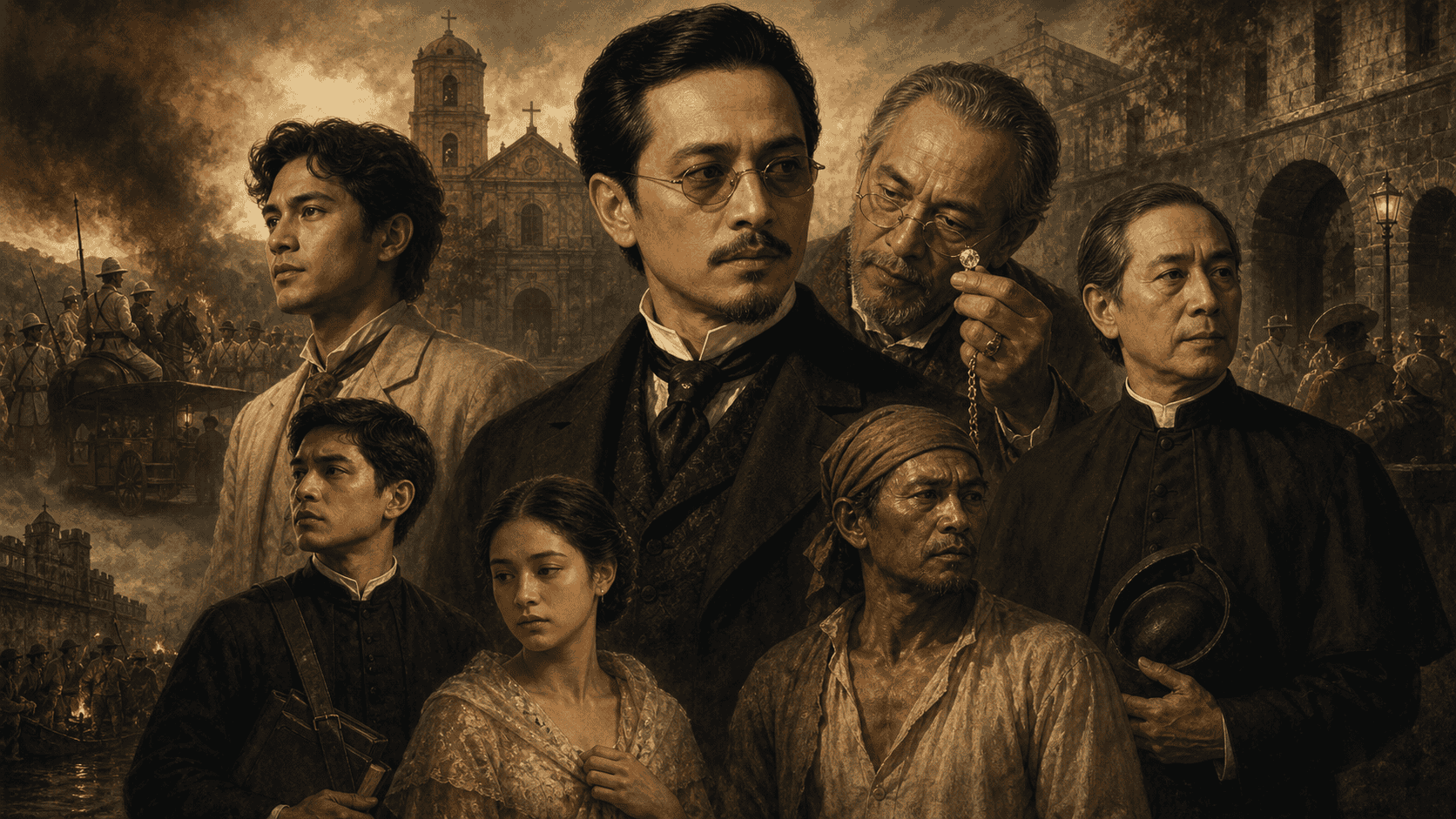
El Filibusterismo is populated by characters who are difficult to like and impossible to dismiss. That is the point. Where Noli Me Tangere gave readers figures to love and mourn, the sequel gives them figures to argue with — people whose choices are comprehensible, even sympathetic, and yet lead somewhere Rizal does not want us to follow without question.
The cast is large and deliberately varied: a man bent on revenge, students with competing visions of the future, women trapped by forces they cannot name, priests who have made their peace with corruption, and bureaucrats who mistake their own caution for wisdom. Together they map a society that has been under colonial pressure long enough for the pressure to show — in the moral compromises people make, in the idealism that curdles, in the suffering that goes unacknowledged until it cannot be contained.
What follows is a guide to the major characters, what they do, and what Rizal was thinking when he put them there.
Simoun
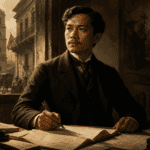
Born Crisóstomo Ibarra, the hopeful young reformist of Noli Me Tangere, Simoun returns in the sequel as a man almost entirely transformed by what the colonial system did to him. He moves through Manila’s elite circles as a wealthy jeweler, cultivating relationships with corrupt officials not because he respects them but because he intends to use them. The man who once believed in schools and petitions now believes in leverage, manipulation, and the strategic deployment of violence.
His plan — to detonate a bomb at a lavish wedding reception, killing the colonial elite in a single act — is the novel’s climax. It fails. And the failure is not accidental: Rizal constructs it carefully to show that the revolution Simoun was building was corrupted at its foundations. His grievances are legitimate. His methods have made him into something he would not have recognized in himself twenty years earlier. The novel’s argument is not that his anger was wrong but that anger alone, severed from moral principle, cannot build what it destroys.
Simoun is the most complex character Rizal ever created precisely because he is not simply wrong. He is right about the injustice. He is right that patience has been exhausted. What he cannot see — and what Padre Florentino tells him in the novel’s final movement — is that the freedom he is trying to force cannot survive the method he has chosen to force it with.
Basilio
Basilio first appeared in Noli Me Tangere as a child: the boy who watched his mother Sisa lose her mind searching for him and his brother Crispín, who disappeared into the church’s cruelty and never came back. In El Filibusterismo he is a medical student — older, quieter, and carrying everything that happened to his family like weight he has learned to walk with.
He represents a particular kind of Filipino response to injustice: the decision to work within the system, to achieve something through individual effort, to not look too directly at what the system requires you to ignore. It is a comprehensible response. Rizal renders it with sympathy rather than contempt. But the novel keeps testing it — keeps showing Basilio the moments when the system refuses to let even the diligent and the careful alone.
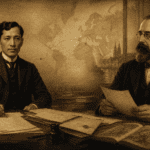
His relationship with Simoun is the novel’s moral spine. Simoun wants Basilio to join the revolution; Basilio keeps pulling back. Neither of them is entirely right. Rizal does not resolve the argument cleanly, which is what makes it honest.
Isagani
Isagani is the novel’s idealist — a student poet whose conviction that change must come through principle rather than violence puts him at odds with nearly everyone around him. He is not naive. He understands the injustice of the colonial system as well as anyone in the novel. He simply refuses to let that understanding justify methods he finds morally wrong.
His love for Paulita Gómez, and its destruction by the social machinery that surrounds her, is the novel’s most personal tragedy. He does not lose her to a rival in any straightforward sense. He loses her to the gap between what people feel and what a stratified society permits them to choose.
His dramatic intervention at the end — throwing the lamp into the sea, preventing the explosion, saving lives he perhaps should not have saved given everything the colonial system has done — is the act that most readers find hardest to interpret. It can be read as moral courage or as the failure of nerve at the crucial moment. Rizal may have intended both readings simultaneously.
Paulita Gómez
Paulita is often described as Isagani’s love interest, which is accurate but insufficient. She is a young woman navigating a world that has very precise ideas about what she is worth and what she is for — and those ideas are entirely organized around the question of whom she marries.
Her choice of Juanito Pelaez over Isagani is not presented as a betrayal of feeling. It is presented as a rational calculation made by someone who has internalized the society’s values so completely that feeling and calculation have become the same thing. She is not a villain. She is someone who made the choice her world made available to her, which is its own kind of tragedy.
Juli
If Paulita represents what happens when a woman accommodates the system, Juli represents what happens when a woman cannot. Basilio’s beloved, she is caught between poverty, a father driven to desperation, and a friar who wants something from her that she should never have to give anyone.
Her arc is the novel’s most emotionally direct indictment — not of any individual villain but of the interlocking structures that leave women with no protection when powerful men decide they want something. She does not fail. She is failed, repeatedly and systematically, by every institution that should have helped her.
Padre Florentino
Padre Florentino appears only at the end, but the novel has been moving toward him the whole time. A Filipino priest who declined the wealth and influence his position could have brought him, he has spent his life trying to maintain integrity within an institution that makes integrity costly.
His conversation with the dying Simoun is the philosophical heart of the novel — the moment where Rizal most directly states what he believed about revolution, justice, and the conditions under which genuine liberation becomes possible. He does not tell Simoun he was wrong to be angry. He tells him that what he was building could not have produced what he wanted, because it was built on the wrong foundation.
He is the character Rizal most clearly respects, which makes it significant that he is also the character who does the least. He appears after the explosion that did not happen, speaks wisdom to a dying man, and throws the treasure into the sea. He is hope deferred — the future that cannot arrive yet.
Kabesang Tales
One of the novel’s most grounded figures, Tales is a farmer — hardworking, patient, and thoroughly destroyed by the combination of the friar orders, bandits, and a colonial legal system that has no mechanism for protecting people like him. His land is taken. His family suffers. The ordinary routes of recourse are closed to him one by one.
His transformation from farmer to bandit to reluctant revolutionary is not driven by ideology. It is driven by the simple exhaustion of every other option. Rizal uses his story to make a point that is easy to miss in the novel’s more philosophical sections: revolutions are not only made by people with theories. They are made by people who have run out of alternatives.
Doña Victorina
She appeared in Noli Me Tangere and returns here as sharp a satirical portrait as before. Doña Victorina’s obsession with appearing European — her contempt for everything Filipino including herself — is a comedy that is also a diagnosis. She is what colonial rule produces when it operates long enough: people who have absorbed the colonizer’s contempt for the colonized so completely that they direct it at themselves and their community.
Rizal’s satire is not cruel so much as clinical. He is not mocking her for being ridiculous. He is showing exactly what made her that way.
Ben Zayb
Ben Zayb is the journalist who covers everything and understands nothing — or rather, who understands exactly which version of events it is convenient to present and presents that version with great confidence. He is Rizal’s portrait of the press as an instrument of power rather than a check on it.
He is also one of the novel’s more timeless figures, which is perhaps not a compliment to any particular era.
Don Custodio
The self-described progressive who blocks every actual progress. Don Custodio’s handling of the students’ petition for a Spanish language academy is the novel’s most sustained piece of institutional satire: he considers it, refers it to committees, weighs competing interests, and ultimately does nothing in a way that appears thoughtful. The academy is denied not because anyone is overtly malicious but because no one in a position to help has any real incentive to do so.
He is the bureaucratic obstacle as a character study — the person whose caution, self-interest, and procedural habits do as much damage as any villain’s deliberate cruelty.
The Students: Pecson, Sandoval, Tadeo
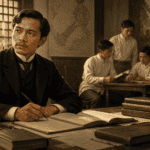
The student group exists to show that the Filipino youth of Rizal’s time was not a monolith. Sandoval is enthusiastic and idealistic, driven by conviction. Pecson is skeptical, more interested in what works than in what ought to. Tadeo is chronically absent, uninterested, the embodiment of the apathy that Rizal feared as much as he feared oppression.
Taken together, they are the argument that education alone does not produce the national consciousness Rizal was working toward. What it produces depends entirely on what the students bring to it — and on what the society makes possible for them to become.
Padre Salvi and Padre Camorra
Two friars, two flavors of the same corruption. Padre Salvi, carried over from Noli Me Tangere, is the manipulator — patient, indirect, working through influence and insinuation. Padre Camorra is more openly predatory, less interested in concealment.
Their coexistence in the novel is deliberate. Rizal is not arguing that bad priests are an aberration in an otherwise sound institution. He is arguing that the institution’s structure — its unaccountability, its entanglement with colonial power, its protection of its own members — produces both kinds of men and protects them equally.
What This Cast Tells Us About the Novel
Read together, the characters of El Filibusterismo constitute an argument about what colonial oppression does to a society over time. It produces Simoun — someone whose righteous anger has been transformed into something that can no longer distinguish between justice and revenge. It produces Basilio — someone whose survival instinct has become indistinguishable from complicity. It produces Paulita — someone who has learned to want what the system offers rather than what she actually feels. It produces Kabesang Tales — someone who simply ran out of road.
And it produces Padre Florentino, who holds the possibility that none of this is inevitable — that the next generation, if it learns the right things and builds on the right foundations, might accomplish what this one could not.
That is the note the novel ends on. Not triumph, not despair, but the careful preservation of a possibility. Rizal believed in it enough to write it down. Whether he believed in it enough to think it would arrive in his lifetime is a different question, and the answer is probably no.