“Hymn to Labor” (Imno sa Paggawa in the original Tagalog) is one of the more unusual poems in Rizal’s body of work. Where most of his verse is written in a single, unified voice — the poet observing, mourning, appealing — this one is staged. It assigns lines to men, wives, maidens, and children in turn, with a chorus that returns between each section. It reads less like a lyric poem and more like a script for a civic occasion, something meant to be performed rather than read alone.
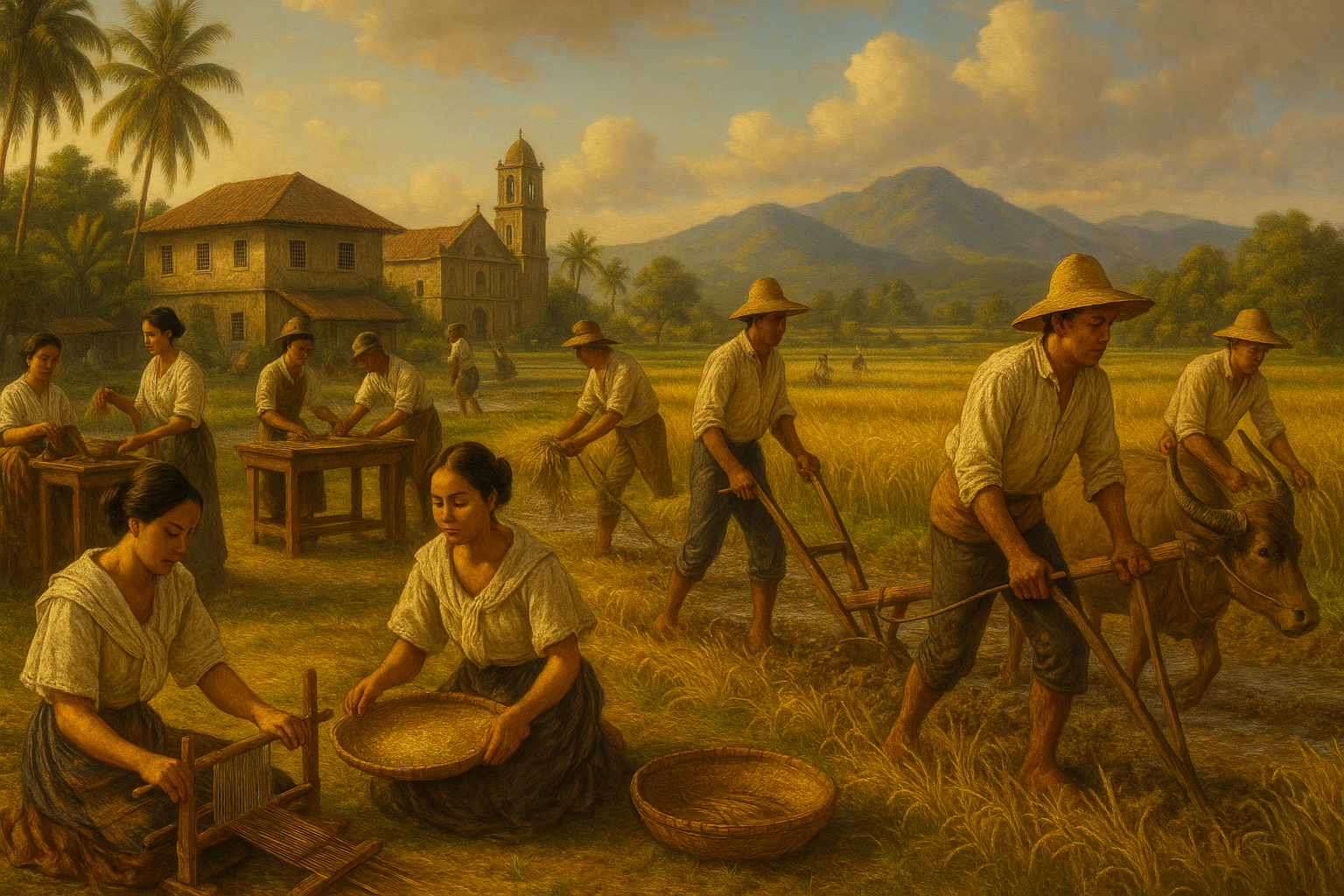
The poem’s argument is simple and direct: labor — ordinary, daily, purposeful work — is what sustains the family, the home, and the Motherland. Each voice in the poem makes the same claim from a different position. The men go to the fields at dawn. The wives keep the household and raise the next generation. The maidens praise labor as the measure of a man worth loving. The children ask to be taught, so they can carry the work forward when their turn comes.
What makes the poem worth attention is not the argument itself, which is conventional enough, but what Rizal is doing with the form. By distributing the poem across different members of a household and a community, he is saying that national renewal is not the project of heroes or intellectuals — it belongs to everyone, in whatever role they occupy. The farmer and the mother and the child are not supporting characters in someone else’s story. They are the story.
This sat in deliberate contrast to how colonial ideology had framed Filipino society for generations: as passive, dependent, in need of guidance from outside. Rizal’s poem insists on the opposite. Filipino life — its labor, its families, its daily continuity — is the foundation on which everything else rests. The country does not exist despite its people; it exists because of them.
The poem was written in Tagalog, which was itself a choice. Rizal wrote most of his poetry in Spanish, the language of education and publication. Writing Imno sa Paggawa in Tagalog placed it closer to the people it described — the farmers and wives and children it addresses directly would have been able to hear it in their own language.
Full Poem: Hymn to Labor
Chorus
For the Motherland in war,
For the Motherland in peace,
Will the Filipino keep watch,
He will live until life will cease!
Men:
Now the East is glowing with light,
Go! To the field to till the land,
For the labour of man sustains
Fam’ly, home and Motherland.
Hard the land may turn to be,
Scorching the rays of the sun above…
For the country, wife and children
All will be easy to our love.
Chorus
Wives:
Go to work with spirits high,
For the wife keeps home faithfully,
Inculcates love in her children
For virtue, knowledge and country.
When the evening brings repose,
On returning joy awaits you,
And if fate is adverse, the wife,
Shall know the task to continue.
Chorus
Maidens:
Hail! Hail! Praise to labour,
Of the country wealth and vigor!
For it brow serene’s exalted,
It’s her blood, life, and ardor.
If some youth would show his love
Labor his faith will sustain :
Only a man who struggles and works
Will his offspring know to maintain.
Chorus:
Chorus
Children:
Teach, us ye the laborious work
To pursue your footsteps we wish,
For tomorrow when country calls us
We may be able your task to finish.
And on seeing us the elders will say:
‘Look, they’re worthy ‘f their sires of yore!’
Incense does not honor the dead
As does a son with glory and valor.
Analysis
The structure of the poem is its argument. By giving each group its own stanza, Rizal builds a picture of Filipino society as a functioning whole — not a collection of individuals waiting to be led, but a community in which every member has a role that matters. The chorus that returns after each section reinforces this: whatever your position in the household or the field, you are keeping watch for the Motherland, in peace and in war alike.
The men’s stanza is the most straightforward. Dawn breaks, the work begins, the land is hard and the sun is hot — and none of it matters, because the work is done for something worth doing. The specific image of scorching heat is not incidental. Rizal is writing about agricultural labor in a tropical country, and he is not romanticizing it. The difficulty is named and then set aside, not because it isn’t real but because love makes it bearable.
The wives’ stanza is notable for what it claims. The wife does not merely keep house — she “inculcates love in her children for virtue, knowledge and country.” In Rizal’s framing, the domestic sphere is where national character is formed. The mothers of the Philippines are doing the same work as its teachers and its reformers, just in a different room. The final lines of the stanza are also worth noting: if fate is adverse, the wife shall know how to continue. She is not a passive figure waiting for her husband’s return. She is a capable person who can carry the work alone if she has to.
The maidens’ stanza introduces a different kind of claim: that labor is the measure of a worthy man. A youth who would show his love must let his labor sustain his faith. Only a man who struggles and works will know how to maintain his family. This connects the poem’s central theme — productive work for the Motherland — to the most intimate decisions of personal life. The standards of the nation and the standards of the household are the same standards.
The children’s stanza closes the cycle. They ask to be taught, they promise to continue the work, and they name the form of honor they want to earn: not incense burned at a grave, but living proof that they were worthy of those who came before them. It is a quietly moving ending — the youngest voices asking to be included in something larger than themselves, and offering the most honest measure of what that inclusion would mean.
Taken together, the poem is a vision of Filipino society renewing itself through ordinary effort — across generations, across roles, from the field to the hearth to the classroom. For a people living under colonial rule, that vision carried more weight than it might seem. It said: you are already doing the work that makes a nation. You have been doing it all along.