Most national heroes stay home — fixed in the collective memory of the country that claimed them, honored in the capital, taught in the schools, and otherwise unknown beyond the border. Their monuments mark a local devotion. Visitors from elsewhere walk past them without recognition.
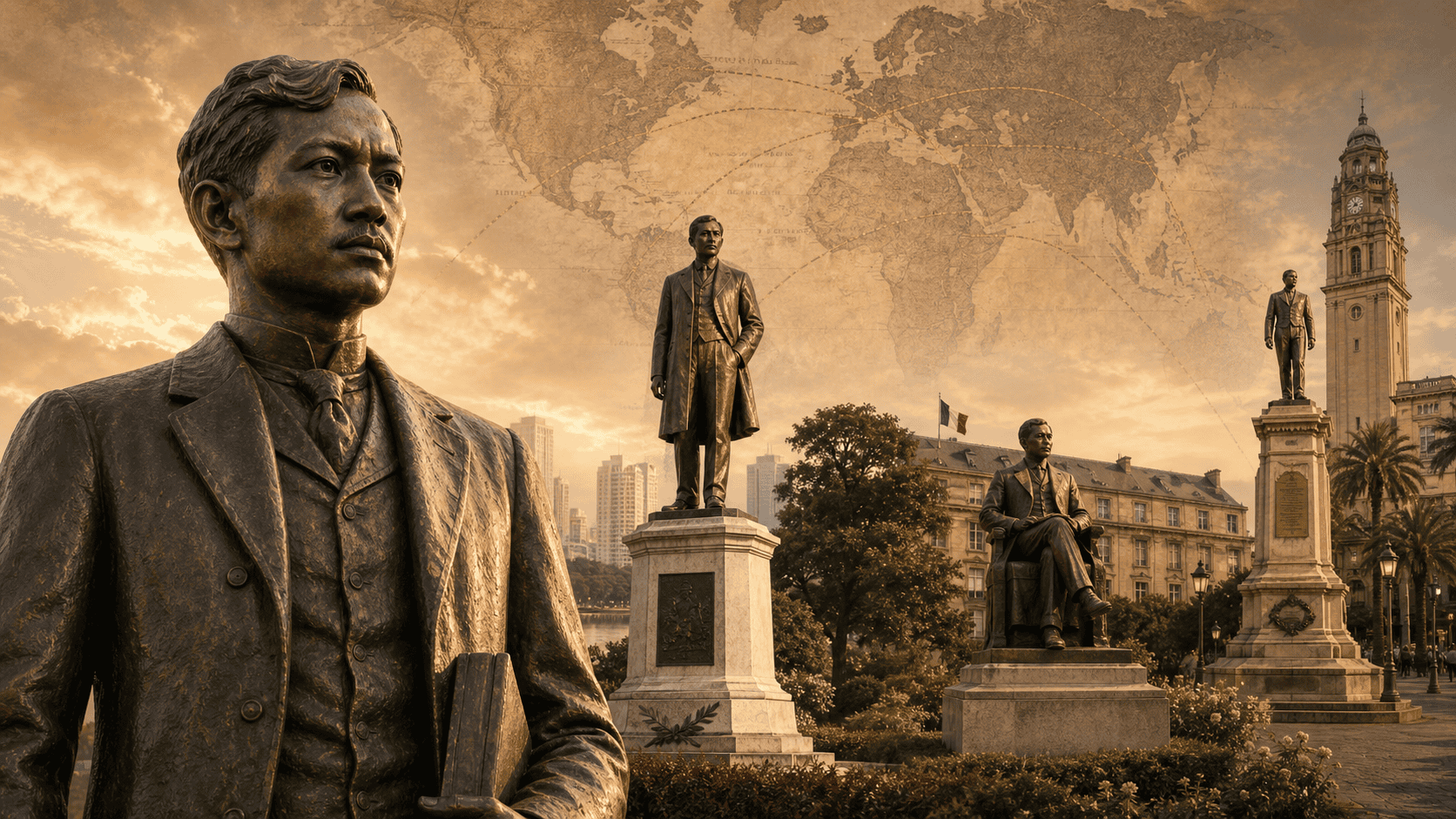
Rizal is different. Across four continents, in cities he visited and cities he never saw, bronze and stone versions of him stand in parks, plazas, and public squares — erected by Filipino communities abroad, by foreign governments that recognized something worth honoring, and by nations that found in his story a reflection of their own struggles. The monuments are not all the same. Some are grand civic gestures. Some are modest plaques on unremarkable walls. Together they form a kind of atlas of a life that refused to stay in one place — and a legacy that has refused to either.
The monuments abroad are only half the picture. Within the Philippines itself, Rizal’s likeness stands in nearly every province, from the national monument at Rizal Park in Manila to the heritage zone in Dapitan where he spent his exile, a landscape of memory that stretches from the capital to the farthest islands of the archipelago.
Madrid, Spain: The Replica That Took a Century
That Spain erected a Rizal monument at all is remarkable, given that Spain executed him.
The Madrid monument stands at the junction of Avenida de las Islas Filipinas and Calle Santander in the Chamberí district — a near-exact replica of the original Luneta monument in Manila, sculpted by Filipino artist Florante Caedo and unveiled in 1996, exactly a century after Rizal’s death. Unlike other countries which erected their own Rizal monuments in the 1960s during the centennial of his birth, Spain at the time refused to consider building one, owing to prevailing negative sentiment against Rizal in the country. Changing attitudes eventually made it possible — though it took nearly a hundred years.
The front of the pedestal contains two plaques: one commemorating its inauguration in 1996, and another unveiled on October 28, 2022, celebrating 75 years of Philippines-Spain relations. To the sides of the monument are smaller brass markers engraved with Rizal’s final poem, Mi Último Adiós, with the Spanish original on the left and a Tagalog translation on the right.
A street in Madrid has since been renamed Calle de Jose Rizal. The Philippine Embassy runs walking tours of Rizal-associated sites in the city. For Filipinos visiting Madrid, the monument has become an obligatory stop — a quiet act of reclamation in the city where so much of his most important work was done, and which was complicit in his destruction.
London, England: A Blue Plaque in Primrose Hill
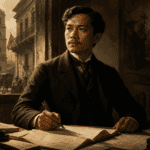
Rizal’s time in London from 1888 to 1889 was pivotal in advancing his intellectual and nationalist work. While lodging with the Beckett family in Primrose Hill — in two rooms at 37 Chalcot Crescent — he gained access to rare texts at the British Museum, where he discovered Antonio de Morga’s Sucesos de las Islas Filipinas, a first-hand account of pre-colonial life in the Philippines. He spent his days copying it by hand, annotating it, and turning it into an argument that Filipino civilization predated Spanish colonialism and would outlast it.
In honor of Rizal living in London in 1888, a blue ceramic plaque was installed in 1983 by the Greater London Council. The inscription reads: “Dr. Jose Rizal 1861-1896 Writer and national hero of the Philippines lived here.”
The blue plaque is the form of commemoration English Heritage reserves for people who shaped history — past residents of London whose work still matters. Rizal is in the company of Sigmund Freud, Virginia Woolf, and Charles de Gaulle. The house on Chalcot Crescent is an ordinary terraced building on an ordinary street, which is precisely what makes the plaque worth finding. The most consequential intellectual work often happens in rented rooms.
Wilhelmsfeld, Germany: The Park in the Forest
Located in an out-of-the-way village buried deep in the Odenwald Forest about 25 kilometers from Heidelberg, there is a statue and park dedicated to José Rizal. The statue was made by Filipino sculptor Anastacio Caedo and stands in the aptly named Rizal Park, which was opened in 1978.
Rizal came to Wilhelmsfeld in 1886 as a young medical student studying ophthalmology in Heidelberg, spending several months with the family of Pastor Karl Ullmer. He celebrated his twenty-fifth birthday there. He wrote his nostalgic poem “A las Flores de Heidelberg” — “To the Flowers of Heidelberg” — in the surrounding landscape, a poem suffused with longing for a home he could not yet return to.
The village has kept his memory with quiet fidelity. The parsonage where he stayed still stands. The Rizal Park with its bronze statue — showing him holding a quill, gaze fixed on some middle distance — sits at the heart of the village. A sandstone fountain from the parsonage garden was gifted by Wilhelmsfeld’s local government to the Philippine government and now stands in Rizal Park in Manila. The two places are, in a small way, tethered to each other across the distance.
Jinjiang, China: Honoring the Ancestry
Situated in Jinjiang City, Fujian Province, the Rizal monument towers 18.61 feet high — a symbolic reference to his year of birth, 1861. The monument’s construction officially began in 2003 to honor the deep cultural ties between China and the Philippines. It serves as recognition of Rizal’s Chinese ancestry, traced to his maternal relatives, the Ke family from the region. The bronze monument stands at the center of Jose Rizal Square, landscaped with blooming flowers and lush greenery.
That China chose to honor Rizal at this scale reflects something the Philippine national narrative sometimes understates: he was, in part, Chinese. His great-great-grandfather was a Chinese immigrant from Fujian. The Jinjiang monument is China’s acknowledgment of that connection — a claim, of sorts, on a share of the legacy.
Chicago, United States: The Filipino-American Presence
The Jose Rizal sculpture was installed in 1999 on N. Marine Drive in Chicago, Illinois, commemorating the 100th anniversary of Philippine independence. Chicago is home to one of the largest Filipino-American communities in the United States, and the Lincoln Park monument is one of two Rizal statues in the city — the other stands in front of the Rizal Center.
Across the United States, monuments and markers to Rizal exist in Juneau, Alaska; Hawaii; Orlando; New Jersey; New York City; Seattle; and Carson, California, where a fifteen-foot bronze statue by Filipino artist Toym Imao was unveiled in 2012 at the International Sculpture Garden.
Each of these monuments is, in part, a statement of presence — the Filipino-American community marking its place in the landscape of American cities, using the figure of Rizal as a symbol legible both to Filipinos who know his story and to non-Filipinos who, standing before the statue, might begin to ask.
Singapore, Prague, Rome, and Beyond
In Singapore, where Rizal stopped four times during his travels, a memorial near the Asian Civilisations Museum was unveiled in 2005 by the National Heritage Board to mark his birth anniversary. In Prague, a bust commemorates his 1887 visit and his friendship with Ferdinand Blumentritt, the Czech-Austrian scholar who became one of his most devoted allies. In Rome, a monument was constructed for his 150th birth anniversary in 2011, marking the city he described in letters as one he could have spent a year in without exhausting its meaning.
In Lima, Peru, a public park was renamed after Rizal in 2008 — reportedly the first public park in the world named after the national hero of a foreign country. A bronze bust, designed by a Czech sculptor, stands at its center.
In Sydney, Australia, a bronze bust installed in 1995 at Plaza Iberoamericana carries an inscription that reads: “Dr. Jose Rizal was the first to inspire Filipinos to regard themselves as a nation and to cherish the Philippines as their fatherland.”
In Tokyo’s Hibiya Park, a bronze bust unveiled in 1998 marks the forty-five days Rizal spent in Japan in 1888, a period he later described with warmth.
What the Monuments Mean Together
Taken individually, each monument tells a local story — a Filipino community asserting its presence, a foreign government acknowledging a historical connection, a city honoring a man who once walked its streets. Taken together, they say something larger.
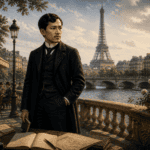
Rizal’s monuments around the world trace the shape of a life that was genuinely international — not because he was privileged or rootless, but because the colonial world he inhabited forced him to be mobile and because he used that mobility with extraordinary intentionality. He went to Europe to learn medicine, but he also went to understand what the rest of the world knew that the Philippines had been denied. He moved through Madrid, Paris, Berlin, London, Heidelberg, Brussels, and Rome not as a tourist but as a student of human societies, accumulating the knowledge and the comparisons that would eventually become his novels.
The monuments that now stand in those cities are a kind of retroactive acknowledgment — the world recognizing, belatedly, that he was paying attention while he was there, and that what he did with that attention mattered.
There is also something worth noting about the monuments in places Rizal never visited — Carson, California; Lima, Peru; Sydney, Australia. These exist not because of his physical presence but because of his ideas, carried by Filipino emigrants who found in his story something worth bringing with them. He became, in those places, what he had always argued for: proof that Filipino identity is not a local condition but a human one, capable of surviving distance and expressing itself anywhere.
That is perhaps the most appropriate legacy for a man who spent most of his adult life far from home, writing about it.