
The Arrival
Rizal came to Heidelberg from Paris, where he had spent several months training under Dr. Louis de Wecker at one of the leading ophthalmological clinics in Europe. Paris had given him clinical experience and access to a level of surgical technique unavailable in Spain. Heidelberg offered something different: Professor Otto Becker, one of the most distinguished eye specialists in German academic medicine, based at the university clinic on Bergheimerstrasse.
He arrived in February 1886 and lodged initially at Ludwigsplatz 12, a building not far from the old university center, within walking distance of the clinic and of the Neckar River. It was winter. Heidelberg in winter is cold and grey, the castle on the hill above the town visible through bare trees, the Neckar moving dark and fast between its banks. He came from the warmth of the Philippines by way of Madrid and Paris, and the German winter was its own kind of adjustment.
He was there to work. He attended lectures by Professor Becker and by Professor Wilhelm Kühne, the physiologist, at the old university. He trained in the eye clinic, assisting with examinations and surgeries, developing the hands-on precision that would later make him one of the more capable ophthalmologists operating in the Philippines. He had chosen the specialty deliberately — his mother Teodora was losing her sight to what was likely a progressive cataract condition, and he intended to return home and treat her. The decision to train under Becker was not incidental. It was the completion of a plan he had been working toward since Madrid.
The Town
Heidelberg is one of the more beautiful university towns in Germany, and in 1886 it was also one of the most intellectually alive. The university — founded in 1386, the oldest in the German-speaking world — had just celebrated its five-hundredth anniversary in August of that year, an event Rizal witnessed before leaving for Leipzig. The town sat at the point where the Neckar River emerged from the Odenwald hills into the Rhine plain, its old quarter built along the south bank with the ruins of the Electoral Palace — the Heidelberger Schloss — rising above it on the Königstuhl hillside.
The Philosophenweg — the Philosopher’s Walk — ran along the north bank of the Neckar, a path through terraced gardens and woodland that had been the walking route of university intellectuals for generations. Rizal walked it regularly in the afternoons and evenings. The path offered a view across the river to the old town and the castle above it — one of the most photogenic views in Germany, unchanged in its essential character from what Rizal would have seen. He observed, thought, and wrote in the margin of his own experience of the place.
In the spring of 1886, the Neckar banks came into bloom. Among the flowers that appeared along the path and the riverbank was the forget-me-not — a small, light blue flower, modest in itself, that grows in clusters along European waterways in spring. Rizal had a particular fondness for it. Looking at the forget-me-not along the Neckar, he thought of the flowers along the banks of the streams near Calamba, and the distance between the two places became suddenly, specifically painful.
The Poem
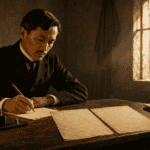
On April 22, 1886, he wrote A las Flores del Heidelberg — To the Flowers of Heidelberg — in Spanish, in the room at Ludwigsplatz 12.
The poem is addressed directly to the flowers, in the way that a letter is addressed to a person. He asks them to carry a message to the Philippines — to his homeland, to his family, to the landscape he grew up in. He tells them what to say: that he was here, that he walked beside the Neckar and thought of home, that he admired the castle and the morning light on the Königstuhl and thought of the light on Mount Makiling. He asks them to find the flowers of Calamba and tell them that the pilgrim remembers.
The poem is not political. It contains no argument, no colonial critique, no call to action. It is a poem of homesickness — the specific, acute kind that comes not from despair but from happiness in an unexpected place, which makes the distance from home feel both larger and more bearable at the same time. Heidelberg was beautiful. The beauty made him miss the different beauty of Calamba more intensely.
There is a formal intelligence in the structure of the poem that rewards attention. Rizal was a technically accomplished poet who had been writing in Spanish since his student years in Manila, and the stanzas of A las Flores del Heidelberg handle their rhyme scheme with the ease of a writer who has done this long enough that the form has become natural rather than labored. The emotional directness of the poem — the simple, unguarded quality of addressing a flower as if it could understand and carry a message — sits interestingly against the formal precision of the verse. The combination is what gives the poem its particular warmth.
The central image — asking the flowers to be his messengers, to drift downstream and somehow reach the Philippines — is impossible, and Rizal knows it. The impossibility is part of the point. The poem is not trying to actually communicate with Calamba. It is a way of holding, in language, the feeling of being very far from home and very much aware of it.
Wilhelmsfeld
In the late spring of 1886, Rizal left the center of Heidelberg for Wilhelmsfeld — a small village in the hills of the Odenwald, about fifteen kilometers east of the city. He lodged with Pastor Karl Ullmer, a Lutheran minister, and his family, staying from roughly late spring through June 25. It was a domestic, quiet interlude — Rizal took long afternoon walks in the wooded hills with the pastor, the two men talking about German religious thought and Philippine culture and the various subjects that formed the natural conversation of two curious people from very different worlds.
The Ullmer family — pastor, wife, and their children Etta and Fritz — became genuinely fond of Rizal. He gave the children language lessons. He sent Fritz a letter from Munich the following year, maintaining the friendship. He also, at Wilhelmsfeld, substantially improved his German — by the time he wrote to Blumentritt on July 31, 1886, his first letter in German to the Austrian scholar who would become his closest European friend, his command of the language was already serviceable.
Wilhelmsfeld is still a small village in the Odenwald hills. It has not forgotten Rizal either. A marker commemorating his stay is placed near the church.
The First Letter to Blumentritt
The Heidelberg months produced one development whose significance extended well beyond the poem and the town: the beginning of Rizal’s correspondence with Ferdinand Blumentritt.
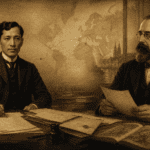
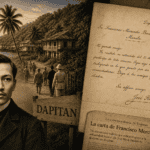
Blumentritt was an Austrian ethnologist and linguist based in Leitmeritz (now Litoměřice, in the Czech Republic), who had developed an extensive scholarly interest in the Philippines — its languages, its peoples, its history — without ever having visited the archipelago. He and Rizal had been aware of each other’s existence through the networks of Philippine scholarship, and on July 31, 1886, Rizal wrote to him for the first time — in German, which was itself a gesture of effort and respect.
Blumentritt responded. The two men discovered an immediate intellectual sympathy. They corresponded for the rest of Rizal’s life, exchanging hundreds of letters on everything from Philippine linguistics and natural history to colonial policy and personal news. Blumentritt became, over the twelve years of their friendship, one of the people who knew Rizal most completely — the foreign scholar who taught himself about the Philippines in part through the eyes of the man who was simultaneously trying to save it.
Rizal called Blumentritt his best friend in Europe. Blumentritt, when Rizal was executed in 1896, was among the first Europeans to write about the loss in public, trying to make the wider world understand what had been killed.
The friendship began in Heidelberg.
The 500th Anniversary
On August 6, 1886, the University of Heidelberg celebrated the five-hundredth anniversary of its founding with ceremonies that drew scholars and dignitaries from across Europe. Rizal was there. A twenty-five-year-old Filipino ophthalmology student, watching one of the oldest universities in the German-speaking world mark half a millennium of existence — the contrast with the restricted, ecclesiastically controlled education available in the Philippines was not lost on him.
He moved on shortly afterward, to Leipzig for lectures in history and psychology, then to Dresden to meet Dr. Adolph Meyer at the anthropological museum, then to Berlin, where the coldest winter of his European years awaited him and where the final chapters of Noli Me Tangere would be written. Heidelberg was behind him.
What Remains
Two markers in Heidelberg commemorate Rizal’s time in the city. One is at the building on Ludwigsplatz 12 where he first lodged and where he completed the poem — a plaque on the facade, visible from the street, identifying the building as the place where he stayed and worked. The other is a stone marker on the Neckar riverbank, at what is now called Rizal Ufer — Rizal Embankment — with an inscription that includes the opening line of A las Flores del Heidelberg and a brief description of who he was and what the poem is about.
The eye clinic on Bergheimerstrasse where he trained under Professor Becker also carries a marker. The Philosopher’s Walk, where he took his afternoon walks in the spring of 1886, is still there — still a wooded path along the north bank of the Neckar, still offering the same view of the old town and the castle that he would have seen.
Heidelberg has kept the connection with some care. The name Rizal Ufer is not incidental — it is a formal place name, on city maps, on bus stop signs. A Filipino ophthalmology student came here for six months in 1886, walked the paths, trained in the clinic, wrote a poem about flowers, and left. The town decided this was worth remembering.
Visiting Today
Heidelberg is easily reached from Frankfurt by direct train — the journey takes less than an hour. The old town is compact enough to cover on foot. From Ludwigsplatz, the eye clinic on Bergheimerstrasse is a short walk. The Karl-Theodor Bridge crosses the Neckar to the north bank and the Philosopher’s Walk. The castle is a steep climb or a funicular ride up the Königstuhl.
Rizal Ufer runs along the south bank of the Neckar, between the old bridge and the hospital district. The marker stone is on the riverbank path, accessible on foot from the city center. It is a quiet spot — a walking and cycling path, trees, the sound of the river, the castle visible on the hill across the water.
The forget-me-nots still grow along the Neckar in spring.
Read next: Rizal in London — his year at the British Museum, the annotated colonial history, and the address he wrote in the reading room register.