What You Need to Know Before You Start
If you haven’t read Noli Me Tangere, here is the essential context: a young Filipino idealist named Crisóstomo Ibarra returned home from Europe full of hope, tried to build a school, fell in love, and was destroyed by the colonial system.
His father had been persecuted by friars. His name was dragged through false accusations. His fiancée, María Clara, was taken from him and forced into a convent. He was forced to flee, and most people believed him dead.
El Filibusterismo picks up more than a decade later. Ibarra is not dead. But the man who returns is not the man who left.
What Does “El Filibusterismo” Actually Mean?
In 19th-century Spanish colonial vocabulary, a filibustero was not a pirate. It was something the authorities considered far more dangerous: a subversive. Someone who worked against the colonial order. An agitator. A revolutionary.
Rizal chose the title deliberately. This novel is not about reform. It is about what happens when a man — and a people — stop believing reform is possible.
The Man in Dark Glasses
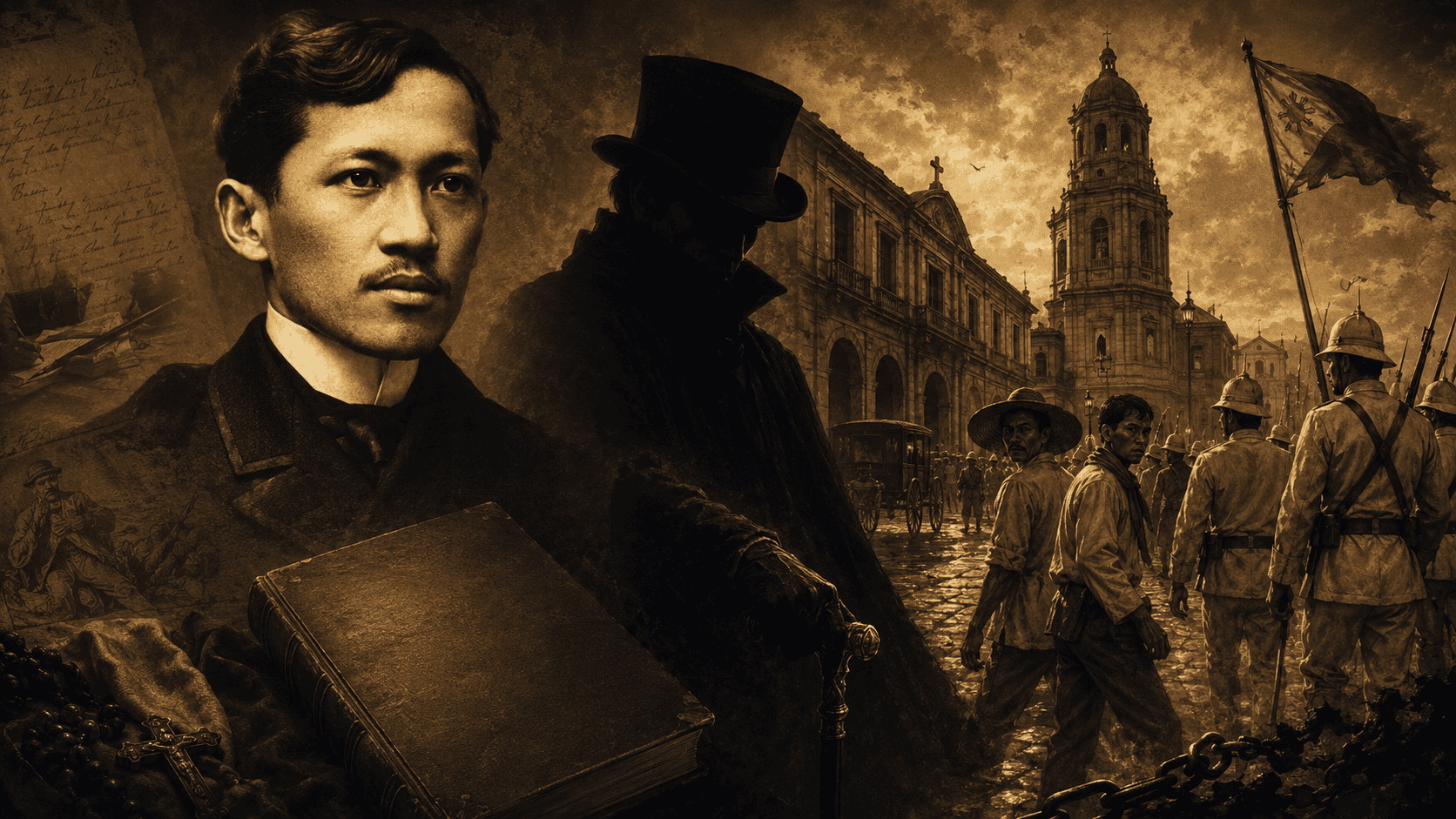
The novel opens on a steamboat, the Tabo, moving through the rivers of the Philippines toward Manila. Among the passengers is a wealthy jeweler named Simoun — dark-skinned, heavily bearded, wearing tinted glasses, moving through the boat with quiet confidence and an air of barely concealed contempt for almost everyone around him.
He is not who he appears to be. Simoun is Crisóstomo Ibarra, transformed by thirteen years of exile, suffering, and rage into something unrecognizable. The optimistic young reformer is gone. In his place is a man who has built a fortune, cultivated access to the highest levels of colonial power, and spent years preparing a plan — not to reform the system, but to destroy it.
The steamboat scene is Rizal establishing the temperature of his new world. Where Noli Me Tangere opened at a dinner party full of nervous social performance, El Filibusterismo opens on a crowded boat where injustice is casual, visible, and completely unremarkable to everyone except the reader. A farmer is losing his land. Students are being mocked. Officials are corrupt by default. The Philippines of this novel is not a society straining against its chains. It is a society that has forgotten what life without chains feels like.
The Students and the Broken Dream of Education
One of the novel’s central subplots follows a group of Filipino university students — among them Basilio, Isagani, and their circle — who are trying to establish an academy for Spanish language instruction. Their logic is pragmatic: if Filipinos learn Spanish properly, they can participate more fully in public life, in law, in governance. Education as the path to dignity.
It is exactly the kind of reform Ibarra believed in, a decade ago.
The petition goes nowhere. Friar authorities see an educated Filipino population as a threat, not a civic improvement. The proposal is delayed, mocked, sabotaged through bureaucratic indifference, and ultimately killed. The students, who began with hope, end with disillusionment.
Rizal is making a point here that cuts against his own earlier beliefs: the system does not reform itself. It absorbs reform attempts and neutralizes them.
Basilio: The Child Who Survived
Basilio appears briefly in Noli Me Tangere as a traumatized boy — a sacristan’s son who lost his brother Crispín to the church’s cruelty and watched his mother Sisa lose her mind from grief. He is now a medical student, intelligent and disciplined, trying to build a life from the ruins of his childhood through sheer determination.
He is also the person Simoun chooses to approach first.
Simoun reveals his true identity to Basilio and lays out his plan. He does not pretend it is anything other than what it is: a violent revolution, timed to ignite from within the colonial establishment itself. He offers Basilio a place in it.
Basilio hesitates. His past gives him every reason to want the system destroyed. His conscience gives him every reason to refuse. This tension — between the desire for justice and the fear of what justice through violence actually costs — runs through everything that follows.
Kabesang Tales: What Happens When a Peaceful Man Runs Out of Options
Running parallel to the Manila storylines is the fate of Kabesang Tales — Telesforo Juan de Dios — a farmer in the provinces who has spent years cultivating his land, paying his dues, and working within the system. The friars take his land anyway. The courts offer no remedy. His petitions go unanswered. His family is left with nothing.
Kabesang Tales does not become a revolutionary through ideology. He becomes one through exhaustion. When every peaceful option has been closed off, he joins a band of outlaws in the mountains. His story is Rizal’s bluntest argument: the colonial system does not just produce injustice. It manufactures its own enemies, then uses those enemies to justify more repression.
His path eventually intersects with Simoun’s, binding the countryside’s quiet fury to the jeweler’s elaborate urban plot.
The Plan
Simoun’s scheme is audacious and cold-blooded. He has spent years engineering the conditions for revolution — not by inspiring people, but by making the colonial system worse. He has encouraged corrupt officials, supported unjust policies, and used his access to power to deepen the grievances of ordinary Filipinos. His reasoning is brutal: a population pushed far enough will finally push back.
The centerpiece of his plan is a wedding. Manila’s colonial elite — officials, friars, the powerful and the pampered — are gathering to celebrate the marriage of Paulita Gómez and Juanito Pelaez. Simoun sends a wedding gift: a magnificent ornate lamp, an object of beauty and craftsmanship. Hidden inside it is a bomb. When the wick burns low enough, the lamp will explode, killing everyone in the room. The blast will be the signal for armed groups positioned around the city to rise simultaneously and begin the revolution.
It is a plan built from grief and fury, disguised as a gift.
The Moment It All Falls Apart
Isagani is a student and a poet, idealistic and impulsive, and he is still in love with Paulita Gómez even though she has chosen to marry someone else. On the night of the wedding, he overhears that something terrible is about to happen inside. He doesn’t know about Simoun’s plan. He only knows that the woman he loves is in danger.
He runs into the building. He grabs the lamp. He throws it into the river.
The explosion happens far from its intended target. The signal is never given. The armed groups wait, then scatter. The revolution — years in the making, built on the suffering of thousands — collapses in the space of a few seconds because one young man acted on instinct rather than calculation.
Rizal does not present this as a simple tragedy or a simple relief. It is both. The revolution would have been violent and may have failed regardless. But it also might have changed everything. The novel refuses to tell you which outcome would have been better.
The Dying Man’s Confession
Simoun flees. He is wounded, exhausted, and hunted. He makes his way to the home of Padre Florentino — a Filipino priest who is thoughtful, principled, and genuinely good in a novel full of people who are not.
Florentino takes him in without knowing who he is. As Simoun lies dying, he reveals everything: his real name, his history, the plan, the love that was taken from him, the years of exile, the rage that replaced everything else. It is not a triumphant deathbed speech. It is the confession of a man who spent thirteen years becoming someone he might not recognize, in pursuit of a justice he never reached.
He dies in Florentino’s house, having accomplished nothing he set out to accomplish, having lost everything twice.
The Jewels and the Sea
Before the authorities arrive, Padre Florentino gathers Simoun’s collection of jewels — the vast fortune that funded the entire plan, wealth accumulated across years of exile and calculation — and carries them to a cliff overlooking the sea.
He throws them in.
The gesture is symbolic and deliberate. Wealth built on suffering, used to fund vengeance, returned to the earth. Florentino does not mourn Simoun exactly, but he understands him. His final monologue — addressed to no one, or perhaps to the sea, or to the future — is one of the most important passages Rizal ever wrote. It does not celebrate what Simoun tried to do. But it does not dismiss it either. It asks what kind of freedom is actually worth having, and whether a revolution without moral foundation can produce anything other than a new form of the same injustice.
The novel ends on that question, unanswered and open.
Why This Novel Is Harder Than the First One
Noli Me Tangere is a novel about injustice. Its moral landscape, while complex, has clear villains and sympathetic victims. The reader knows whose side to be on.
El Filibusterismo offers no such comfort. Simoun is not a villain exactly — his grievances are real, his suffering was real, and the system he wants to destroy is genuinely monstrous. But his methods are also genuinely monstrous. He is willing to kill innocent people, to make the lives of ordinary Filipinos worse in order to push them toward revolution, to use human suffering as a strategic instrument. The novel forces the reader to hold both truths at once: his cause is just, and his means are not.
Rizal wrote this novel four years before the Philippine Revolution began. He had seen enough of the reform movement to know it was failing. He had also thought hard enough about violence to know what it costs. El Filibusterismo is his attempt to hold that contradiction honestly — to write a novel that understands the rage behind revolution without endorsing what revolution, done wrong, produces.
It is a harder book than Noli. It is also, in some ways, a braver one.
Read next: El Filibusterismo: A Long-Form Analysis — a deeper look at the novel’s themes, moral questions, and place in world literature.