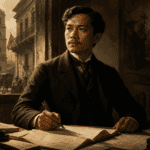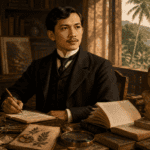
He won with a poem written in the colonizer’s language, judged by the colonizers, that quietly insisted his own people mattered more than theirs. Rizal was eighteen. It was the first time a Filipino-written Spanish poem had been recognized by Spanish literary authority — and the judges appear not to have fully grasped what they had just rewarded.
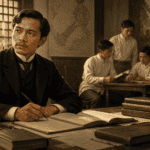
He was studying medicine at the University of Santo Tomas, had not yet left for Europe, and had not yet written a single novel. What he had already formed, at eighteen, was a conviction precise enough to win a literary contest — and audacious enough to do it in the language of the people he was arguing against.
Background and Context
A la Juventud Filipina was written while Rizal was studying at the University of Santo Tomas. He was eighteen years old. He had not yet left for Europe, had not yet written the novels, had not yet become the figure history would make him. What he had already formed was a clear conviction: that the colonial narrative of Filipino inferiority was false, and that the most effective way to refute it was not argument but demonstration.
The poem is the demonstration. It was written in Spanish — the colonizer’s language — submitted to a contest judged by Spaniards, and it won. The content of the poem insisted that Filipinos were the hope of their own fatherland. The act of winning insisted that Filipinos could excel in any form the colonial world considered prestigious.
It was the first Spanish poem written by a Filipino to be recognized by Spanish literary authority. Rizal’s Jesuit professors from Ateneo congratulated him. His family celebrated. And the poem began to circulate among Filipinos who understood exactly what it meant that one of their own had beaten the Spanish at their own literary contest.
The poem addresses the Filipino youth directly — not as a passive audience but as agents. It calls on them to pursue knowledge, art, science, and moral excellence. It imagines them as the inheritors of the nation’s potential, and it places responsibility on their shoulders without making that responsibility feel like a burden. The tone throughout is encouragement rather than obligation — an eighteen-year-old speaking to his generation as an equal.
What it does not do, and what distinguishes it from Rizal’s later work, is confront colonial power directly. The poem works through implication. By insisting that Filipino youth are capable of greatness, it implicitly rejects the colonial claim that they are not. The political argument is embedded in the affirmation rather than stated outright. A Spanish judge could read it as an inspiring poem about youth. A Filipino reader would understand it as something considerably more pointed.
A Note on Translation
The English text most commonly reproduced online — including the version that appeared on this page — is Charles Derbyshire’s translation from the early twentieth century. Derbyshire’s translation contains flaws, and Philippine National Artist Nick Joaquin also produced his own version. Multiple translations exist and they differ in significant ways.
The version presented here is Derbyshire’s, as it remains the most widely circulated English text of the poem, but readers should know that it is a translation of a translation, and that the original Spanish carries nuances that English approximates rather than reproduces. Studocu
One error worth flagging: the line “The Spaniard’a holy hand” — appearing across dozens of websites — is simply a typo that has propagated uncorrected for years. It should read “The Spaniard’s holy hand.”
The Poem
A la Juventud Filipina (1879) English translation by Charles Derbyshire
Hold high the brow serene,
O youth, where now you stand;
Let the bright sheen
Of your grace be seen,
Fair hope of my fatherland!
Come now, thou genius grand,
And bring down inspiration;
With thy mighty hand,
Swifter than the wind’s summation,
Raise the eager mind to higher station.
Come down with pleasing light
Of art and science to the fight,
O youth, and there untie
The chains that heavy lie,
Your spirit free to blight.
See how in flaming zone
Amid the shadows thrown,
The Spaniard’s holy hand
A crown’s resplendent band
Proffers to this Indian land.
Thou, who now wouldst rise
On wings of rich emprise,
Seeking from Olympian skies
Songs of sweetest strain,
Softer than ambrosial rain;
Thou, whose voice divine
Rivals Philomel’s refrain
And with varied line
Through the night benign
Frees mortality from pain;
Thou, who by sharp strife
Wakest thy mind to life;
And the memory bright
Of thy genius’ light
Makest immortal in its strength;
And thou, in accents clear
Of Phoebus, to Apelles dear;
Or by the brush’s magic art
Takest from nature’s store a part,
To fix it on the simple canvas’ length;
Go forth, and then the sacred fire
Of thy genius to the laurel may aspire;
To spread around the fame,
And in victory acclaim,
Through wider spheres the human name.
Day, O happy day,
Fair Filipinas, for thy land!
So bless the Power today
That places in thy way
This favor and this fortune grand!
Analysis
The poem opens with the image that became its most enduring phrase: the youth raising their brow — serene, confident, unashamed. In a colonial context where Filipinos were systematically taught to see themselves as inferior, this is not a decorative image. It is a political one. To hold the brow high is to refuse the posture of subjugation.
The second and third stanzas call on genius — artistic, intellectual, scientific — to descend and elevate the Filipino mind. The metaphor of chains appears here: the chains are not only those imposed from outside but those internalized. The poem asks the youth to untie both. Rizal understood, from his own experience, that colonial oppression works partly through the minds of the colonized — through the acceptance of inferiority as a natural rather than a constructed condition. The poem is a direct argument against that acceptance.
The fourth stanza is the most politically complex. It describes the Spanish offering a crown to “this Indian land” — a reference to the official colonial position that Spain had brought Christianity and civilization to the Philippines and that this gift should be received with gratitude. Rizal places this claim inside the poem without endorsing it. He describes it. The implication — that the Filipino youth, pursuing their own excellence, do not need to define their worth by what the colonizer offers — is left for the reader to draw.
The middle stanzas address specific vocations: poetry, music, sculpture, painting. Rizal was writing to students like himself — young people being educated in the arts and sciences — and he is telling each of them that their particular gift is part of the national project. The painter, the poet, the musician: all of them are agents of the same awakening.
The final stanzas issue the call directly. The sacred fire of genius awaits. Go forth. Spread the name. The “happy day” of the closing stanza is conditional — it is the day that will come when the youth rise to their potential. It has not arrived yet. The poem is about what must happen before it does.
Why It Matters Beyond the Classroom
A la Juventud Filipina is often taught as an inspirational poem — a piece of uplifting verse that tells young Filipinos they are capable of great things. This reading is not wrong, but it is incomplete.
The poem matters because of when it was written, who wrote it, and who judged it. A colonial subject, at eighteen, wrote a poem in the colonizer’s language arguing that his own people were the hope of their land — and the colonizers’ own judges declared it the best poem submitted. That is not simply inspiration. It is a small, precise act of cultural reclamation, accomplished at a literary contest in Manila in 1879 by a teenager who understood exactly what he was doing.
The novels and the essays would come later. The political philosophy would develop, deepen, and eventually contribute to a revolution. But the conviction that drove all of it — that Filipinos were capable of anything the colonial world considered worth doing, and that demonstrating this was itself a form of resistance — was already fully formed at eighteen, expressed in this poem, and rewarded by the very authority it was quietly challenging.
Read more about Rizal’s quotes on youth, the complete works of José Rizal, and Mi Último Adiós — the poem he wrote at the other end of his life, the night before his execution.