
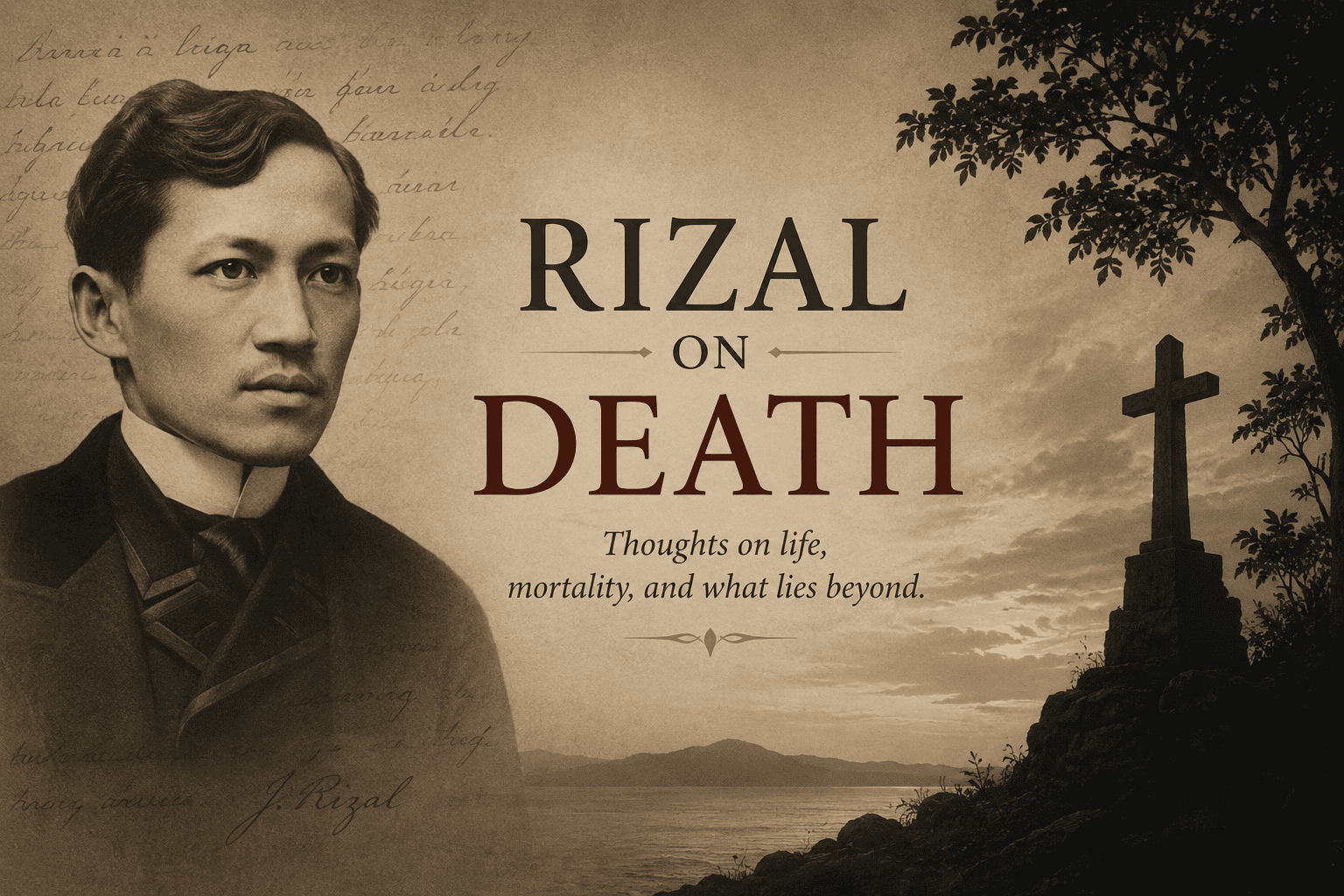
José Rizal thought about death for most of his adult life. He wrote about it in his novels, declared it in his letters, and ultimately faced it before a firing squad at thirty-five. What makes his words on the subject remarkable is not just their courage but their consistency — from a private letter written six years before his execution to the last thing he ever wrote to his closest friend, Rizal’s view of death barely wavered.
From His Novels
Rizal’s first published statement on dying well came not under his own name but through a fictional character. In Noli Me Tangere (1887), the revolutionary Elias speaks his final words as he lies dying in the forest on Noche Buena:
I die without seeing the dawn brighten over my native land. You who have it to see, welcome it and forget not those who have fallen during the night!
Rizal wrote those lines nine years before his execution. When he was shot at Bagumbayan on December 30, 1896, they read less like fiction and more like prophecy.
The same novel contains another line on death, this time in the “Song of Maria Clara”:
How sweet to die for the native country, where friendly shines the sun above! Death is the breeze for him who has no country, no mother, and no love!
Both passages were written when Rizal was twenty-six, living in Berlin, and already certain that his work would make him a target.
From His Letters
Rizal’s letters are where his thinking on death is most direct. Across six years and three very different moments in his life, he returned to the same subject — each time with a different urgency.
Letter to Mariano Ponce, 1890
Three years after Noli, Rizal wrote to his friend and fellow propagandist Mariano Ponce with a more personal reflection. He was in Europe, fighting for Filipino rights through journalism and political lobbying, and the possibility of his own death was no longer abstract:
One only dies once, and if one does not die well, a good opportunity is lost and will not present itself again.
The line is philosophical rather than political — less about patriotism than about the moral weight of how a person meets their end. It suggests that Rizal had already worked out his position: that dying with integrity, for something real, was not a tragedy but a final act of meaning.
Farewell Letter to All Filipinos, June 1892
Two years later, his tone had shifted. On the eve of his deportation to Dapitan — after being arrested for possessing anti-friar documents — Rizal wrote what amounted to a farewell letter addressed not to one person but to his entire countrymen. The language is urgent, almost defiant:
I wish to show those who deny us patriotism that we know how to die for our duty and our convictions. What matters death if one dies for what one loves, for native land and adored beings?
He added an instruction that says much about how he understood his own legacy: “Publish these letters after my death.” He knew the letters would matter more once he was gone. He was right.
Letter to Ferdinand Blumentritt, December 29, 1896
The night before his execution, writing from his death cell in Fort Santiago, Rizal addressed one last letter to his closest European friend — the Austrian professor Ferdinand Blumentritt, with whom he had corresponded for over a decade. He opened by telling Blumentritt he would already be dead by the time the letter arrived, then wrote:
Tomorrow at seven, I shall be shot; but I am innocent of the crime of rebellion. I am going to die with a tranquil conscience.
It was the last thing he ever wrote to his best friend. The source is Epistolario Rizalino, the collected letters compiled by Teodoro Kalaw.
What These Passages Tell Us
Read together, these quotations trace an arc. The Elias passage (1887) is romantic — death as noble sacrifice in service of a dawn the dying man will never see. The Ponce letter (1890) is philosophical — death as opportunity, to be either seized or squandered. The 1892 letter is political — death as proof, a way of answering those who questioned Filipino courage and conviction. And the Blumentritt letter (1896) is simply true: a man reporting his own inner state in the last hours of his life.
The thread running through all of them is the same idea: that death, handled well, is not the end of a life’s meaning but its confirmation.
Further reading: Mi Último Adiós · Rizal’s Trial and Execution · Rizal’s Death and Execution · Noli Me Tangere