The Night It Was Written
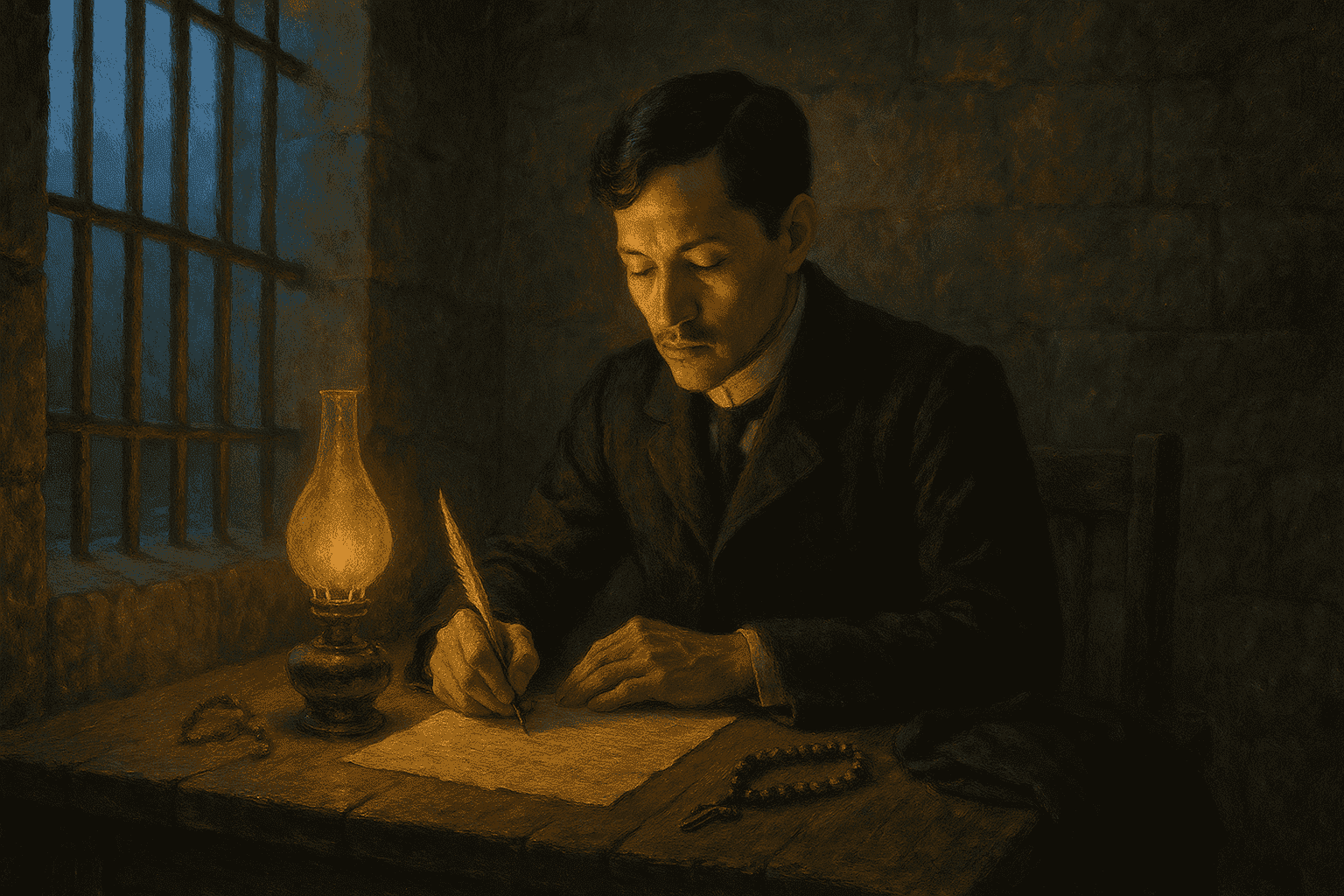
The date was December 29, 1896. Jose Rizal was 35 years old, held in Fort Santiago — the Spanish colonial fortress in Manila — with his execution scheduled for the following morning. He had been tried, convicted, and sentenced for rebellion and conspiracy, in a military tribunal that had decided the outcome before the proceedings began.
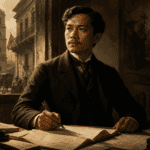
He spent his final night writing. Letters to his family. A retraction document that historians still debate. And one last poem — written in Spanish, untitled, on a single folded sheet of paper.
He hid the poem inside an alcohol burner in his cell. When his sister Trinidad came to say goodbye, he pressed the lamp into her hands and whispered that there was something inside. He gave no other explanation. He could not risk the guards understanding.
After the execution the following morning — after the firing squad at Bagumbayan field, after the body was buried in an unmarked grave — Trinidad found the paper. She unfolded it. She read it. And within days, handwritten copies were circulating across Manila.
What Kind of Poem Is It
This is the thing that surprises most people who encounter Mi Último Adiós for the first time: it is not an angry poem.
A man hours from death, wrongly convicted, dying at 35 with everything unfinished — you might expect rage. You might expect accusation. You might expect a final indictment of the people who put him there.
What Rizal wrote instead was a love poem. Addressed to the Philippines. Tender, calm, almost serene. He imagines his blood coloring the dawn — that his death might be the moment freedom begins to break through. He imagines flowers growing over his grave, and asks that if someone draws a flower to their lips, that kiss might reach him. He thinks of moonlight, breezes, birdsong. He says goodbye to his parents, his friends, and — in a line scholars believe refers to Josephine Bracken, the woman he loved — a “sweet friend that lightened my way.”
Then he returns, always, to the Philippines. Even in imagining his ashes scattered to the wind, he says his faith in the country will remain.
The tone is not resignation. It is something closer to peace — the specific peace of a person who has done what they believed was right and is not asking for it to have turned out differently.
Why He Left It Untitled
Rizal gave the poem no title. The name Mi Último Adiós — “My Last Farewell” — was given to it afterward by his friend and fellow reformist Mariano Ponce, who arranged for it to be printed in Hong Kong.
The absence of a title may have been practical — a titled poem is easier for guards to identify as contraband. But it may also have been deliberate in a deeper sense. A title fixes a poem in place. Leaving it untitled left it open, available, able to become whatever the people who read it needed it to be.
The Translation Question
The poem was originally written in Spanish — Rizal’s literary language, the language of his novels, the language of the colonial power he was writing against. There is a particular weight to that choice: his final words, addressed to his country, written in the language of its oppressors.
The most widely read English translation is by Charles Derbyshire, published in the early 20th century. Derbyshire preserves the poem’s formal structure and its elevated, hymn-like tone — the language feels old, deliberately so, appropriate to a poem meant to endure. Other translations exist, some more contemporary in their phrasing, trading some of the solemnity for clarity. Neither approach is wrong. They are different windows onto the same interior.
The original Spanish remains the most direct point of contact with Rizal’s voice. If you read Spanish, it is worth experiencing the poem that way at least once.
My Last Farewell (Full English Translation)
Translated by Charles Derbyshire. Public domain.
Farewell, dear Fatherland, clime of the sun caress’d,
Pearl of the Orient seas, our Eden lost!
Gladly now I go to give thee this faded life’s best,
And were it brighter, fresher, or more blest,
Still would I give it thee, nor count the cost.
On the field of battle, ‘mid the frenzy of fight,
Others have given their lives, without doubt or heed;
The place matters not—cypress or laurel or lily white,
Scaffold or open plain, combat or martyrdom’s plight,
‘Tis ever the same, to serve our home and country’s need.
I die just when I see the dawn break,
Through the gloom of night, to herald the day;
And if color is lacking my blood thou shalt take,
Pour’d out at need for thy dear sake,
To dye with its crimson the waking ray.
My dreams, when life first opened to me,
My dreams, when the hopes of youth beat high,
Were to see thy lov’d face, O gem of the Orient sea,
From gloom and grief, from care and sorrow free;
No blush on thy brow, no tear in thine eye.
Dream of my life, my living and burning desire,
All hail! cries the soul that is now to take flight;
All hail! And sweet it is for thee to expire;
To die for thy sake, that thou mayst aspire;
And sleep in thy bosom eternity’s long night.
If over my grave some day thou seest grow
In the grassy sod, a humble flower,
Draw it to thy lips and kiss my soul so,
While I may feel on my brow in the still hour,
A kiss that is fresh with the fragrance I love.
Let the moon beam over me soft and serene,
Let the dawn shed over me its radiant flashes,
Let the wind with sad lament over me keen;
And if on my cross a bird should be seen,
Let it trill there its hymn of peace to my ashes.
Let the sun draw the vapors up to the sky,
And heavenward in purity bear my tardy protest;
Let some kind soul o’er my untimely fate sigh,
And in the still evening a prayer be lifted on high
From thee, O my country, that in God I may rest.
Pray for all those that hapless have died,
For all who have suffered the unmeasur’d pain;
For our mothers that bitterly their woes have cried,
For widows and orphans, for captives by torture tried;
And then for thyself that redemption thou mayst gain.
And when the dark night wraps the graveyard around
With only the dead in their vigil to see,
Break not my repose or the mystery profound,
And perchance thou mayst hear a sad hymn resound;
‘Tis I, O my country, raising a song unto thee.
And even my ashes may some day be thrown
To the winds, and over the fields be spread;
And still will I whisper, when fate is unknown,
And still will I cry, though men overthrow,
My undying faith in thee, my country, to thee!
My Fatherland ador’d, that sadness to my sorrow lends,
Beloved Filipinas, hear now my last farewell!
I give thee all: parents and kindred and friends;
For I go where no slave before the oppressor bends,
Where faith can never kill, and God reigns o’er all.
Farewell to you all, from my soul torn away,
Friends of my childhood in the home dispossessed!
Give thanks that I rest from the wearisome day!
Farewell to thee, too, sweet friend that lightened my way!
Beloved creatures all, farewell! In death there is rest!
Analysis
Using Charles Derbyshire’s translation brings out the solemn musicality of Rizal’s original Spanish, preserving the poem’s blend of tenderness, resignation, and unwavering patriotism. The language is elevated but never distant, reflecting Rizal’s classical education as well as his emotional clarity during his final hours.
A central theme in the poem is the transformation of personal sacrifice into national hope. Rizal envisions his blood coloring the dawn, symbolizing that freedom may arrive through the collective suffering of a people awakening to their identity. He imagines the natural world — moonlight, breezes, birdsong — carrying on his message long after his death, suggesting that the memory of sacrifice becomes part of the nation’s landscape.
The Derbyshire translation also preserves the poem’s emotional layering. Rizal’s farewell to life is gentle rather than anguished. He shifts from patriotism to intimate affection, addressing parents, friends, and a “sweet friend that lightened my way,” believed by many scholars to be Josephine Bracken. These final stanzas humanize him, reminding readers that behind the national hero was a man with a circle of loved ones whose grief would be personal and immediate.
Yet the poem always returns to the Philippines. Even in imagining his ashes scattered, Rizal expresses ongoing faith in the country’s eventual redemption. The poem closes not with fear but with peace — a rest earned through fidelity to one’s ideals.
“My Last Farewell” remains essential to understanding Rizal not only as a martyr, but as a writer whose final act was to offer beauty, clarity, and courage to a nation still in the process of imagining itself free.
What the Poem Did
Mi Último Adiós was banned by Spanish colonial authorities. This, predictably, guaranteed its circulation. Within weeks of the execution, handwritten copies were being passed between Filipinos across the archipelago. The poem was translated into Tagalog, making it accessible to people who couldn’t read Spanish. It was memorized, recited, wept over.
The Philippine Revolution, which had already begun before Rizal’s execution, intensified afterward. Rizal had warned against a premature uprising and had explicitly distanced himself from the Katipunan’s methods. But his death — and the poem that followed it — transformed him from a reformist intellectual into a martyr, and martyrs are harder to argue with than intellectuals.
The poem didn’t cause the revolution. But it gave it an emotional center. It gave Filipinos a language for what they were fighting for — not revenge, not hatred, but the specific, costly love of a place and a people that asks everything of you.
Why It Still Matters
Mi Último Adiós has been translated into more than 35 languages. It is studied in schools across the Philippines and read at commemorations every December 30th — the anniversary of Rizal’s execution. Monuments to Rizal stand in cities around the world, and the poem is often inscribed on or near them.
But its power is not really about monuments. It is about what Rizal chose to do with his last hours of consciousness. He could have spent them in bitterness, in prayer, in silence. He chose to write. And what he wrote was not a condemnation but a declaration of love — for mountains, for sea, for a people he would never see free.
That choice — to meet death with beauty rather than rage, to address his country as a lover rather than a victim — is why the poem has outlasted the empire that killed him.
Discover the full Spanish text in “Mi Último Adiós” and explore the Filipino version in “Huling Paalam,” the Tagalog translation that helped carry Rizal’s final message to the masses.