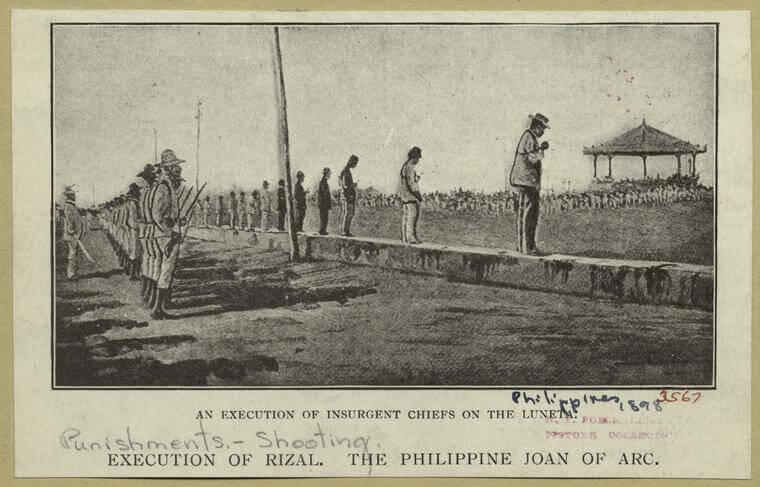
The question of what Rizal said in his final hours is well documented. The poem exists. The letters exist. The hour-by-hour record of his final night in Fort Santiago has been reconstructed from multiple witness testimonies. What follows covers all of it: the poem, the letters, the final night, and the words he spoke at Bagumbayan.
The Final Night in Fort Santiago
Rizal spent December 29, 1896 — his last full day alive — in his cell at Fort Santiago. The schedule of that final day has been reconstructed from the accounts of the Jesuit priests who attended him, the prison records, and the testimony of family members who visited.
He received visits throughout the day and evening. His mother Teodora, his sisters Narcisa, Lucia, Josefa, and Maria, and his nephew Mauricio Cruz came during the afternoon visiting hour. Josephine Bracken, his companion, was permitted a final visit. The Jesuit fathers Vilaclara, March, and Rosell were present for much of the day and night, attending to his spiritual preparation.
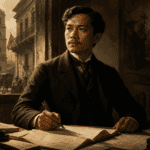
During the afternoon and evening, Rizal wrote. He wrote letters to his family. He wrote a final letter to his brother Paciano. He wrote a letter to the Governor-General containing a protestation of his innocence. And at some point during the night he completed the poem that would become known as Mi Último Adiós, folded it, and hid it inside the small alcohol stove he would hand to his family during their visit.
At 6:00 p.m. he met with Don Silvino Lopez Tuñon, Dean of the Manila Cathedral. At 8:00 p.m. he sat down to his last supper and told Captain Dominguez that he had already forgiven those who had condemned him. At 9:30 p.m. the fiscal of the Royal Audiencia, Don Gaspar Cestaño, visited. Rizal offered him the best chair in the cell.
Those who were present that night consistently remarked on his composure — not the composure of a man who had stopped feeling, but of a man who had worked through to some resolution about what he was facing.
The Poem: The Most Enduring Last Words
The most significant of Rizal’s last words are the ones he wrote down. Mi Último Adiós — untitled in his own hand, named afterward by Mariano Ponce who arranged its first publication in Hong Kong in 1897 — is the clearest and most complete expression of his state of mind at the end of his life.
The poem was written in Spanish across fourteen stanzas. It opens with a farewell to the Philippines — its sun, its seas, its people — and moves through images of sacrifice, acceptance, and continuity. He describes dying at the moment of dawn, his blood dyeing the morning sky. He asks for a humble flower over his grave, for the moon and the wind to keep him company, and for the Philippines itself to pray for him. He says that even forgotten and unremembered, he will continue — in the air, in the light, in the sound of the wind across the valleys.
The closing stanzas return to the personal. He bids farewell to his parents, his friends, and the sweet stranger who lightened his way — Josephine. And the final line: morir es descansar — to die is to rest.
What is striking about the poem as a last testament is its absence of bitterness. There is sorrow in it — the sorrow of dying young, of not seeing the dawn he hoped for — but no rage, no recrimination, no address to his executioners. He had moved past all of that. The poem’s emotional register is closer to elegy than to protest, and it is this quality — the calm, the acceptance, the love — that has made it one of the most significant poems written in the nineteenth century.
The poem was smuggled out of Fort Santiago inside the alcohol stove during the family visit. His sister Trinidad carried it out without knowing what was inside. When the family opened the stove after his execution, they found the folded paper.
For the full text with stanza-by-stanza commentary, see Mi Último Adiós and My Last Farewell: Side by Side.
The Letters: Final Words to Specific People
Alongside the poem, Rizal wrote several letters during his final hours. These are less well known than Mi Último Adiós but in some ways more revealing, because they are addressed to specific people and deal with specific things.
His letter to Paciano is the most direct — it contains his clearest statement about his innocence and his belief that history would eventually vindicate him. His letters to his parents are tender and grateful, thanking them for their sacrifices and asking them not to grieve excessively. His letters to his sisters ask them to care for their parents and to look forward rather than backward.
Across all the letters, the consistent note is forgiveness. He was explicit: he had forgiven everyone who had wronged him, including those who had manufactured the case against him. The letters document a man who had decided, with full awareness of what was coming, how he wanted to end — and who wanted the people he loved to know it before he did.
The Execution Morning
On the morning of December 30, 1896, Rizal was escorted from Fort Santiago to the field at Bagumbayan — the public execution ground facing Manila Bay. He walked steadily through the streets of Intramuros in the early morning light, exchanging quiet words with the Jesuit priests accompanying him. Witnesses described no visible fear.
At Bagumbayan, he was positioned facing away from the firing squad — the position reserved for traitors, designed to deny him the honor of facing his executioners. He asked to be turned to face the guns and was refused. At the moment the shots were fired, he twisted his body. He fell facing the sky — toward the dawn he had written about in the poem the night before.
His Spoken Last Words
As the shots struck him, Rizal said:
“Consummatum est.”
It is finished — the phrase attributed to Christ at the moment of death on the cross. It was the last thing he said. The choice of words, from a man who had been educated by Jesuits and who had spent his final hours with Jesuit priests, was precise and deliberate. His life’s work — the writing, the organizing, the exile, the trial — was complete. He had done what he came to do.
What the Last Words Reveal Together
Taken as a whole — the poem, the letters, the documented statements, the gesture at Bagumbayan, and the final words — Rizal’s last hours form a consistent picture. He was not performing courage for an audience. He was enacting convictions that had been consistent across his entire adult life: that the Philippines deserved better, that he had done what he could to give it better, that the people who had condemned him were wrong but not worth hating, and that whatever came next would have to be managed by a generation he would not live to see.
The absence of bitterness in all of it is the most striking thing. He had been convicted on fabricated charges of inspiring a revolution he had explicitly opposed. He was thirty-five years old. He had spent his final night writing forgiveness into letters his family would read after he was gone, and his final breath completing a biblical phrase that framed his death as the conclusion of a mission accomplished.
Whether or not the Philippines was free, he was finished. And he was at peace with it.
For the full account of his final days, see The Death of José Rizal: What Happened on December 30, 1896 and Rizal’s Trial and Execution. For the complete text of the poem he wrote that final night, see Mi Último Adiós.