When Rizal sat down to write Noli Me Tangere in the early 1880s, he did not need to invent the religious world his characters inhabit. He had grown up inside it.
The Catholicism of nineteenth-century Philippines was not a private spiritual matter separable from public life — it was the architecture of public life, the framework through which time was organized, power was exercised, community was defined, and meaning was made.
Understanding that world is essential to understanding both the society Rizal was writing about and the specific targets of his criticism.
The Church at the Center of Town
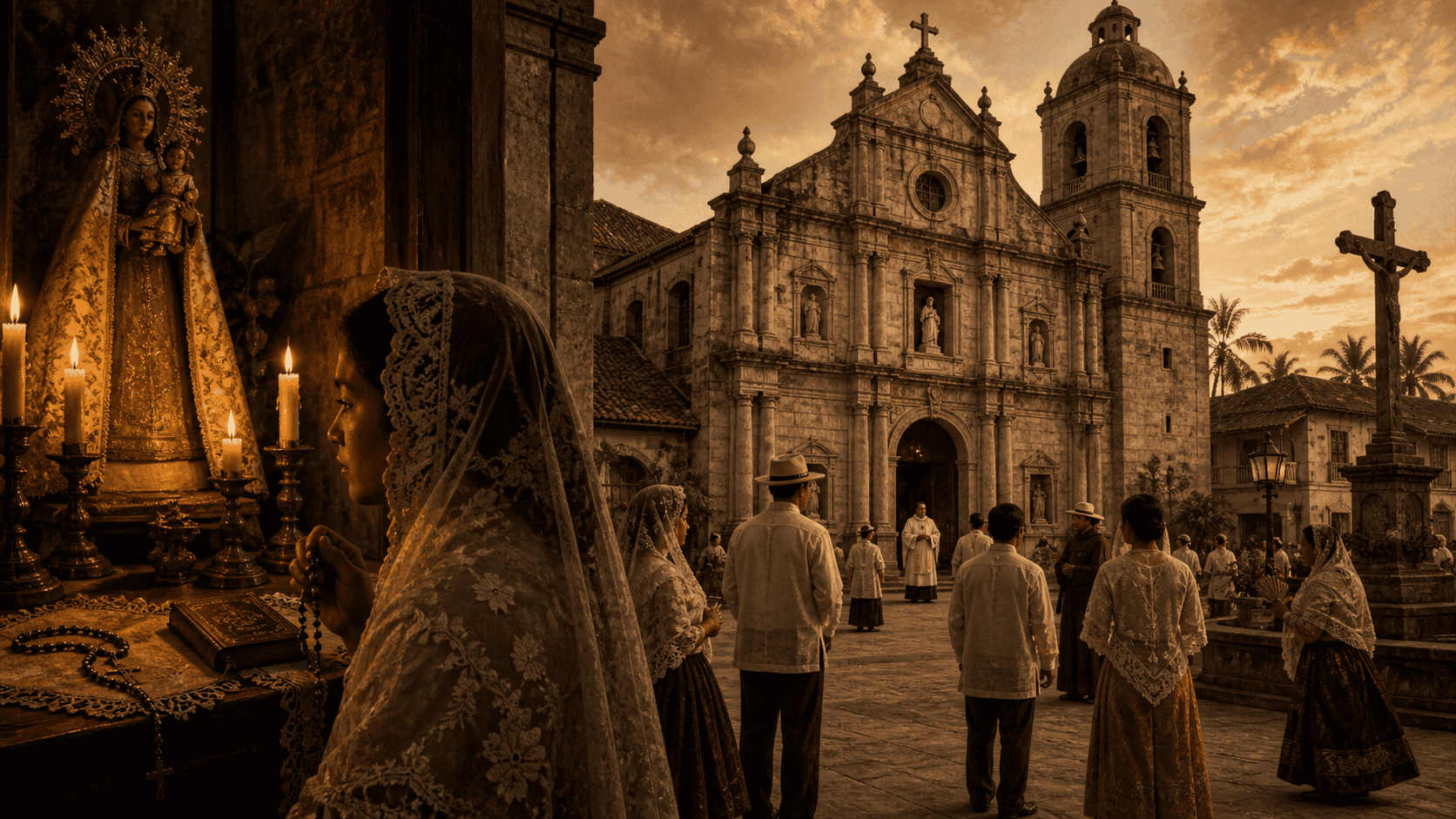
The physical arrangement of a Filipino town in the nineteenth century was itself a statement about power. At the center of every municipality stood two buildings: the church and the convent. The church was the largest building most Filipinos would ever enter. The convent beside it housed the parish priest and served as the effective administrative headquarters of the town. The government building — the tribunal — was typically smaller and less substantial. The arrangement was not accidental. It reflected the actual distribution of authority in colonial Philippines, where the Catholic religious orders exercised a degree of civil power that the formal colonial administration rarely challenged.
The church building was more than a place of worship. It was where births were registered, marriages solemnized, deaths recorded, and disputes mediated. It was where children received their first education, where the community gathered for announcements of civic importance, and where the social hierarchy of the town was physically enacted — with the principalia, the landed Filipino gentry, seated in the front pews and everyone else arranged behind them in an order that corresponded exactly to their social standing.
The Parish Priest and His Authority
The parish priest was the most powerful figure in most Filipino towns. He was usually a member of one of the major religious orders — Dominican, Augustinian, Recollect, or Franciscan — rather than a secular priest, and he held his position with a degree of permanence and institutional backing that made him nearly impossible to challenge through normal means.
His authority was not limited to spiritual matters. He controlled access to the sacraments, which in a deeply Catholic society meant he controlled access to the markers of respectable social life: baptism, marriage, Christian burial. He oversaw the parish school, which was often the only formal education available in the town. He had the ear of colonial officials and the backing of his order’s institutional resources. And he submitted regular reports to both the Church and the colonial government about the state of his parish — reports that could, and did, result in the surveillance or punishment of residents who attracted his displeasure.
Rizal understood this structure with particular intimacy. His mother Teodora Alonso’s unjust imprisonment — the result of a colonial official’s fabricated accusation — was made possible in part by the culture of unaccountable authority that the religious orders had helped create. And the corrupt, self-serving friars who appear throughout Noli Me Tangere and El Filibusterismo are not caricatures. They are precise portraits of a system Rizal had observed directly.
Daily Devotions and the Rhythm of Prayer
For ordinary Filipino Catholics in the nineteenth century, faith was not primarily an intellectual commitment but a daily practice structured around prayer, ritual, and the liturgical calendar. Families began and ended each day with prayer. The rosary was recited in the evenings, often communally, with neighbors gathering in homes or the church courtyard. Images of saints were displayed in household altars — small shrines decorated with candles, flowers, and offerings — that served as the domestic center of religious life.
The Church bells structured daily time in ways that had no secular equivalent. They rang for the Angelus at dawn, noon, and dusk, calling the faithful to pause and pray regardless of what they were doing. They rang for Mass, for processions, for deaths, and for festivals. In a world without clocks in every home, the bells were the primary timekeeping technology, and their authority was religious as well as practical.
Confession and communion were regular expectations rather than occasional events. The parish priest heard confessions, and access to the sacrament of the Eucharist required a state of grace that only he could certify. This gave him an intimate and formally institutionalized access to the private lives of his parishioners that no other authority figure possessed.
The Fiesta: Religion as Community
The most visible expression of religious life in nineteenth-century Filipino towns was the fiesta — the annual celebration of the town’s patron saint. The fiesta was simultaneously a religious observance, a social event, a civic ceremony, and an economic occasion, and it was the moment in the year when the community presented itself most fully to itself.
Preparations began weeks in advance. Homes were cleaned and decorated. Food was prepared in quantities calibrated to receive guests from neighboring towns. Processions were organized, with the image of the patron saint carried through the streets on an elaborately decorated platform, accompanied by music, prayers, incense, and the participation of the entire community. Theatrical performances — including the komedya, dramatizations of Christian history and medieval romance — were staged in the plaza. Masses were celebrated with particular solemnity.
The fiesta was also a significant financial burden. Families spent beyond their means to host adequately, and the hermano mayor — the community leader responsible for organizing the celebration — was expected to contribute substantially from personal resources. This expectation reinforced the social hierarchy: the principalia demonstrated their status through generosity, and ordinary families demonstrated their membership in the community through participation and offering.
Rizal depicts the fiesta culture in both novels, capturing both its genuine communal warmth and the ways it was exploited — by friars who collected substantial fees for religious services, by officials who used the occasion to extract favors, and by a social system that converted religious obligation into a mechanism of economic extraction.
The Liturgical Year
The Catholic liturgical calendar imposed a structure on the entire year that had no parallel in the civil or agricultural calendars. Lent — the forty days before Easter — was the most demanding season, bringing fasting, abstinence, and the suspension of ordinary entertainments. The pabasa, a continuous choral reading of the Pasyon (the Philippine passion narrative, which combined the Gospel account of Christ’s suffering with local poetic traditions), lasted twenty-four hours or more, with community members taking turns to chant through the night.
Holy Week was the liturgical year’s emotional center. Passion plays dramatized the arrest, trial, and crucifixion of Christ with an intensity that engaged the entire community. The Salubong — the meeting of the risen Christ with his mother on Easter Sunday morning — was performed before dawn, with images carried from opposite ends of the town to meet in the church plaza. For many Filipinos, these rituals were not representations of a distant historical event but participatory encounters with sacred reality.
Christmas brought a different tone — the nine-day Simbang Gabi Masses celebrated before dawn from December 16 to 24, attended despite the early hour by communities that treated the obligation as a mark of devotion and the pre-Mass gathering in the cold and dark as a social pleasure.
The Blending of Catholic and Pre-Colonial Practice
What the Spanish missionaries encountered in the Philippine archipelago was not a spiritual vacuum but a rich and varied set of indigenous religious traditions: animist beliefs, ritual specialists, healing practices, and a relationship with the natural and supernatural worlds that had developed over centuries before the first friar arrived. Catholicism did not erase these traditions. It overlaid them, and in many cases the two systems fused into something distinctively Filipino.
The albularyo — the traditional healer — continued to practice alongside the parish priest, and many Filipino families consulted both without perceiving any contradiction. Belief in anito (ancestral spirits), engkanto (supernatural beings associated with natural features), and various forms of protective magic persisted within communities that attended Mass regularly and identified strongly as Catholic. The Church periodically campaigned against these practices as superstition, but the campaigns rarely succeeded in eliminating what they targeted, and over time a syncretic religious culture emerged that drew on both traditions.
This blending is visible in Rizal’s fiction in the folk beliefs of characters like Sisa and in the superstitions that circulate through the communities he depicts. He was neither contemptuous of these traditions nor uncritical of them — he understood them as the product of a specific historical encounter, and he treated them with the same sociological precision he brought to everything else he observed.
Religious Brotherhoods and Women’s Organizations
Alongside the parish structure, Filipino religious life was organized through a network of lay associations. Cofradías — confraternities — brought together men and women around specific devotions: the Blessed Sacrament, the Virgin Mary, particular saints. These organizations maintained altars, organized processions, cared for the church’s material needs, and supported members during illness and bereavement.
For women in particular, the cofradía offered an organizational role and a form of community leadership that was otherwise largely unavailable to them. The woman who organized a major procession, managed the decoration of the church for a feast, or led a novena in her neighborhood exercised genuine social authority within a sphere that the parish priest generally acknowledged and respected.
These organizations also represented one of the few civil society institutions in towns that were otherwise entirely administered from above. Their records, their funds, and their activities were managed by lay Filipinos, which gave them a degree of autonomy — modest, carefully bounded, but real — that the purely colonial institutions did not offer.
Religion, Respectability, and Social Control
Religious participation in nineteenth-century Filipino towns was not purely voluntary in the sense that modern readers might assume. It was socially compulsory in ways that had direct material consequences. Families that did not baptize their children promptly, that failed to attend Mass regularly, that did not observe the fiestas and sacramental milestones of the Catholic calendar, risked something more serious than social disapproval: they risked the parish priest’s negative assessment in the reports he submitted to colonial authorities, and they risked being denied the sacramental services — burial, marriage, baptism — on which full participation in community life depended.
This is the mechanism that Rizal anatomized most precisely in his novels. The religious orders did not maintain their power through overt violence alone. They maintained it through the control of access: to sacraments, to education, to respectability, to the markers of a life fully lived within the community. A family that crossed the parish priest risked not just his personal disapproval but a cascade of social and institutional consequences that could affect everything from their children’s schooling to their ability to marry within the community.
Understanding this mechanism is essential to understanding why the friars appear as they do in Rizal’s fiction — not simply as bad individuals but as representatives of a structural power that operated through the most intimate aspects of daily life.
What Rizal Saw and What He Wrote
Rizal was not anti-religious. He was educated by the Jesuits, maintained a lifelong intellectual engagement with Catholic theology and philosophy, and wrote poetry addressed to the Virgin Mary. What he was against — and what he documented with surgical precision in both novels — was the use of religious authority as a tool of political and social control.
The corrupt friars of Noli and Fili are not indictments of Catholicism as a faith. They are indictments of a specific institutional arrangement: one in which men with unaccountable power over the most intimate aspects of people’s lives used that power to enrich themselves, suppress dissent, and maintain a colonial order whose primary beneficiaries were neither Filipino nor sacred.
The religious world described in this article is the world those novels were written about. To read them without understanding it is to miss much of what Rizal was doing — and to miss the specific precision with which he identified, named, and held to account the institutions that shaped the world he grew up in.
For more on how religion appears in Rizal’s fiction, see the literary analysis of Noli Me Tangere and the literary analysis of El Filibusterismo. For the historical context of colonial rule more broadly, see Spanish Rule in the Philippines: The World That Made Rizal Necessary.