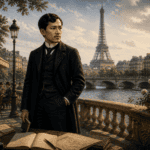
The two visits tell entirely different stories — and together they account for some of the most consequential months of his life. The first shaped his hands. The second shaped his politics.
The First Visit: A Clinic on Rue du Cherche-Midi
Rizal arrived in Paris in November 1885, twenty-four years old, freshly graduated from the Universidad Central de Madrid with his Licentiate in Medicine. He had chosen to specialize in ophthalmology for reasons that were personal before they were professional — his mother Teodora was losing her sight to cataracts, and he intended to be the one to restore it.
He found his way to the clinic of Dr. Louis de Wecker on Rue du Cherche-Midi, a long street in the sixth arrondissement, within walking distance of where he was staying. De Wecker was, at that moment, arguably the most accomplished ophthalmologist in Europe. He had introduced ophthalmoscopy into France, advanced cataract and strabismus surgery, devised new methods of treating glaucoma, and trained surgeons from across the world. His iris scissors — the de Wecker scissors — are still in use today. His patients included members of European royal families.
De Wecker’s clinic received between fifty and one hundred patients a day, with as many as ten major operations on busy days. Rizal wrote home to his family describing what he was learning with barely contained excitement. By January 1886, he could write: “With respect to the study of the ailments of the eyes, I am doing well. I know now how to perform all the operations.” De Wecker treated him, by several accounts, almost like a son — a rare form of recognition from a man who did not distribute his regard carelessly.
Rizal worked at the clinic from November 1885 to February 1886 — four months of intensive clinical training that gave him the surgical foundation he would later use to restore his mother’s sight, first the left eye in 1891 and then the right in 1894.
Outside his working hours, he moved through the city’s Filipino social world. He spent time in the studio of Juan Luna on Boulevard Arago, where he fenced, discussed art, and posed for at least one painting — he appears as an Egyptian priest in Luna’s The Death of Cleopatra. He visited the Pardo de Tavera family, sketched portraits of friends, and published an article on the Carolines Question in the newspaper La Publicidad, whose editor he had met on a stopover in Barcelona.
He left Paris in February 1886, satisfied that he had learned what de Wecker could teach him. He moved on to Heidelberg, and then Berlin. But Paris had given him something essential: the technical confidence to practice eye surgery at the highest level then available.
Between the Visits: What Changed
When Rizal returned to Paris in 1889, he was no longer simply a young doctor completing his training. Noli Me Tangere had been published in 1887 and banned in the Philippines. He had spent a year in London working at the British Museum, annotating de Morga’s colonial history of the Philippines. He had been contributing to La Solidaridad, the reform newspaper that circulated among Filipino expatriates. He was, by this point, the most prominent voice of the Propaganda Movement — watched carefully by the Spanish colonial authorities, admired and occasionally envied by fellow Filipino reformists.
Paris in 1889 was hosting the World Exposition — the centennial celebration of the French Revolution, the occasion for which the Eiffel Tower was built. The city was expensive, crowded with visitors from across the world, and electrically alive with ideas. For a Filipino reformist thinking about what freedom actually looked like in practice, it was a charged environment to inhabit.
The Second Visit: Politics, Art, and the Cost of Paris
Rizal stayed in Paris through most of 1889, living at the home of his friend Valentin Ventura and moving through a world of artists, intellectuals, and politically engaged Filipinos. He continued contributing essays to La Solidaridad, met with Filipino community members, and worked on what would become El Filibusterismo.
Juan Luna was still in Paris, and his studio remained a gathering point for the Filipino artistic and intellectual community. Rizal fenced with Luna’s social circle, including the Boustead sisters — Adelina and Nellie — daughters of a wealthy English merchant family who had taken a liking to him. He attended parties at the Boustead home on the rue Lord Byron. He was, for this period, a figure in Parisian social life as much as a political exile working in relative hardship.
The political work was serious. In Paris, Rizal was at the center of ongoing debates about the direction and leadership of the Propaganda Movement. His disagreements with Marcelo del Pilar — about strategy, about tone, about the best use of the movement’s limited resources — were coming to a head. Del Pilar believed in aggressive political agitation; Rizal believed in education and moral example. Neither man was wrong, and neither would fully convince the other.
It was also in Paris, in early 1889, that Rizal continued drafting the manuscript of El Filibusterismo — the novel that would mark his decisive break with the reformist optimism of Noli Me Tangere. The city that had given him his surgical training in 1886 was now the backdrop for a considerably darker vision of what Philippine colonial society had become and what it was capable of becoming.
He left Paris for Brussels in January 1890, driven by two practical considerations: the cost of living during the exposition year had been prohibitive, and the social life of the city — the parties, the fencing, the gatherings — was interfering with his writing. He needed a quieter, cheaper place to finish the book.
What Paris Gave Him
The two periods in Paris add up to something more than their individual circumstances suggest.
The first visit gave Rizal technical mastery in a medical specialty he had chosen for the most personal of reasons — so that he could fix what colonialism could not touch, the vision of the woman who had first taught him to read. The training he received at de Wecker’s clinic on Rue du Cherche-Midi was world-class in the most literal sense: de Wecker’s patients came from across Europe, and Rizal learned beside them.
The second visit gave him something harder to measure but equally significant. Paris in 1889 was a city thinking loudly about the meaning of liberty — the centennial of the French Revolution hung over the entire year, with the exposition designed explicitly as a celebration of republican values, industrial progress, and the idea that human society could be deliberately improved. For a Filipino reformist who had spent the better part of a decade arguing that his country deserved exactly those things, the city was an argument he could walk through.
It also showed him the limits of reform. The political tensions within the Filipino expatriate community — the factionalism, the rivalry, the tendency toward self-destruction that he would eventually criticize directly in letters to del Pilar — were on full display in Paris. The movement he had given so much to sustain was not holding together as cleanly as the cause deserved. El Filibusterismo, which he was writing through these years, absorbed all of it: the exhaustion, the anger, the recognition that patience has a ceiling.
He would eventually settle the Paris question in the only way available to him. He left. He went to Brussels to finish the book. He sent it to the printer in Ghent. He never returned.