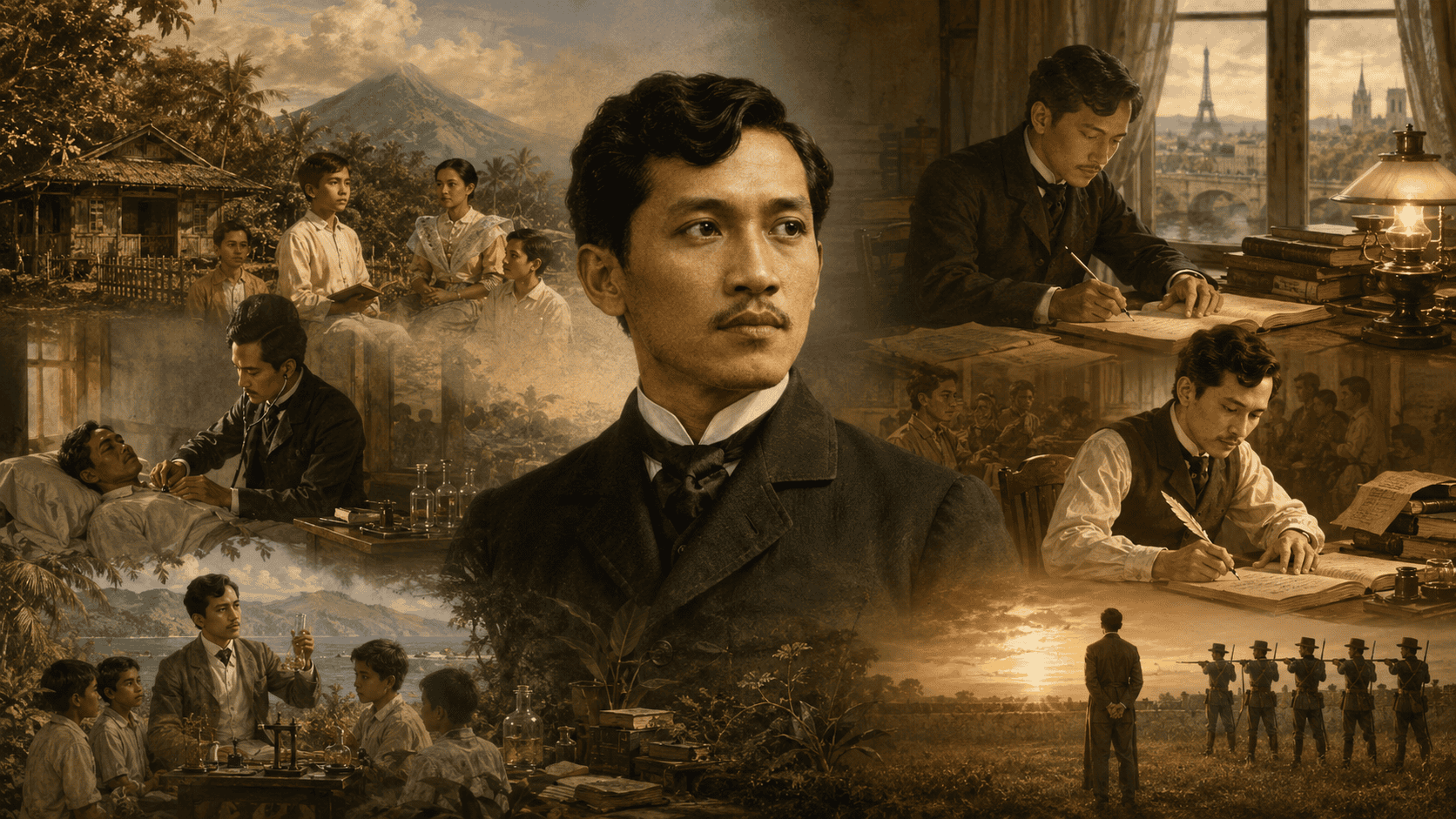
Imagine this: a man speaks 22 languages, practices ophthalmology, sculpts, paints, writes the two novels that collapse a colonial empire, discovers several animal species, and does most of this before age 35 — when he is shot dead by the government he embarrassed.
Now imagine almost nobody outside Southeast Asia knows his name.
That’s José Rizal. And once you learn about him, you’ll find yourself bringing him up at dinner parties to people who will nod politely and immediately Google him afterward.
Why the World Doesn’t Know His Name
If Rizal had been European, he’d be in every curriculum on earth. He’d be the subject of biopics, airport novels, HBO miniseries. His face would be on a stamp in countries that had nothing to do with him.
Instead, he was born in 1861 in Calamba, a town in the Philippines, which was then a Spanish colony of nearly 300 years — a place the wider world neither thought about nor cared about. He was the seventh of eleven children in a moderately prosperous family of Chinese-Filipino descent. His mother, who was highly educated and read widely, taught him to read before anyone else thought to. He was writing poetry by eight.
None of this was supposed to amount to anything remarkable. The colonial system had very clear ideas about what Filipino men of mixed ancestry were permitted to become. José Rizal became something else entirely.
He Left — and Europe Couldn’t Quite Believe Him
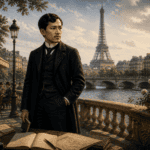
In 1882, at 21, Rizal boarded a ship for Spain without telling his parents or the colonial authorities. He enrolled in medicine at the Universidad Central de Madrid. He specialized in ophthalmology — partly, he said, so he could treat his mother’s deteriorating eyesight, which is the kind of detail that makes him almost unbearably sympathetic.
But medicine was only one thing he did in Europe. He also studied philosophy, sketched portraits, learned German well enough to correspond with European scientists, befriended reformers and intellectuals across the continent, and started noticing something that would change everything: that the world outside the Philippines had actual ideas about human dignity, and that his country was being denied all of them.
He was an extraordinary student of other societies. He watched. He read. He compared. And then he went home — in a manner of speaking — and wrote it all down.
He Wrote Two Novels and Broke an Empire
The first, Noli Me Tangere — “Touch Me Not” — came out in 1887, published in Berlin because no printer in Spain would touch it. It follows a young Filipino man who returns from Europe full of hope and is systematically destroyed by the machinery of colonial rule: the corrupt priests who own the land, the administrators who enforce cruelty as policy, the system that grinds idealism into dust.
It was fiction. It was also a mirror held up to every Filipino who read it, showing them their own life rendered visible and nameable for the first time.
The Spanish colonial government banned it immediately. Possessing a copy could get you imprisoned. It spread through the islands anyway, passed hand to hand, read aloud in secret, copied by hand when printed copies ran out. You cannot ban a book that people already believe in their bones.
The sequel, El Filibusterismo, published in 1891, was darker and angrier. The idealist from the first novel returns in disguise as a wealthy schemer planning violent revenge. He fails. The revolution he attempts collapses. Some readers took this as Rizal’s argument that violence was futile. Others read it as a warning: this is what happens when you leave people no other option.
Together, the two novels did something that armies had failed to do in 300 years of resistance. They gave Filipinos a shared story about who they were and what was being done to them. Identity is, it turns out, more dangerous than a rifle.
He Wasn’t Even a Revolutionary — That’s the Maddening Part
Here is where Rizal becomes genuinely complicated and genuinely interesting.
He did not want a revolution. He said so, clearly, repeatedly. He believed the Philippines was not yet ready for independence. He argued, publicly and in writing, for reform within the Spanish system — equal rights, legal representation, an end to the worst abuses. He was, in modern terms, a gradualist. A reformist. He thought working through institutions was the only way that wouldn’t end in catastrophe.
When Andrés Bonifacio — a working-class Filipino of far more radical convictions — founded the Katipunan, the secret society that would launch the armed uprising of 1896, Rizal explicitly refused to join and refused to endorse it. He thought the moment was wrong. He thought Filipinos would be massacred.
The Spanish government didn’t care about any of this nuance. They looked at his novels, his organizing, his newspaper essays, his general existence, and concluded he was the most dangerous man in the archipelago. They were right, just not for the reasons they thought.
His Exile Was the Most Productive Imprisonment in History
After he returned to the Philippines in 1892 and founded a modest civic organization — essentially a reading group with political ambitions — he was arrested within four days and exiled to Dapitan, a small town on the island of Mindanao. He would spend four years there.
What did he do in exile?
He built a water system for the town. He opened a school for local boys, teaching them without charge. He practiced medicine for the poor, again without charge. He conducted scientific correspondence with researchers in Europe. He landscaped his property. He carved sculptures. He fell in love with an Irish-American woman named Josephine Bracken, who had come to the Philippines seeking treatment for her stepfather’s blindness, heard about the exiled doctor in Dapitan, and made the journey to find him. She stayed.
He also discovered several previously uncatalogued animal species during this period. There is a frog that bears his name. He was in exile, and he was still cataloguing frogs.
His Trial Was a Sentence Looking for Justification
When the Katipunan launched its uprising in August 1896, the Spanish colonial administration needed someone to blame. Rizal was the obvious choice — famous, widely read, already established as the intellectual godfather of Filipino nationalism, even if he had spent years trying to pump the brakes on exactly this kind of revolt.
He was arrested, brought to Manila, and tried before a military tribunal. He had no meaningful defense. The outcome was decided before the first witness was called.
There’s something almost classical about the injustice: he was convicted of inspiring a revolution he had argued against, sentenced by a government that had made revolution inevitable, condemned in the name of a legal system that had never once applied equally to him or anyone who looked like him.
The Night Before They Shot Him
On December 29, 1896, the night before his execution, Rizal wrote a poem. He hid it inside a small alcohol stove and gave it to his family, knowing they would find it.
He called it nothing. We call it Mi Último Adiós — “My Last Farewell.”
It is fourteen stanzas of extraordinary calm. He says goodbye to the Philippines — its mountains, its seas, its people. He says he dies willingly, without anger. He says he hopes that someday, somehow, his death means something for the country he loved. He does not rage. He does not beg. He writes like a man who has made peace with something most of us spend our whole lives running from.
The next morning, December 30, 1896, he was marched to Bagumbayan field in Manila and shot. He was 35 years old. He had asked to face the firing squad — the traditional honor afforded to gentlemen — and was refused. He was shot in the back. At the moment of impact, witnesses said, he turned his body so he fell facing the sky.
The Complicated Afterlife of a Hero
After the revolution succeeded — eventually, messily, with American intervention following the Spanish-American War — the new order needed a national hero. They chose Rizal.
But here’s the part that historians still argue about: it was largely the American colonial administration that cemented Rizal’s status, not Filipino revolutionaries. And their reasons were not entirely pure. Rizal, the peaceful reformist who had opposed armed rebellion, was a much safer symbol than Bonifacio, the working-class radical who had actually organized and led the uprising. A hero who believed in gradual reform through proper channels was useful to a new colonial power trying to present itself as a benevolent modernizing force.
Bonifacio was tried and executed in 1897 — by the revolution’s own leadership, in one of history’s grimmer ironies — and sidelined from the national mythology for decades. This debate is alive in the Philippines today. Some argue Bonifacio was the true hero, the one who actually fought and bled, and that elevating Rizal was a colonial sleight of hand.
Most Filipinos have arrived at something like this position: both men were necessary. Both mattered. The argument about who matters more is mostly an argument about what you think a nation owes its founders.
Why Rizal Matters Now, to You, Today
There’s a version of Rizal’s story that is purely historical — interesting, impressive, filed away. And then there’s the version that is uncomfortable in a useful way.
Rizal proved that the most threatening thing you can give an oppressed people is not a weapon. It’s a story about themselves that tells the truth. His novels didn’t arm anyone. They just made invisible things visible — the systematic humiliation, the casual cruelty, the way a whole society is organized to make certain people feel like they don’t exist. Once people could see it named and rendered on the page, they couldn’t unsee it. That’s not a metaphor. That’s what happened.
He also died for something he didn’t entirely believe in, which is the kind of tragic irony that history keeps producing and we keep failing to learn from. He spent his life trying to find a moderate path, a reformist path, a path that didn’t end in blood — and they shot him anyway, and the blood came anyway, and the revolution happened anyway.
What he left behind was a poem. Written the night before his execution, smuggled out in an alcohol stove, found by his family in the morning.
Fourteen stanzas. Completely calm. No bitterness.
That’s the part that stays with you.